
_edited.png)
ASSISTIVE TECHNOLOGY SERVICES PROVIDER IN OREGON
- Fatumata Kaba
- Oct 6, 2025
- 4 min read

Updated: Jan 13
ENABLING GREATER INDEPENDENCE, ACCESSIBILITY, AND SAFETY FOR OREGONIANS THROUGH INNOVATIVE TECHNOLOGY SOLUTIONS
Assistive Technology (AT) Services in Oregon are Medicaid-funded supports that provide individuals with disabilities or chronic conditions access to devices, equipment, and technology-related services that increase functional independence in their daily lives. These services include both the provision of AT devices (e.g., mobility aids, communication tools, environmental controls) and the customization, training, or maintenance of those devices. AT Services are authorized through the Oregon Health Plan (Medicaid) and delivered under multiple Home and Community-Based Services (HCBS) waivers and the K Plan (Community First Choice Option).
1. GOVERNING AGENCIES
Agency: Oregon Department of Human Services (ODHS) – Aging and People with Disabilities (APD), Developmental Disabilities (DD)
Role: Approves and authorizes AT services via local service coordinators or case managers.
Agency: Oregon Health Authority (OHA)
Role: Oversees Oregon Medicaid (OHP) and manages provider enrollment, funding, and compliance.
Agency: Centers for Medicare & Medicaid Services (CMS)
Role: Ensures Oregon’s Medicaid HCBS and K Plan services meet federal standards, including assistive technology provisions.
Agency: Oregon Secretary of State (SOS)
Role: Registers provider businesses operating in Oregon.
2. ASSISTIVE TECHNOLOGY SERVICES OVERVIEW
AT Services help individuals acquire, retain, or improve their ability to perform daily activities at home or in the community. Services can include device procurement, customization, repair, installation, and user training.
Approved providers may deliver:
Device Selection & Procurement: Identifying and ordering AT that meets the client’s functional needs.
Installation & Setup: Ensuring devices are safely and properly configured in the home or community setting.
Customization & Programming: Modifying AT for individual preferences (e.g., voice commands, mobility access).
Training & Coaching: Teaching individuals and caregivers how to use AT effectively.
Repair & Maintenance: Troubleshooting, replacing parts, and servicing equipment.
Environmental Accessibility Solutions: Smart home devices, switches, alarms, and remote controls for safety and independence.
Documentation & Reporting: Progress notes, equipment logs, service plans, and billing records.
3. LICENSING & PROVIDER APPROVAL REQUIREMENTS
Prerequisites:
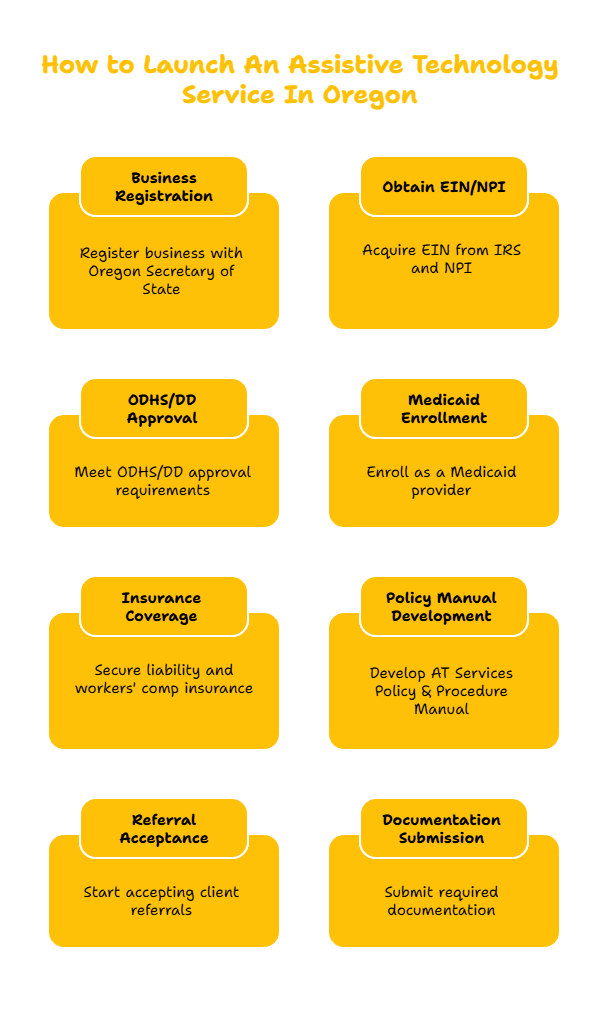
Register your business with the Oregon Secretary of State.
Obtain an EIN from the IRS and a Type 2 NPI.
Enroll as a Medicaid provider via the Oregon Health Plan Provider Portal.
Meet ODHS/DD approval requirements for AT service vendors.
Carry general liability and workers’ comp insurance.
Develop an Assistive Technology Services Policy & Procedure Manual aligned with Oregon Medicaid expectations.
If operating as a Durable Medical Equipment (DME) provider, you may also require accreditation (e.g., through CHAP or ACHC) and licensing via the Oregon Board of Pharmacy (for some devices with medical components).
4. OREGON PROVIDER ENROLLMENT PROCESS
Step 1: Register your LLC or corporation and obtain an EIN/NPI and insurance.
Step 2: Complete provider enrollment through the OHP Provider Portal.
Step 3: Submit required documentation, including service types, coverage areas, and qualifications.
Step 4: Coordinate with ODHS/APD or DD to become an approved AT provider for relevant waivers.
Step 5: Start accepting client referrals and authorizations from service coordinators.
5. REQUIRED DOCUMENTATION
Business registration and Articles of Incorporation
EIN and NPI documentation
Liability and workers’ compensation insurance
AT Policy & Procedure Manual, including:
AT assessment and recommendation process
Device tracking and inventory systems
Installation and safety guidelines
Client and caregiver training protocols
Incident and service failure reporting
Maintenance, warranty, and replacement procedures
Billing and documentation templates
HIPAA compliance and participant rights safeguards
6. STAFFING REQUIREMENTS
Role: Assistive Technology Specialist / Technician
Requirements: Background check, technical knowledge in AT and DME; may require certifications (e.g., RESNA ATP credential preferred).
Role: Program Coordinator / Service Planner
Requirements: Coordinates services, ensures compliance, and oversees billing and staff supervision.
Role: Licensed Clinical Professional (optional, for evaluations)
Requirements: OT, PT, or Speech-Language Pathologist (SLP) licensed in Oregon; often required for AT assessments.
All staff must complete:
HIPAA, client safety, and documentation training
Equipment-specific onboarding and safety protocols
Emergency planning, environmental modification awareness
Annual review and credentialing updates
7. MEDICAID WAIVER PROGRAMS
Assistive Technology is authorized under:
K Plan (Community First Choice, 1915(k)) – broad AT access for individuals needing ADL/IADL supports.
APD Waivers – for seniors and adults with physical disabilities needing environmental or mobility supports.
DD Waivers (e.g., Comprehensive and Support Services Waivers) – includes AT for individuals with IDD.
Children’s Waiver & Medically Fragile Services – includes pediatric AT such as speech devices and accessible toys.
State Plan OHP Coverage (limited) – for medically necessary durable equipment when prescribed.
8. TIMELINE TO LAUNCH
Phase: Business Formation & Policy Manual Development
Timeline: 1–2 months
Phase: Medicaid Enrollment & DD/APD Approval
Timeline: 2–3 months
Phase: Equipment Sourcing, Staff Onboarding & Training
Timeline: 30–60 days
Phase: Referral Network Building & Service Activation
Timeline: Begins once authorizations are issued by case managers or service coordinators.
9. CONTACT INFORMATION
Oregon Department of Human Services (ODHS)
Website: https://www.oregon.gov/DHS
ODHS – Developmental Disabilities Services
Website: https://www.oregon.gov/dhs/DD
Oregon Health Authority (OHA)
Website: https://www.oregon.gov/oha
Oregon Health Plan Provider Enrollment
Centers for Medicare & Medicaid Services (CMS)
Website: https://www.cms.gov
WAIVER CONSULTING GROUP’S START-UP ASSISTANCE SERVICE — OREGON ASSISTIVE TECHNOLOGY PROVIDER
WCG helps AT providers in Oregon launch and scale with full compliance and technical guidance.
Scope of Work:
Business registration, Medicaid enrollment, and policy manual support
DD/APD vendor certification assistance
AT service documentation templates and device tracking logs
Staff credentialing systems and EVV onboarding
Referral pipeline building and partnership development
Medicaid billing setup, quality assurance, and audit preparation
Our Client Portal offers a wealth of resources that you can explore related to various programs and state requirements.


Comments