ASSISTIVE TECHNOLOGY PROVIDER IN VERMONT
- Fatumata Kaba
- Apr 9
- 3 min read

ENABLING GREATER INDEPENDENCE THROUGH SPECIALIZED DEVICES THAT SUPPORT MOBILITY, COMMUNICATION, AND DAILY FUNCTIONING
Assistive Technology (AT) Services in Vermont help individuals with disabilities access and use specialized equipment that enhances their independence, safety, and participation in daily life. These services may include evaluation, acquisition, customization, training, and maintenance of both high- and low-tech devices. AT is a covered service under several of Vermont’s Medicaid Home and Community-Based Services (HCBS) Waivers and must be outlined in the participant’s Individual Support Plan (ISP). These services are coordinated through the Department of Disabilities, Aging and Independent Living (DAIL) and its network of Designated and Specialized Service Agencies (DAs/SSAs).
1. GOVERNING AGENCIES
Agency: Vermont Department of Disabilities, Aging and Independent Living (DAIL)
Role: Approves AT services through waiver programs and oversees provider qualifications and documentation.
Agency: Department of Vermont Health Access (DVHA)
Role: Administers Medicaid funding and billing systems for authorized AT services.
Agency: Designated Agencies (DAs) / Specialized Services Agencies (SSAs)
Role: Coordinate AT assessments and include AT services in Individual Support Plans (ISPs).
2. ASSISTIVE TECHNOLOGY SERVICES OVERVIEW
Assistive Technology services support individuals in acquiring and using devices that increase functional capabilities. Devices can be commercial off-the-shelf or custom-designed to meet specific needs.
Examples of covered AT devices:
Communication aids (e.g., speech-generating devices)
Environmental control units (e.g., remote-operated lights or doors)
Adaptive computer software or hardware
Mobility supports (e.g., adapted walkers, powered chairs)
Sensory equipment (e.g., visual timers, calming devices)
Adaptive switches and mounts
Modified utensils, grooming tools, and writing aids
AT services can also include professional evaluation, training, fitting, and routine maintenance.
3. LICENSING & PROVIDER APPROVAL REQUIREMENTS
Prerequisites:
Register business with the Vermont Secretary of State
Obtain EIN and Type 2 NPI
Apply through a Designated or Specialized Service Agency for AT provider status
Complete Medicaid enrollment (if billing DVHA directly)
Maintain liability insurance and follow device safety standards
Develop a Policy & Procedure Manual for Assistive Technology services
Secure manufacturer certifications for staff (as applicable for device support)
4. VERMONT PROVIDER ENROLLMENT PROCESS
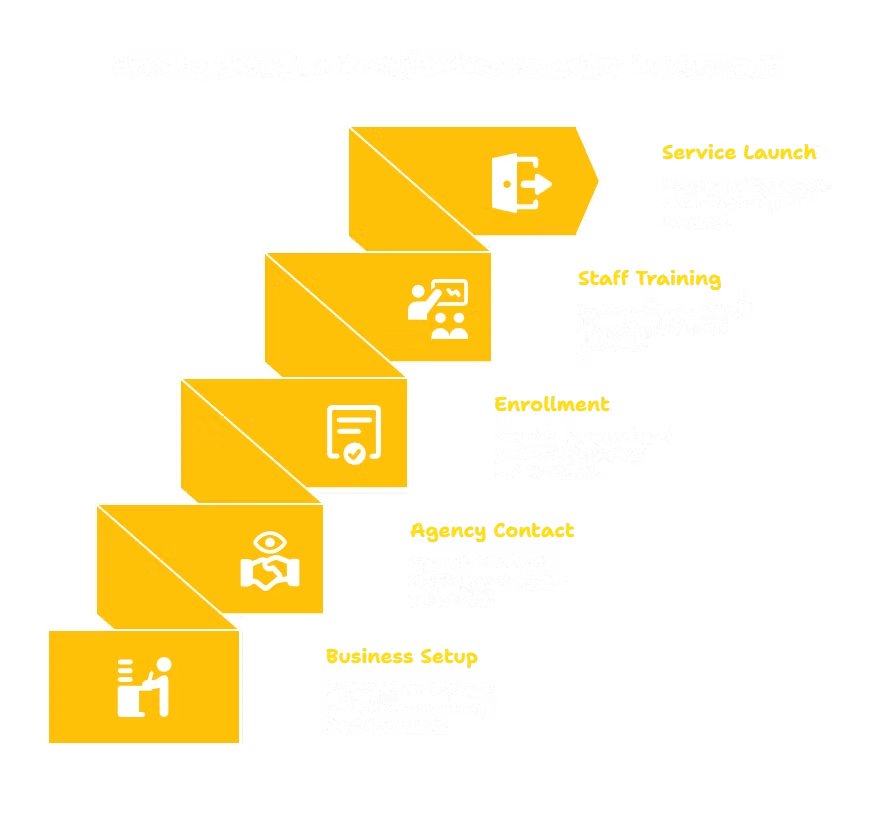
Step 1: Register business and obtain EIN and NPI
Step 2: Contact local DA/SSA to contract as an AT provider
Step 3: Submit Policy Manual and staff qualifications to agency
Step 4: Enroll with DVHA (if required for billing reimbursement)
Step 5: Coordinate with AT professionals (e.g., OT/PT/Speech) for device justification
Step 6: Begin delivering services upon ISP authorization
5. REQUIRED DOCUMENTATION
Articles of Incorporation, EIN, and NPI
DA/SSA agreement or contract
Medicaid enrollment confirmation (if billing DVHA directly)
Assistive Technology Policy & Procedure Manual, including:
Device evaluation and selection process
Equipment ordering, tracking, and delivery protocols
Installation and training guidelines
Maintenance and repair logs
Staff training documentation and certifications
Participant consent and HIPAA compliance policies
AT justification reports and service documentation forms
6. STAFFING REQUIREMENTS
Role: Assistive Technology Specialist / Technician
Requirements:
Background in rehabilitation, technology, or disability services
Manufacturer/device-specific certifications (recommended)
Experience in client training and equipment setup
HIPAA and confidentiality training
Optional Role: Licensed Therapist (OT, PT, SLP)
Requirements:
Vermont licensure
Provides clinical evaluation and justification for AT use
All staff must complete:
Client safety and dignity training
ISP and Medicaid documentation training
Emergency procedures and device safety protocols
Annual skills assessments (recommended)
7. MEDICAID WAIVER PROGRAMS
Assistive Technology is covered under the following Vermont HCBS Waivers:
Developmental Disabilities Services Waiver
Choices for Care (CFC) Waiver – For older adults and physically disabled individuals
Children’s Personal Care and High-Tech Services Waiver – On a case-by-case basis
Brain Injury Program – As part of individualized support plans
AT must be functionally necessary, not duplicative of other services, and included in the ISP with supporting documentation.
8. TIMELINE TO LAUNCH
Phase: Business Setup & Documentation Prep
Timeline: 2–4 weeks
Phase: DA/SSA Enrollment & Policy Manual Approval
Timeline: 1–2 months
Phase: Staff Training & Equipment Vendor Setup
Timeline: 2–3 weeks
Phase: Begin Service Delivery
Timeline: Upon authorization in ISP and agency agreement
9. CONTACT INFORMATION
Vermont Department of Disabilities, Aging and Independent Living (DAIL)
Website: https://dail.vermont.gov
Department of Vermont Health Access (DVHA)
Website: https://dvha.vermont.gov
Vermont Assistive Technology Program (VATP)
Website: https://atp.vermont.gov

WAIVER CONSULTING GROUP’S START-UP ASSISTANCE SERVICE — VERMONT ASSISTIVE TECHNOLOGY PROVIDER
WCG helps new and existing providers implement Medicaid-compliant Assistive Technology services by guiding them through policy creation, agency alignment, and device documentation.
Scope of Work:
DA/SSA and Medicaid enrollment support
AT Policy & Procedure Manual development
Vendor and equipment sourcing strategies
Staff onboarding checklists and training plans
Service logs, device justification forms, and HIPAA templates
Coordination tools for therapist collaboration and ISP alignment
Our Client Portal offers a wealth of resources that you can explore related to various programs and state requirements.


Comments