Zoning and Local Approvals: The Hidden Blocker in HCBS Program Launches
By Fatumata Kaba · 2026-06-14 · 5 min read
For many provider agency founders, the path to launching a Medicaid Home and Community-Based Services (HCBS) program feels like a race toward state-level approval. However, even with a polished application and a fully vetted staff, physical program sites frequently hit a wall caused by local municipal oversight—a hurdle that state licensing departments do not control.
Zoning and local land-use regulations serve as the final gatekeepers for any HCBS program operating out of a physical location, such as a group home, adult day center, or residential support setting. Failing to harmonize state licensure requirements with local municipal codes can delay operations for months or even derail a project entirely, making proactive local engagement a critical, yet often overlooked, component of the launch lifecycle.
Understanding the Disconnect Between State Licensing and Local Zoning
State licensing agencies focus on clinical standards, patient safety, service delivery, and staffing ratios. They operate within a statewide regulatory framework that ensures a provider meets the requirements to participate in the Medicaid waiver program. In contrast, local zoning and planning departments are concerned with how a specific piece of real estate functions within a community. They manage traffic flow, building density, life-safety codes, and the neighborhood's overall land-use character.
The confusion often stems from the assumption that if a state grants a license to operate, the location is inherently approved. This is incorrect. State agencies generally do not verify local zoning compliance during their licensure process; they assume the provider is operating legally within their jurisdiction. Relying solely on state-level approval without securing a Certificate of Occupancy or local use permit leaves a provider vulnerable to cease-and-desist orders, fines, or permanent closure by local code enforcement officers.
How Local Rules Impact Your Program's Capacity and Scope
Local zoning ordinances dictate not just whether a program can operate at a specific address, but the precise manner in which it can function. These regulations are typically found in the local municipal code or city charter and vary significantly even between adjacent towns. Zoning districts define specific permitted uses—for instance, a district zoned for single-family residential use may have restrictive rules regarding the number of unrelated individuals who can reside in one house, regardless of whether that house is a licensed group home.
When searching for a site, providers must evaluate how local ordinances influence the following operational realities:
- Occupancy Limits: The number of clients permitted in the facility at any given time, which may be lower than the number allowed under state licensing.
- Parking Requirements: Mandatory off-street parking spots based on the number of staff, visitors, and transportation vehicles utilized by the program.
- Facility Designations: Whether the location is classified as a commercial, institutional, or residential property, and whether that classification matches the program’s service model.
- Public Access and Safety: Requirements for ADA compliance, fire department inspections, and ingress/egress patterns for emergency vehicles.
Navigating the Variance and Special-Use Permit Process
If a property is not "as-of-right" for the intended HCBS service, providers may need to pursue a variance or a special-use permit. A variance allows for a departure from the strict application of zoning laws, usually due to a unique hardship or specific site condition. A special-use permit, or conditional use permit, is granted for uses that are generally compatible with the area but require additional scrutiny and oversight by a planning board or city council.
The process of obtaining these authorizations is often public and time-consuming. It may require:
- Filing formal applications with the local Planning Department or Zoning Board of Adjustment.
- Participating in public hearings where neighborhood residents may voice concerns about traffic, property values, or program impact.
- Providing architectural site plans, traffic studies, or drainage assessments to demonstrate that the program will not negatively affect the surrounding area.
- Submitting to building inspections to ensure the facility meets local life-safety codes, which can differ from state-mandated fire safety standards.
The Strategic Integration of Zoning into Your Launch Plan
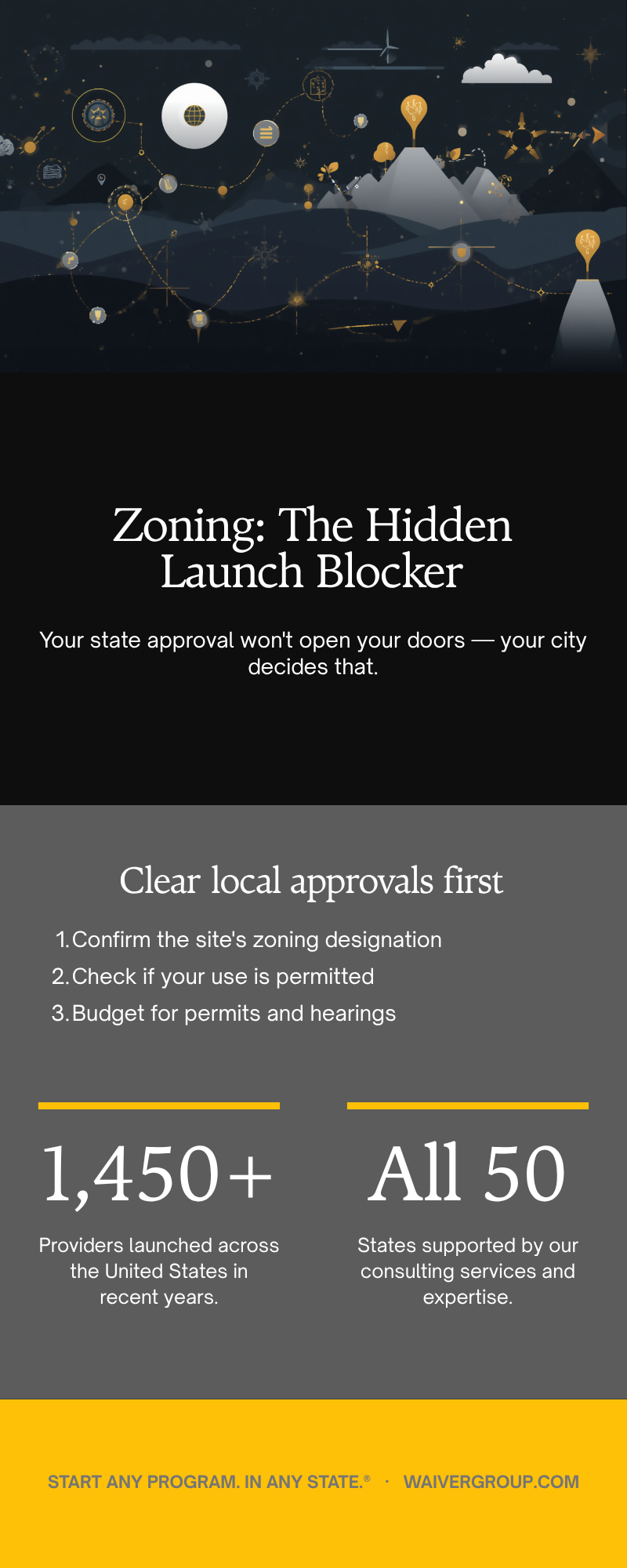
To avoid the "hidden blocker" scenario, zoning and occupancy must be treated as a high-priority, time-sensitive milestone in your launch plan. Rather than viewing this as an afterthought, integrate it into the site-selection phase. Before signing a lease or purchasing property, perform due diligence by meeting with the local municipal planners to disclose your exact intended use. Ask direct questions about existing zoning designations and whether your program triggers any "change of use" requirements.
Assign a specific owner to the zoning task in your project timeline. This person should be responsible for tracking local meeting schedules, permit application deadlines, and follow-up communications with the city. By treating zoning with the same professional rigor as state licensing and policy development, providers ensure that their site is not just a building, but a compliant, long-term foundation for service delivery.
Frequently Asked Questions
What is the difference between a Certificate of Occupancy and a State License?
A state license authorizes a provider to offer specific Medicaid-funded services according to health and safety standards. A Certificate of Occupancy (CO) is a local document that confirms a building complies with the local building and zoning codes for its intended use. You must have both to operate legally.
Can I open my program while waiting for a zoning variance?
No. Operating a business in violation of local zoning ordinances can lead to legal penalties, immediate shutdown orders, and the loss of your state license. You should never initiate service delivery at a site until all local permits are officially approved and the final Certificate of Occupancy is issued.
Why do some cities require public hearings for HCBS providers?
Local jurisdictions often require public hearings for any project that involves a change of use or a request for a variance. These meetings are intended to allow the community to provide feedback on how the proposed use of the property might impact the neighborhood. Preparing for these meetings with detailed information about the program’s scope and safety protocols is essential for a successful outcome.
Key Takeaway
State approval confirms you are a qualified provider under the Medicaid HCBS framework, but local approval makes your facility legally authorized to host that program. Zoning and land-use requirements are the most frequent cause of unplanned delays for new providers; therefore, you must prioritize municipal compliance as a foundational pillar of your site selection and operational strategy.
The Waiver Consulting Group has helped launch more than 1,450 providers across all 50 states. We prepare you to handle licensing and local requirements together — so a zoning question never becomes the reason your program waits. Book a video consultation at waivergroup.com/videoappointment, call 302.888.9172, or email [email protected].
Last verified: October 2023. The information provided in this article is for educational purposes only and does not constitute legal or professional advice. Requirements for zoning and licensure vary by state, county, and municipality. Always consult with local authorities or legal counsel regarding the specific regulations applicable to your facility location and program type.