Your Provider Licensing Timeline: What Really Drives It
By Fatumata Kaba · 2026-06-19 · 5 min read
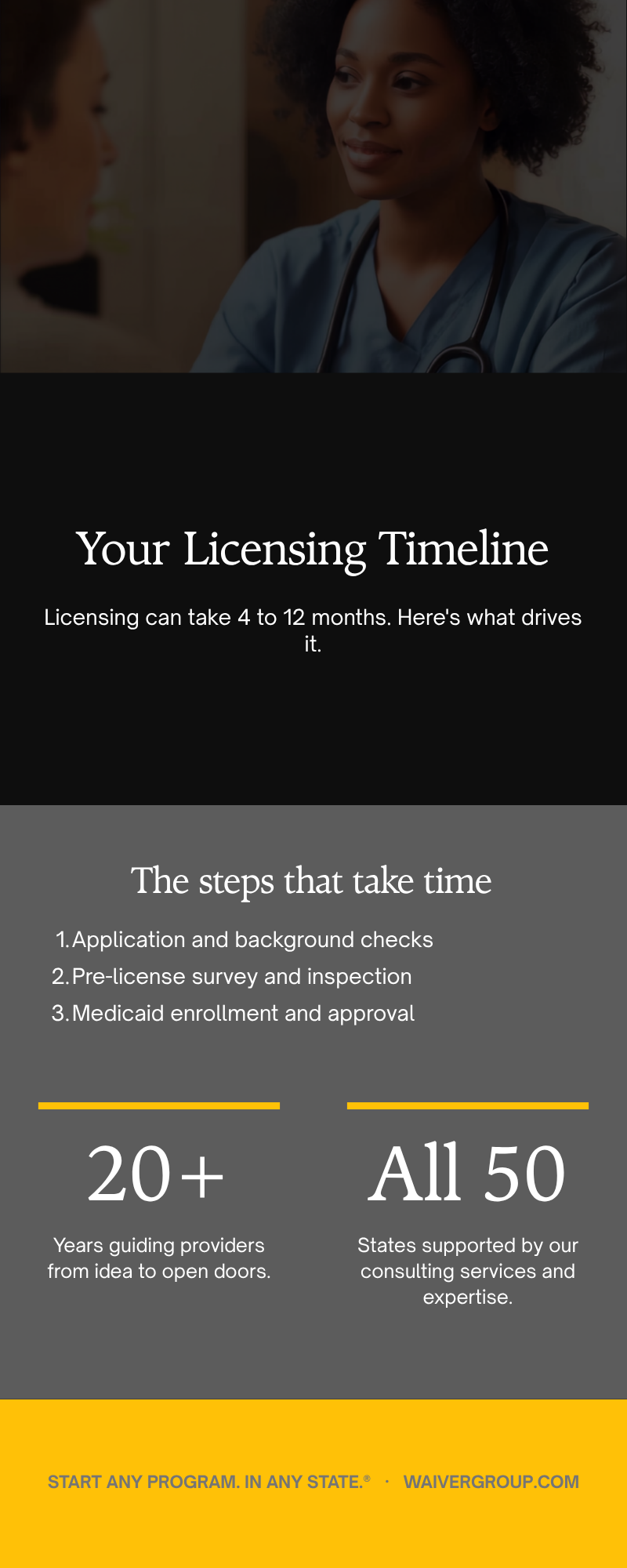
The timeline for obtaining Medicaid Home and Community-Based Services (HCBS) provider licensing is rarely uniform, typically ranging from four months in streamlined jurisdictions to twelve months or more in states with complex regulatory requirements. While state-specific mandates set the baseline, the most significant driver of the final approval date is the applicant's internal administrative readiness and the accuracy of the initial submission.
What Defines the Baseline Licensing Timeline?
Licensing timelines are dictated by a combination of state statutory mandates, the capacity of the survey agency, and the complexity of the specific waiver program being applied for. States with high demand for HCBS services often face backlogs in application processing, while smaller or more rural programs may operate on a rigid cycle tied to fiscal year budgets or provider capacity needs.
Regulatory agencies must conduct thorough due diligence, which involves verifying the financial stability, organizational structure, and clinical readiness of the applicant. Because these agencies must maintain compliance with federal Centers for Medicare & Medicaid Services (CMS) requirements, they cannot bypass the sequential steps of review, regardless of the applicant's desire for speed. Understanding that the timeline is a function of both state bureaucratic volume and regulatory rigor is the first step toward effective project management.
Phase One: The Critical Role of Documentation Accuracy
The application phase is the foundation upon which all subsequent approvals are built. It involves assembling comprehensive documentation, including formal business registration, employer identification numbers (EIN), clearly defined operational leadership, detailed resumes, robust staffing plans, and proof of required insurance coverage. Any discrepancy, omission, or lack of clarity in these documents acts as an immediate trigger for requests for information (RFI), which halts the clock on an application.
When an agency submits an incomplete or flawed packet, it forces the state reviewer to move the file to the bottom of the queue. To maintain momentum, applicants should ensure that every document reflects the exact legal name of the entity, matches the credentials required by the state’s provider manual, and aligns with the organizational structure submitted to the Secretary of State. High-performing applicants treat the initial filing as a formal audit of their business readiness rather than a simple administrative task.
Managing Background Checks and Personnel Compliance
Background checks and fingerprinting processes are non-negotiable hurdles that often surprise new provider founders. These requirements vary by state, but they consistently mandate that all key personnel, administrators, and sometimes direct support staff undergo thorough screenings through state and federal databases. Delays frequently occur here because applicants fail to monitor the submission status of their key personnel.
- Ensure completeness: Verify that every required staff member has submitted their fingerprints to the correct state-designated clearinghouse.
- Address hitches early: If a background check returns an error or a flag, address the discrepancy immediately through the state's appeals or clarification process.
- Synchronization: Align staff onboarding timelines with the expected date of licensure to avoid paying salaries before the agency is legally authorized to bill for services.
The Pre-License Survey and Site Inspection
Once the paperwork clears, the state will conduct a pre-license survey and site inspection. This phase is designed to verify that the physical location and the internal policies of the provider are not just theoretical, but operational. Inspectors will examine your facilities for safety compliance, accessibility, and documentation of internal quality assurance processes.
Preparation for the site inspection requires that the provider has fully implemented the policies and procedures stated in their application. This means having physical files, emergency plans, and training logs ready for inspection. If the surveyor discovers that the written policies do not match the physical practice or that the facility is not ready, the license will be denied or delayed, often requiring a second, lengthy inspection process to clear the findings.
Navigating Medicaid Enrollment and Waiver Approval
The final gate is Medicaid enrollment and final waiver approval. Even after a provider is licensed to operate by the state, they are not authorized to bill for Medicaid services until they have been officially enrolled as a Medicaid provider in the state’s portal. This is a separate, yet interconnected, administrative process that verifies the entity's eligibility to receive federal and state funds.
Successful navigation of this stage requires absolute precision in banking information, provider classification codes, and tax documentation. Because this is the gateway to reimbursement, the state’s fiscal agent will subject the enrollment application to rigorous financial and operational validation. Until this enrollment is finalized, the provider remains in a "pre-revenue" state, highlighting the necessity of careful capital planning during the earlier months of the licensing process.
Frequently Asked Questions
What is the most common cause of a delay in the licensing timeline?
The most common cause of delay is the submission of incomplete or inconsistent documentation. When an application contains errors, the state regulatory body issues requests for information, which suspends the application's progress until the applicant provides a sufficient response. Minimizing these "stop-start" interactions is the most effective way to keep the timeline on track.
Do all states have the same background check requirements?
No. Each state sets its own rules regarding which personnel must be fingerprinted and which databases must be checked. Some states utilize a central background check clearinghouse, while others require separate submissions to state law enforcement and the state’s health department. It is critical to consult the specific provider manual for your jurisdiction to understand the exact scope of the requirement.
Is it possible to begin billing the moment the physical site inspection is passed?
No. Passing the site inspection is a precursor to licensure, but it is not the final step. An agency must first receive its formal license from the state, then complete the separate Medicaid provider enrollment process before they are legally permitted to bill for services. Attempting to bill before these two distinct processes are finalized is a major compliance violation.
Key takeaway: The providers who move fastest aren't lucky — they prepare every document correctly the first time.
Last verified August 2024. This information is intended for educational purposes only and does not constitute legal or professional advice. Requirements for Medicaid HCBS programs vary significantly by state and are subject to change. Always refer to your state’s specific Medicaid provider manual and consult with relevant regulatory authorities when seeking licensure.