Your Medicaid Provider Number Isn't Approval — Here's the Sequence
By Fatumata Kaba · 2026-06-25 · 5 min read
Receiving a Medicaid provider number is a milestone, but it is frequently misunderstood as a green light for billing. In reality, a provider number acts solely as an identification string within the state system, while the formal authority to submit claims for payment is granted only after successfully completing a specific, multi-layered sequence of state and federal enrollment protocols.
Understanding the Role of the Provider Identifier
The confusion surrounding Medicaid enrollment often stems from the distinction between an identity and an authorization. A Medicaid provider number, which may be issued in tandem with a National Provider Identifier (NPI) or a state-specific Medicaid Provider Identifier (MPI), serves as a foundational data point. It confirms that your organization exists within the state’s administrative database, allowing the system to recognize your agency's profile when data is queried.
However, possessing this number does not grant the right to collect payment for Home and Community-Based Services (HCBS) or waiver-funded activities. State Medicaid agencies treat the issuance of an identifier as a backend administrative task rather than a programmatic endorsement. Treating this number as a substitute for formal billing approval is one of the most common reasons new provider agencies experience significant delays or administrative denials during their initial months of operation.
The Regulatory Hierarchy: Why Sequence Matters
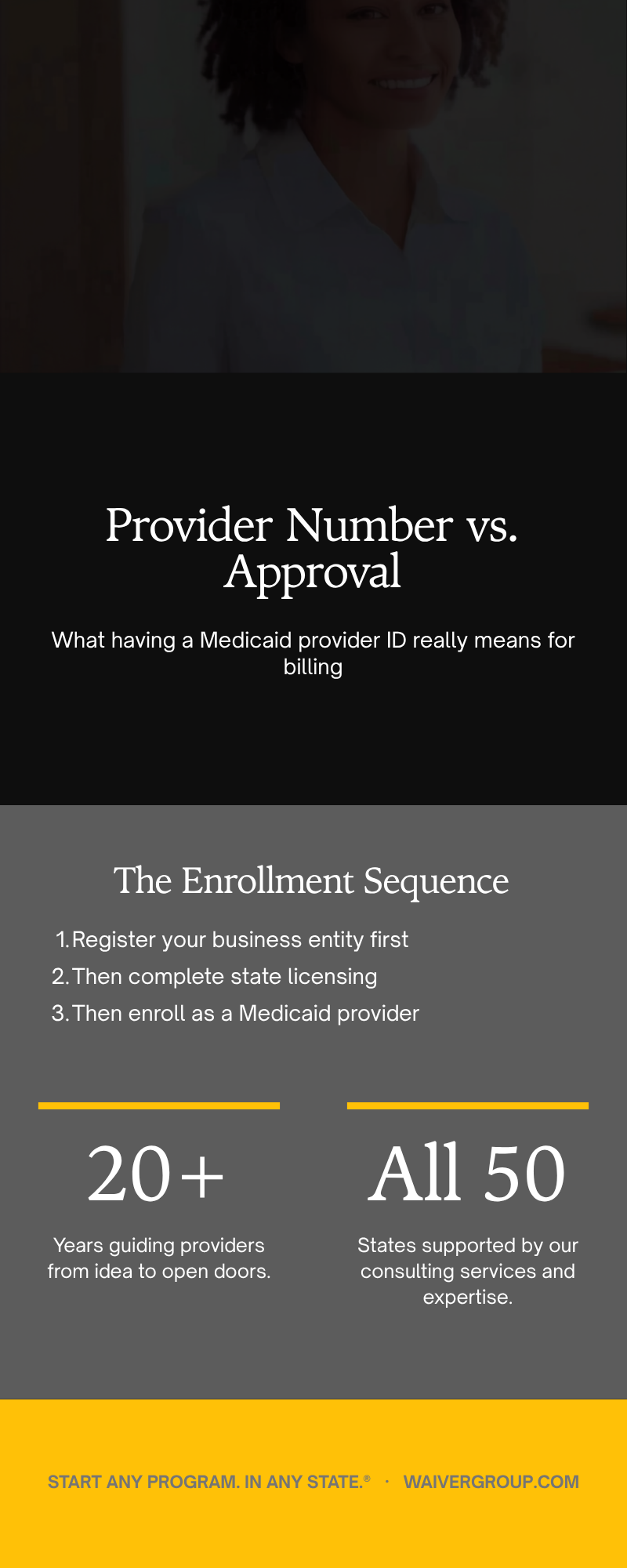
The path to becoming a billable Medicaid provider follows a strictly defined logical sequence. Each step builds upon the previous one, and regulatory agencies require proof of compliance at every stage. When a provider attempts to leapfrog these steps—such as applying for a Medicaid ID before finalizing state licensure or organizational certification—the result is almost always a "pending" status that can stall an agency for months.
To move effectively through the process, providers must view the timeline as a mandatory chain of dependencies. If any link in this chain is broken or out of order, the billing system will reject claims because the foundational requirements (such as active state licensure or compliant provider agreements) will be flagged as missing in the audit trail.
Step 1: Establishing Legal and Administrative Foundation
Before any contact with a state Medicaid agency, the legal entity must be fully formed and recognized by the Secretary of State. This includes filing your Articles of Organization, obtaining an Employer Identification Number (EIN), and ensuring that the business entity is correctly categorized for the specific HCBS waiver services intended for delivery.
This phase also involves registering with the appropriate state and federal databases. Without a legally registered business entity, Medicaid authorities cannot issue a contract or provider agreement. Ensure that your organization’s legal name, tax ID, and address are consistent across all documents, as discrepancies here are a primary cause of application rejection during the early screening process.
Step 2: Securing State Licensure and Certification
Once the entity is registered, the agency must secure the specific licensure or certification required for the HCBS services being provided. This step is often overseen by a state Department of Health or a Department of Aging and Disability Services, depending on the state’s regulatory structure. This is the stage where the state validates that the agency meets the clinical, safety, and operational standards required to serve waiver populations.
This certification is distinct from Medicaid enrollment. It represents the state's stamp of approval on your operational capabilities. Without valid, current, and active certification, the Medicaid enrollment department will not authorize the agency to move forward to the provider agreement stage. It is essential to maintain copies of all initial survey reports and certificates, as these are frequently required as attachments during the subsequent Medicaid enrollment application.
Step 3: Formal Medicaid Enrollment and Provider Agreements
With a legal entity and the necessary certifications in place, the agency is finally positioned to apply for enrollment in the state's Medicaid program. This is the process that leads to the assignment of a Medicaid provider number. During this phase, the provider must submit a formal application, which often includes a comprehensive background check of owners and managing employees, disclosure of ownership interests, and signed provider agreements.
- Reviewing the provider manual for specific documentation requirements.
- Completing the mandatory provider agreement or contract.
- Ensuring all background checks and disclosures are current.
- Verifying that the NPI matches the taxonomy codes assigned to the waiver services.
Step 4: Contracting with Managed Care Organizations (MCOs)
In many states, the transition from state enrollment to actual billing involves a secondary layer: managed care. Even if an agency holds a Medicaid provider number, they may be required to contract specifically with individual MCOs that administer waiver services in their geographic region. These organizations have their own credentialing processes that run parallel to, but are distinct from, the state Medicaid program.
Securing a contract with an MCO is often the final hurdle before billing can begin. This process involves proving that your agency has the capacity to handle referrals, manage electronic visit verification (EVV) requirements, and comply with specific MCO reporting standards. Failure to finalize these network participation agreements will leave a provider with a valid Medicaid ID but no entities to bill for their services.
Frequently Asked Questions
Can I begin billing as soon as I receive my NPI?
No. An NPI is a national identifier for health care providers, not a Medicaid approval. You cannot bill Medicaid for waiver services until you have completed the full state-specific enrollment process and have been issued a state-specific Medicaid provider number that is active for the specific service taxonomy you are providing.
What happens if I try to bill before the enrollment sequence is complete?
Submitting claims before the full enrollment and credentialing sequence is complete will result in the immediate denial of those claims. Furthermore, it may flag your organization for audit or cause your application to be suspended due to premature attempts to access the billing system.
Does a Medicaid provider number guarantee that I am eligible to serve all waiver populations?
Not necessarily. A Medicaid provider number is often tied to specific service codes and taxonomy codes. If you are approved to provide personal care but attempt to bill for specialized nursing or behavioral health services without the corresponding certification and enrollment in those categories, those claims will be denied.
Key takeaway: A Medicaid provider number identifies you; it does not approve you to bill. Approval comes after entity registration, licensing or certification, and formal Medicaid enrollment, often followed by separate MCO network credentialing.
Last verified: October 2023. This information is provided for general educational purposes and does not constitute legal or professional compliance advice. Policies and enrollment requirements vary significantly by state and program. Always consult the latest state provider manuals and official state Medicaid portal documentation to verify specific regulatory requirements for your jurisdiction.