Your Medicaid Billing Has an Order: The 3 Steps Home Care Providers Miss
By Fatumata Kaba · 2026-06-26 · 5 min read
New home care providers frequently encounter a common obstacle: they attempt to bill Medicaid before their administrative infrastructure is fully aligned with state and federal requirements. The delay in receiving payment is almost always rooted in a failure to follow the precise, non-negotiable sequence of state approval, Medicaid enrollment, and Managed Care Organization (MCO) credentialing.
Becoming a Medicaid provider is not a single application process, but rather a three-tiered administrative hierarchy where each stage depends entirely on the completion of the previous one. Understanding this sequence is essential for agency founders who wish to avoid months of unnecessary downtime and revenue leakage.
Why Is the Sequence of Medicaid Provider Enrollment So Critical?
The Medicaid system operates on a "dependency model" where data must flow from the state regulatory agency to the Medicaid Management Information System (MMIS) and finally to the individual Managed Care Organization's billing database. If you attempt to initiate a contract with an MCO before your National Provider Identifier (NPI) is active in the state Medicaid system, the MCO will be unable to verify your status, leading to an automatic rejection of your credentialing application.
Many providers mistakenly believe they can work on these steps concurrently. While you can prepare your business policies while waiting for state regulatory approval, you cannot force the enrollment systems to recognize you until the preceding government entity has officially validated your business. Missing this order results in a "loop" of paperwork that can leave an agency in limbo for weeks or months.
Step 1: Achieving State Certification or Agency Approval
The foundation of your ability to bill any health program is the approval of your entity by the state’s program agency, such as the Department of Health or the Department of Aging. This phase focuses on proving your organization’s legitimacy and readiness to provide specific Home and Community-Based Services (HCBS).
During this stage, the state will review your business formation documents, insurance coverage, and compliance policies. They are looking for evidence that your agency has the administrative capacity to manage care, maintain HIPAA compliance, and protect patient welfare. You must secure your official license or letter of approval before moving to the next phase.
- Ensure your organizational structure matches your business license exactly.
- Prepare detailed service delivery policies that reflect the specific waiver program requirements.
- Maintain copies of all licensure documents, as these will be required as digital attachments in subsequent enrollment portals.
Step 2: Enrolling as a Medicaid Provider Using Your NPI
Once you have secured your state certification, you must enroll as a Medicaid provider. This step establishes your unique billing record within the state’s MMIS portal. A critical component of this step is the National Provider Identifier (NPI), which serves as your permanent, unique identifier in the healthcare system.
It is vital that your NPI is correctly linked to your legal entity name and tax identification number. Any discrepancy between your state license and your NPI record will cause the system to flag your application for manual review, significantly delaying your approval. Once the state verifies your information, you will be issued a Medicaid Provider ID, which serves as your "key" to the billing ecosystem.
Step 3: Navigating MCO Contracting and Credentialing
In many jurisdictions, Medicaid waiver services are managed by Managed Care Organizations (MCOs). While you are a Medicaid-approved provider at the state level, you are not yet a vendor for the specific insurance companies managing the care. Contracting with these MCOs is the final, essential step in the sequence.
Each MCO manages its own network and maintains its own credentialing portal. Because these organizations operate independently, you must apply to each one separately. They will request your Medicaid Provider ID, your NPI, and your state-issued certification to verify your eligibility. Only after this rigorous vetting process will you be granted a contract that allows for the submission of claims.
- Keep an inventory of every MCO operating in your service area.
- Track the specific documentation requirements for each MCO, as they may differ slightly from the state standard.
- Submit your credentialing packets promptly once you have your Medicaid ID, as MCO onboarding timelines can vary significantly.
Avoiding Common Administrative Pitfalls
The most frequent error providers make is failing to sync their business data across these three platforms. If your physical address, mailing address, or legal contact information changes, you must update the information at the state regulatory agency first. If that data is not reflected in the Medicaid enrollment system or the MCO portal, your claims will be denied for "demographic mismatch."
Consistency is the primary factor in a smooth enrollment lifecycle. Administrative teams should ensure that every document submitted—from your state license to your MCO application—uses the exact same legal name and identifier numbers. By maintaining a clean, centralized file of these documents, you reduce the risk of human error during the application processes.
Frequently Asked Questions
Can I apply to MCOs while my Medicaid enrollment is pending?
Generally, no. MCOs verify your status through the state’s Medicaid provider database. If you are not yet showing as an active provider in that system, the MCO’s internal validation check will fail, and your application will likely be returned or denied.
Why does my NPI matter if I already have a Medicaid Provider ID?
Your NPI is a national standard that links your practice to federal healthcare data, while your Medicaid Provider ID is specific to your state’s reimbursement system. Both are required for the "handshake" between the state program and the MCOs to successfully process claims.
How do I know if my state uses MCOs or a fee-for-service model?
You can verify this by checking your state's Medicaid portal under the "Provider Enrollment" or "Waiver Services" sections. If the state uses Managed Care, the website will typically list the contracted health plans that you must contact for network participation.
Key Takeaway
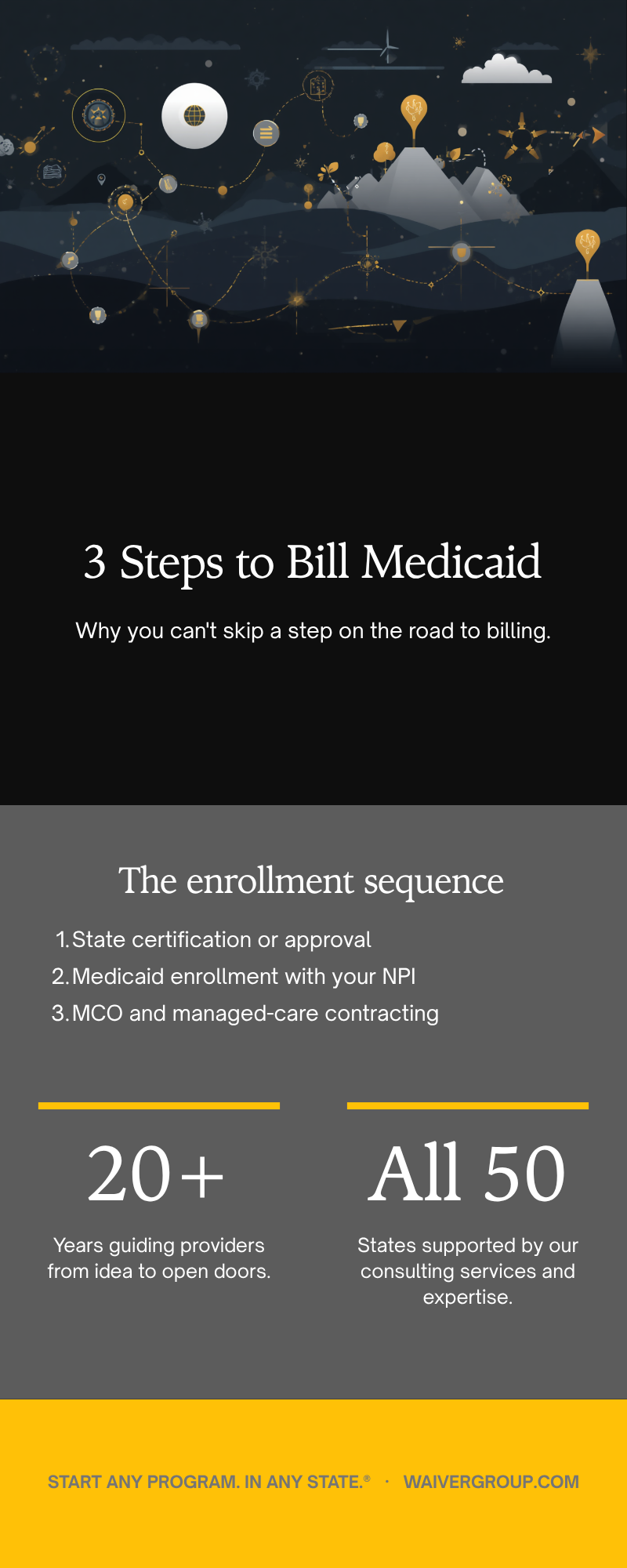
Billing Medicaid is a structured sequence, not a single application event. To ensure your agency receives payments, you must prioritize state certification first, followed by Medicaid provider enrollment using your NPI, and conclude with individual MCO contracting. By adhering to this hierarchy, you minimize administrative friction and establish a reliable foundation for your revenue cycle.
Last verified: October 2023. Disclaimer: This information is for educational purposes and does not constitute legal or financial advice. Regulations regarding Medicaid provider enrollment and Managed Care contracting are subject to change. Consult with state program manuals and professional advisors before submitting applications to ensure compliance with current local requirements.