Why Your Provider Licensing Application Stalls — and How to Keep It Moving
By Fatumata Kaba · 2026-06-24 · 5 min read
Provider licensing applications often stall not because of state administrative backlogs, but because of common, avoidable errors in the submission process. By proactively managing documentation, administrative access, and communication timelines, applicants can significantly reduce the time spent in the "pending" phase and move toward operational approval more efficiently.
Why Does My Application Status Remain Stalled?
The perception that state agencies are inherently slow is a common misconception among new provider agency founders. In reality, state reviewers operate under strict regulatory frameworks and follow rigid checklists; if a single document is missing, improperly formatted, or contradictory, the entire application file is often moved to a "deficiency" or "pending" queue until the applicant resolves the issue. This results in unnecessary administrative friction.
Most delays stem from a lack of internal synchronization. When an application is treated as a series of disconnected tasks rather than a cohesive project, information gaps appear. Recognizing that the state’s role is to verify compliance—not to troubleshoot your internal processes—is the first step in regaining control over your timeline. Consistency, accuracy, and promptness are the primary drivers of an expedited review.
Maintain One Clean, Unified Application Record
One of the most frequent causes of stalled applications is the existence of multiple, conflicting files within the state’s system. If an agency submits a draft, later uploads a revised version, and perhaps submits a third version under a different entity name or primary contact, reviewers often encounter conflicting data. This requires the state to pause the review to verify which information is current, effectively halting the process.
To prevent this, ensure that you maintain a single, "source of truth" application record. Before submitting any follow-up documentation, check the current state of your portal to ensure you are amending the correct file. If you have inadvertently submitted duplicate or incorrect applications, contact the relevant agency to formally close the erroneous files. Keeping the administrative record lean and singular reduces the cognitive load on the state reviewer and minimizes the chance of a "file mismatch" error.
Verify Portal Access Well Before Deadlines Arise
Modern Medicaid HCBS licensing often relies on state-specific online portals. A common failure point occurs when an administrator discovers they cannot log in—or that their account lacks the necessary permissions to upload documents—at the very moment a deadline is looming. Waiting until you receive a deficiency notice to test your credentials is a major risk factor for missed deadlines.
Proactively confirm that your login credentials work and that your user account has the appropriate permissions to view statuses and submit files. If your agency is represented by a consultant or a specific team member, ensure they have delegated access early. Do not assume that because you can access the main state website that you can access the specific licensing portal. Testing these systems early allows for troubleshooting with state IT departments before the pressure of a submission window begins.
Master the Art of Business Day Calculations
State agencies typically issue Requests for Information (RFI) or deficiency notices with specific response windows. A critical error made by many administrators is confusing calendar days with business days. Because these windows often dictate the legal standing of your application—and sometimes even your eligibility to remain in the queue—miscalculating these dates can lead to an automatic withdrawal of your application by the state.
To ensure compliance, create a structured tracking system for every communication received from the licensing board. The moment a request arrives, calendar the deadline using the following approach:
- Identify the specific deadline language used in the correspondence.
- Distinguish clearly between "calendar days" and "business days."
- Account for state-observed holidays, which do not count toward your response window.
- Establish an internal buffer of 48 hours before the deadline to conduct a final quality check of your submission.
Standardize Your Documentation Formatting
Reviewers at state agencies handle hundreds of applications simultaneously. When an applicant submits documents with inconsistent naming conventions, unclear file types, or fragmented information, it slows down the review process significantly. Standardizing your submission materials makes it easier for the reviewer to verify your compliance with specific state requirements.
Adopt a professional filing system that mirrors the requirements laid out in the state’s licensing handbook. Rename all uploaded files using a clear, descriptive naming convention (e.g., "AgencyName_Policy_Name_Date.pdf"). Ensure that all required signatures are present and that document versions are clearly marked. By submitting a clean, organized digital package, you demonstrate professional readiness and allow the reviewer to move through your application without needing to request clarifications on basic administrative details.
Frequently Asked Questions
How can I tell if my application is truly stuck or just under review?
Most state portals provide a status indicator. If the status remains unchanged for a period exceeding the state’s published "average review time," it is appropriate to reach out to the assigned licensing analyst. Always reference your application ID and keep your inquiry brief, professional, and limited to a request for a status update rather than a demand for acceleration.
What should I do if a deficiency notice includes a requirement I don't understand?
Do not guess. Contact the licensing analyst or the agency’s technical assistance line immediately. Request a clarification of the specific statute or rule that the requirement refers to. It is far better to delay your response by one day to get the correct information than to submit a response that does not actually address the deficiency.
Can I change my key personnel or contact info while an application is pending?
Yes, but you must notify the state agency immediately through the formal channels specified in the application guidelines. Changing personnel without updating the state records creates a mismatch that can trigger an automatic administrative hold, as the reviewer needs to ensure that all new key personnel meet the required background check and qualification standards.
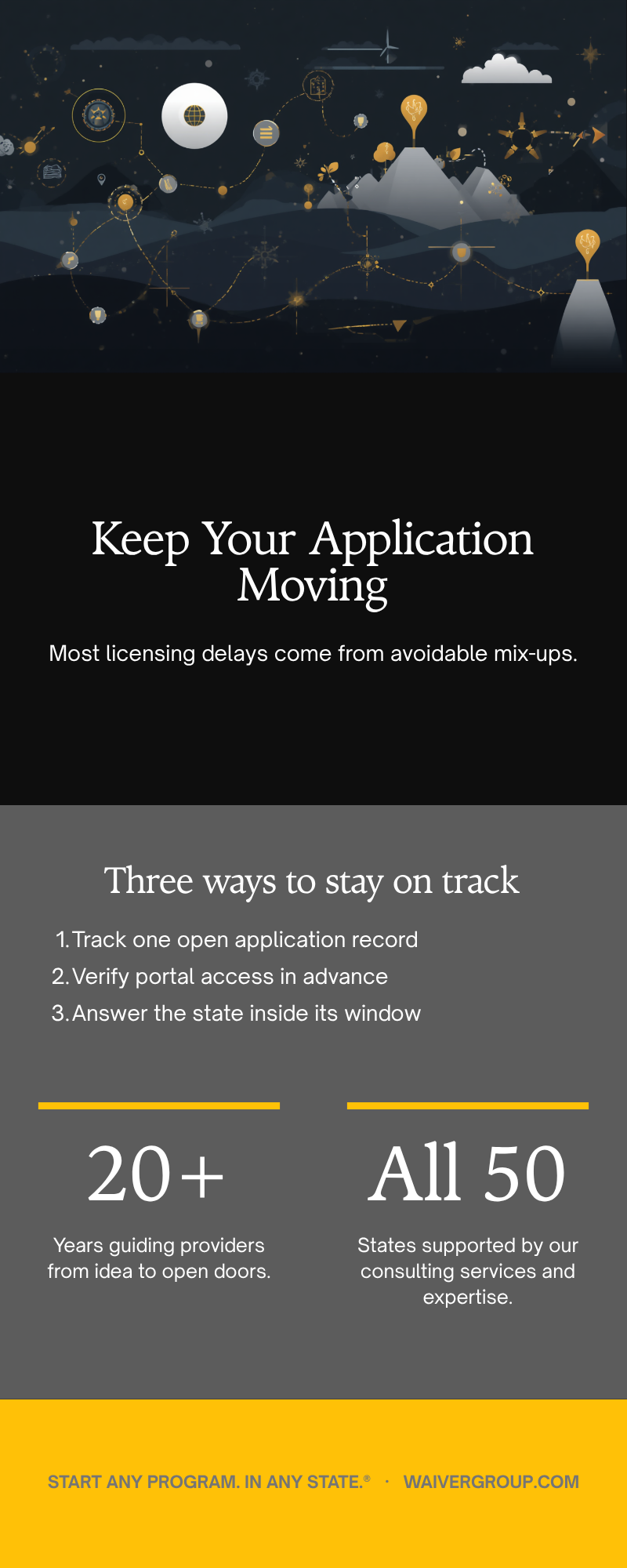
Key takeaway: Keep one clean application on file, confirm portal access early, and respond inside the state's window — counting business days.
Last verified in 2024. The information provided is for educational purposes only and does not constitute legal or professional advice. Always verify current state regulations, as licensing requirements, fees, and submission processes are subject to change by state departments and Medicaid agencies. Start Any Program. In Any State.® For further assistance, contact 302.888.9172 or email [email protected].