Why You Need Your Own Medicaid Provider ID to Bill
By Fatumata Kaba · 2026-07-01 · 5 min read
Securing a unique Medicaid provider identification number is the foundational step for any Home and Community-Based Services (HCBS) agency aiming for long-term viability and financial independence. Relying on "borrowed" billing rights or secondary status under another entity creates structural vulnerabilities that threaten cash flow, limit scalability, and ultimately jeopardize the legal standing of a provider agency.
Why Borrowed Billing Rights Are a Strategic Liability
Many new providers attempt to enter the HCBS market by operating under the umbrella or NPI (National Provider Identifier) of an existing, established agency. While this may provide a temporary mechanism to begin service delivery, it is a precarious arrangement that places your agency’s revenue at the mercy of a third party. When you bill under another entity, you are effectively a subcontractor or a guest in their house; you have no direct contractual relationship with the state Medicaid agency.
This dependency is inherently unstable. If the host agency decides to shift their focus, exit a specific geographic region, or if their own contract with the state is audited or terminated, your billing capabilities disappear instantly. By not possessing your own Medicaid provider ID, you forfeit the ability to negotiate directly with managed care organizations (MCOs) or state authorities, leaving your agency’s survival tied to a relationship that can be dissolved without your consent.
The Risks of Contractual Entanglement
Operating without direct state approval creates a significant lack of transparency and legal protection. In the eyes of the Medicaid program, the agency that owns the provider ID is the party responsible for service delivery, compliance, and clinical outcomes. When you outsource your billing rights, you often lose access to the very portal data and remittance advice that demonstrate your own agency's performance and quality metrics.
Furthermore, this arrangement complicates compliance. Medicaid programs require rigorous documentation and adherence to specific service definitions. If you are operating under another entity's ID, you are subject to their administrative oversight and their interpretation of state rules. If their compliance posture is weak, your agency faces direct risk by association. Securing your own ID ensures that you are the sole entity responsible for your compliance narrative, documentation, and billing accuracy.
Establishing Your Agency as an Independent Entity
To scale a business effectively, you must enroll as a distinct corporate entity rather than an individual practitioner. Enrolling as an entity signifies that your organization has the administrative capacity, insurance coverage, and operational infrastructure to meet state-specific requirements. This transition is essential for building an asset that can be valued, audited, and sustained over the long term.
- Entity-level enrollment: Provides legal separation between your personal assets and the agency’s business liabilities.
- Credentialing control: Allows your agency to manage its own staff rosters, training records, and provider site locations without third-party interference.
- Direct payments: Ensures that revenue is deposited directly into your agency’s bank accounts, preventing unnecessary delays caused by administrative pass-throughs.
Taking Control of Your Service Area and Growth
A provider ID is not just a billing tool; it is a geographic license to operate. When you are tethered to another provider's ID, your service area is strictly limited to the regions they have designated. If you seek to expand into a new county or zip code, you are often blocked by the limitations of the master contract you are currently utilizing.
Possessing your own provider ID empowers your agency to dictate its growth trajectory. You can apply to expand into any region approved by the state, build relationships with local MCOs, and diversify your service offerings according to your agency’s internal strategy. This autonomy is the difference between being a perpetual subcontractor and becoming a market leader in the HCBS sector.
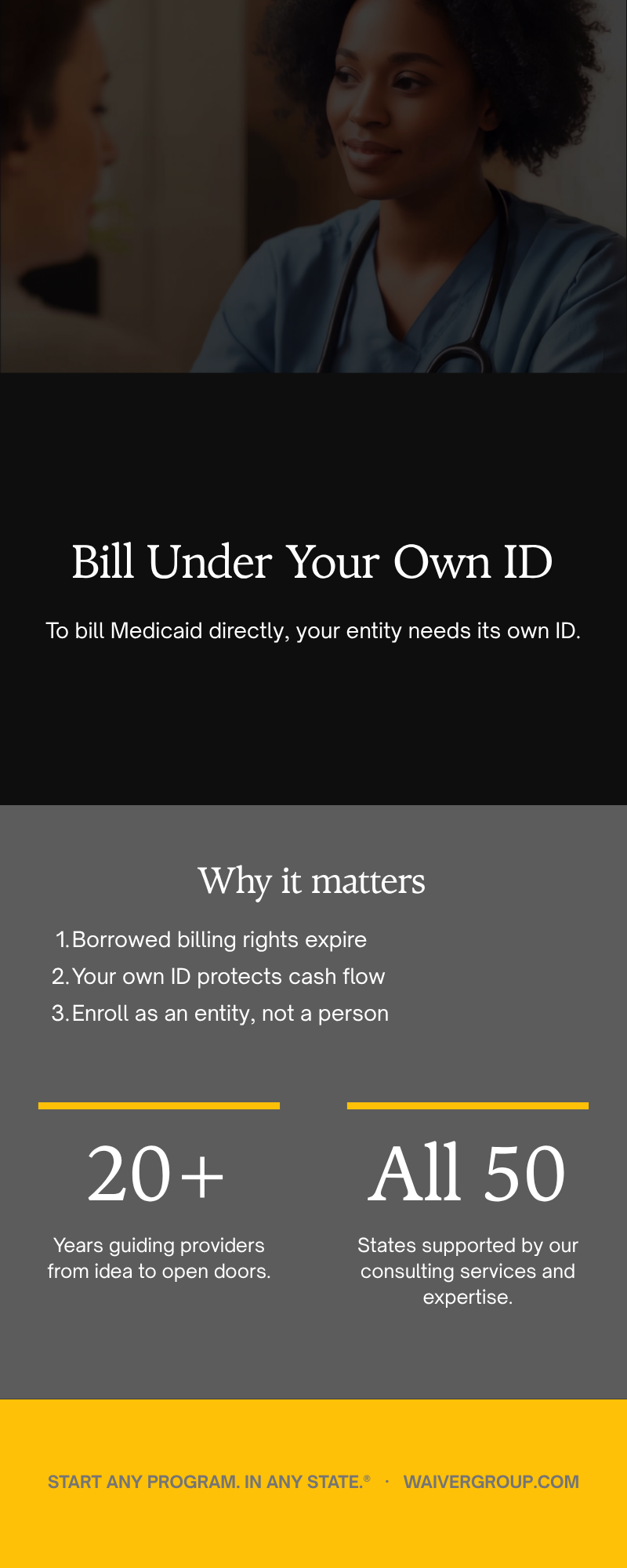
The Long-Term Value of Direct Enrollment
Investment in direct enrollment is a capital investment in your business’s equity. Prospective partners, lenders, and potential buyers look for independent billing history as a primary indicator of agency health. An agency that generates its own billing and maintains a clean record with the state Medicaid program is a tangible asset. An agency that relies on external billing arrangements is often viewed as a liability or a transient business model.
Securing your own credentials requires time and meticulous attention to state-specific regulations. From navigating the initial application in the state Medicaid portal to managing ongoing background checks and facility inspections, the process is rigorous by design. However, this rigor acts as a barrier to entry that, once crossed, protects your agency from competitors and market volatility.
Frequently Asked Questions
Is it possible to switch from a sub-contracting model to an independent model?
Yes, but it requires careful transition planning. You must initiate an independent enrollment application with the state Medicaid agency while ensuring your current service obligations are fulfilled. It is critical to maintain continuity of care for participants during the transition period to avoid any gaps in authorization or reimbursement.
Do I need an NPI for my agency if I already have one as an individual?
Yes. If you are forming a corporate entity (such as an LLC or Corporation), you must obtain an Organizational NPI (Type 2) to link your agency to Medicaid billing. An Individual NPI (Type 1) is typically insufficient for agency-level billing, as Medicaid requires the entity to be the primary provider on record.
What happens if my agency is audited before I have my own provider ID?
If you are billing under another provider’s ID, the state will audit the host agency. If issues are found with your services, the host agency will likely terminate your contract to protect themselves, which leaves you without legal recourse or the ability to contest the audit findings directly with the state authorities.
Key Takeaway
Getting your own provider ID and enrolling as a formal entity is the only way to insulate your agency from the risks of third-party dependency. By controlling your own billing, you secure your revenue, define your own geographic footprint, and build a sustainable organization that stands on its own merits. Start the transition to independent status today to ensure the longevity and stability of your HCBS operations.
Last verified: October 2023. Disclaimer: This information is for educational purposes only and does not constitute legal or financial advice. Medicaid regulations vary significantly by state and are subject to change. Always consult with state Medicaid authorities or professional counsel for specific compliance guidance relevant to your jurisdiction.