Why Medicaid Waiver Program Setup Differs in Every State
By Fatumata Kaba · 2026-06-14 · 5 min read
“Learn the process once and run it anywhere” is the most common — and most expensive — assumption for new home- and community-based services (HCBS) providers. Because Medicaid is a federal-state partnership, federal authorities provide the funding framework while individual states hold the authority to design, manage, and enforce their own specific program requirements.
The variation across state lines is not an administrative quirk; it is a fundamental design feature of the Medicaid waiver program system. Understanding why these discrepancies exist is the first step toward building a sustainable, compliant provider agency capable of navigating the complex regulatory landscape of the United States healthcare system.
Why does state-level variation exist in Medicaid waivers?
Federal law allows states to request “waivers” of certain traditional Medicaid rules, which enables them to bypass institutional care requirements and provide home- and community-based services tailored to the specific needs of their local populations. Since these waivers are essentially state-drafted contracts with the federal government, each state has the autonomy to define the scope of services, eligibility criteria, and clinical thresholds for their residents.
Because each state writes its own waiver document, the operational infrastructure is unique to every jurisdiction. A service category defined in one state may not exist in another, or it may carry completely different clinical expectations. This autonomy allows states to address local demographics and budget realities, but it creates a fragmented environment for providers attempting to operate across multiple regions.
How do provider enrollment and credentialing differ across borders?
The path to becoming an approved provider is rarely identical between two states. In some jurisdictions, provider enrollment is a centralized function handled directly by the state’s Medicaid agency or a dedicated state health department. In others, that authority is delegated to regional entities or third-party managed care organizations (MCOs) that maintain their own separate credentialing portals.
Furthermore, the definition of a “provider” is fluid. One state may require an agency to hold a specific home health license to bill for personal care, while a neighboring state may allow non-licensed agencies to operate under a specific HCBS certification. Without a standardized national template, providers must be prepared to navigate:
- Varied state-specific background check requirements for direct support staff.
- Distinct mandatory training curriculums for employees.
- Differing agency-level accreditation requirements necessary for billing eligibility.
- Specific physical office location requirements versus "virtual" or administrative-only enrollment options.
What are the implications for program expansion?
Expansion is a logical goal for many agencies, but attempting to copy a business model wholesale from one state to another is the primary reason programs stall or face retroactive recoupment. Regulatory compliance is not portable; while a business model (such as a specific software stack or internal policy manual) can be scaled, the technical requirements of the waiver program must be rebuilt for each new environment.
Before entering a new market, administrators must conduct a rigorous discovery phase. This involves mapping the state’s unique licensing statutes, identifying the specific enrollment pathway, and confirming the reimbursement landscape. Agencies that fail to differentiate between their operational internal processes and the state’s mandatory regulatory requirements often find themselves unable to bill for services provided during the first several months of operation.
How should providers navigate the documentation disconnect?
Documentation standards serve as the backbone of Medicaid audits. Because states set their own definitions of "medically necessary" services, the clinical documentation required to prove that a service was delivered appropriately will differ by state. A plan of care that satisfies a state agency in one region may be deemed insufficient in another due to subtle differences in definitions of "direct care" or "supervisory oversight."
Consistency in internal processes is vital, but flexibility in documentation templates is the key to longevity. Agencies must ensure that their electronic health record (EHR) systems are configurable enough to adapt to these state-specific fields. Relying on a rigid, one-size-fits-all software configuration is a significant liability risk when an audit occurs.
What role do Managed Care Organizations play in regional variance?
Many states have transitioned their HCBS waiver populations into Managed Care, meaning the state delegates the administration of the waiver to private insurance plans. This adds another layer of complexity. In a managed care environment, a provider may need to be enrolled with the state Medicaid agency *and* separately credentialed with every individual insurance plan operating in that region.
Each MCO may impose its own set of administrative burdens, including unique prior authorization processes, specific billing portals, and varying clinical utilization reviews. Even when the state’s waiver rules are uniform, the practical application of those rules can fluctuate significantly depending on which insurance plan is coordinating the participant’s care.
Frequently asked questions
Can I use the same business license in every state?
No. Medicaid HCBS providers generally must hold licensure specific to the state in which they provide services. A license from one state is rarely recognized as valid for the provision of Medicaid-funded services in another.
Is provider training portable between states?
Generally, no. While certain concepts (such as HIPAA or infection control) are universal, state-specific waiver training—such as mandatory incident reporting procedures or state-mandated care plan templates—must be completed in accordance with the regulations of the state where the service is being delivered.
Why do rates vary so drastically between states?
Medicaid rates are established based on state-specific budget appropriations, legislative mandates, and actuarial studies conducted at the state level. Because the cost of living, labor market conditions, and state tax contributions differ, the reimbursement rates for identical services will rarely be the same across different states.
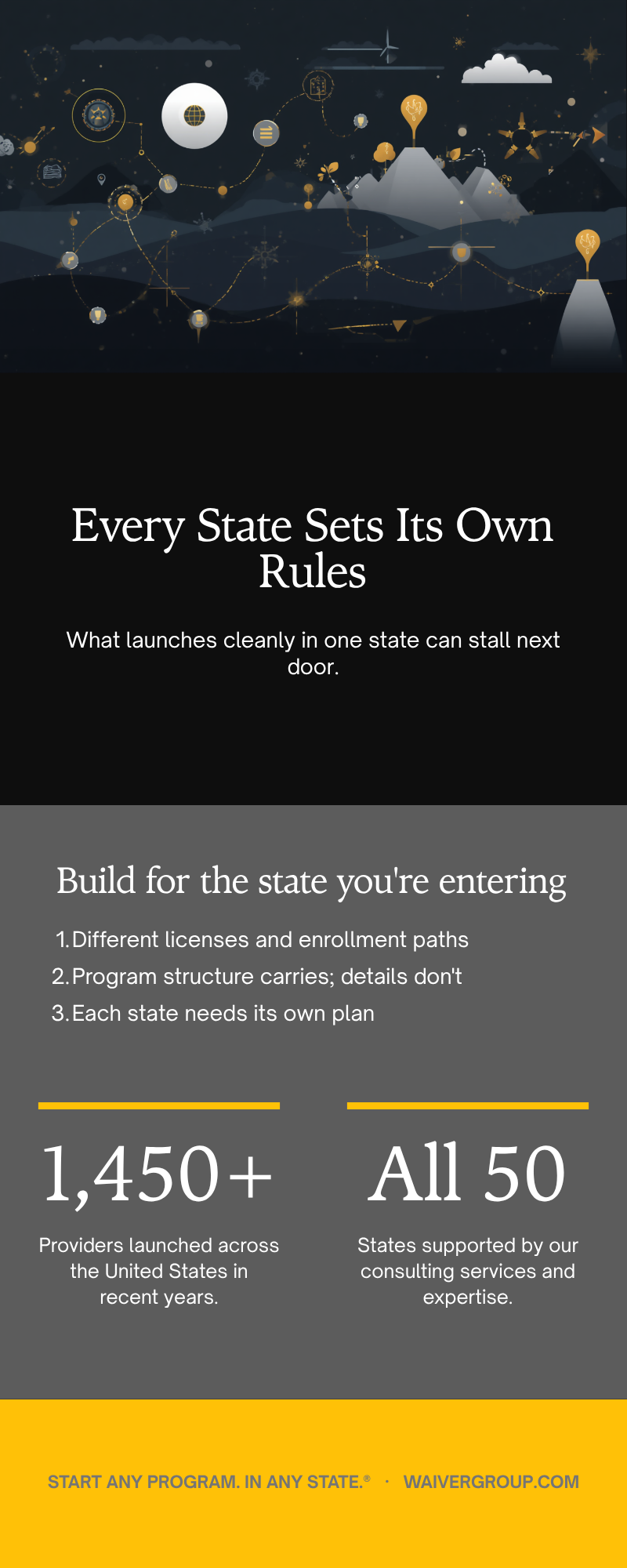
Key takeaway: Each state requires its own customized plan. The program structure, operational workflows, and compliance details must be re-evaluated and rebuilt for every new jurisdiction. Strategy should be built around the specific state you are entering, rather than a generic operational template.
Last verified: September 2023. The Waiver Consulting Group provides professional consulting services for Medicaid provider agencies. The information provided in this article is for educational purposes only and does not constitute legal or financial advice. We recommend consulting with local regulatory bodies or professional counsel regarding specific compliance requirements in your jurisdiction.