Why Generic Policy Manuals Get Your Provider Application Denied
By Fatumata Kaba · 2026-06-25 · 6 min read
Generic policy and procedure manuals are the primary reason many Medicaid Home and Community-Based Services (HCBS) provider applications face immediate rejection. State agencies evaluate these documents not as general business guidelines, but as literal translations of state regulatory code; when a manual fails to mirror the specific mandates, terminology, and procedural requirements of the state, reviewers view it as a non-compliant submission.
For startup agencies and expanding providers, the path to Medicaid certification is paved with rigorous documentation requirements. Submitting a template-based manual suggests to state regulators that an agency lacks the foundational knowledge necessary to protect vulnerable populations or manage public funds, leading to a cycle of administrative denials that can delay revenue for months.
Why State Reviewers Reject Generic Compliance Documentation
State survey and certification agencies operate under strict oversight, utilizing predefined checklists that mirror the specific statutes and administrative codes governing HCBS waivers. When a reviewer opens a policy manual, they are not looking for industry best practices; they are looking for proof that the applicant has operationalized every requirement found in the state's specific provider manual or regulatory statutes. The reviewer is essentially checking boxes against a list of legal mandates.
Generic manuals often fail because they utilize broad, "catch-all" language that lacks the necessary nuance for state-specific oversight. If a state regulation requires a specific timeline for incident reporting or a particular method for service documentation, a generic template will often omit these details or define them inaccurately. Reviewers treat these omissions as evidence that the applicant does not understand the regulatory landscape they intend to enter, often flagging the entire application for further scrutiny.
The Dangers of AI-Generated Templates in Medicaid Licensing
The rise of generative AI has led many providers to attempt to automate their compliance infrastructure. While AI can draft professional-sounding prose, it lacks the ability to cross-reference specific, live state statutes. These tools often "hallucinate" procedures that may sound logical but do not align with the granular legal obligations required for Medicaid participation, such as specific staff-to-participant ratios or mandated training hours that vary wildly from state to state.
A manual generated without a direct mapping to the state's specific administrative code creates a significant liability. Even if the document reads well, it remains untethered to the law. When a state reviewer identifies that a policy manual was created using standardized templates rather than state-specific regulatory research, it often triggers a more rigorous, line-by-line audit of the entire application, significantly delaying the licensing process and potentially marking the provider as a high-risk entity.
Mapping Policies Directly to Regulatory Citations
A submission-ready manual must act as a bridge between the provider’s daily operations and the state’s legal expectations. This is achieved through regulatory mapping—the process of identifying each specific rule within the state code and ensuring there is a corresponding policy section that explicitly addresses that requirement. Without this direct link, the manual is merely a collection of good intentions rather than a compliance instrument.
- Identify every regulatory mandate related to service delivery, participant rights, and health and safety.
- Ensure the terminology used in your policy manual matches the legal definitions provided in the state’s provider manual.
- Include references to the governing statutes within the manual to show reviewers exactly where your policies align with the law.
Ensuring Continuity Between Policies and Operational Forms
A policy manual is only as effective as the documentation system that supports it. State reviewers do not just read your policies; they look for the forms, logs, and checklists that prove those policies are being executed in real time. Discrepancies between what a manual claims and what the internal forms demonstrate are frequent grounds for denial. If your manual describes a robust electronic health record (EHR) procedure, but you cannot produce the sample forms that demonstrate compliance, the application will fail.
For example, if a policy states that a progress note must capture specific indicators, but the provided form lacks the space or fields to document those indicators, the application is technically deficient. Every procedure defined in the manual must have a corresponding, compliant record-keeping tool. This synergy between "how we do it" (policy) and "how we track it" (forms) is the hallmark of a successful submission and demonstrates administrative readiness to state auditors.
Navigating the Operational Infrastructure
Beyond the written manual, providers must ensure their administrative structure supports their stated policies. This means that if a policy requires the reporting of critical incidents within 24 hours, the provider must demonstrate they have a mechanism—such as a dedicated portal or reporting line—to facilitate that speed. Reviewers evaluate the feasibility of your policies; if they determine that a policy is operationally impossible based on the information provided, they will demand revisions.
Agencies should conduct an internal "stress test" on their policies before submission. Ask if a staff member, when faced with a common scenario, could follow the manual's instructions to reach a state-compliant outcome. If the manual is too vague, the staff will act inconsistently, which leads to audit findings later. A compliant manual provides clear, actionable instructions that leave no room for ambiguity or misinterpretation of state rules.
Avoiding the Cycle of Resubmission and Delay
Each time an application is returned for policy revisions, the provider loses critical time, and in some cases, priority status within the state's processing queue. Resubmissions are not simply a matter of fixing a typo; they require a total review of the document's logic and compliance posture. The goal is to provide a "clean" document that requires no further clarification, as state reviewers are often managing high caseloads and rarely offer detailed guidance on how to fix rejected submissions.
Provider agencies that succeed prioritize technical accuracy over administrative convenience. By spending the time to customize every chapter, section, and sub-section to the specific HCBS waiver requirements, agencies minimize the back-and-forth cycle. This front-loaded investment in regulatory accuracy is the most effective way to shorten the path to an active provider status and begin serving participants as quickly as possible.
Frequently Asked Questions
Why does the state return my application if my manual seems professional?
State agencies do not evaluate manuals on writing quality; they evaluate them on legal compliance. If your manual is well-written but does not contain the specific language or requirements mandated by your state’s unique HCBS statutes, it is considered non-compliant regardless of how professional it appears.
Can I use a manual from another state if the services are similar?
No. Each state has its own unique administrative code, waiver language, and provider requirements. Even if you are providing the same type of service in a neighboring state, the regulatory citations, reporting requirements, and compliance standards will differ. Using an out-of-state template is a primary cause for application rejection.
How do I know if my policy manual meets the current state standards?
To verify compliance, you must compare your draft manual against the most recent version of the state’s provider manual and the specific governing statutes for your waiver program. A compliant manual will explicitly address every requirement cited in the state's regulatory documentation and will use the specific terminology defined by that state agency.
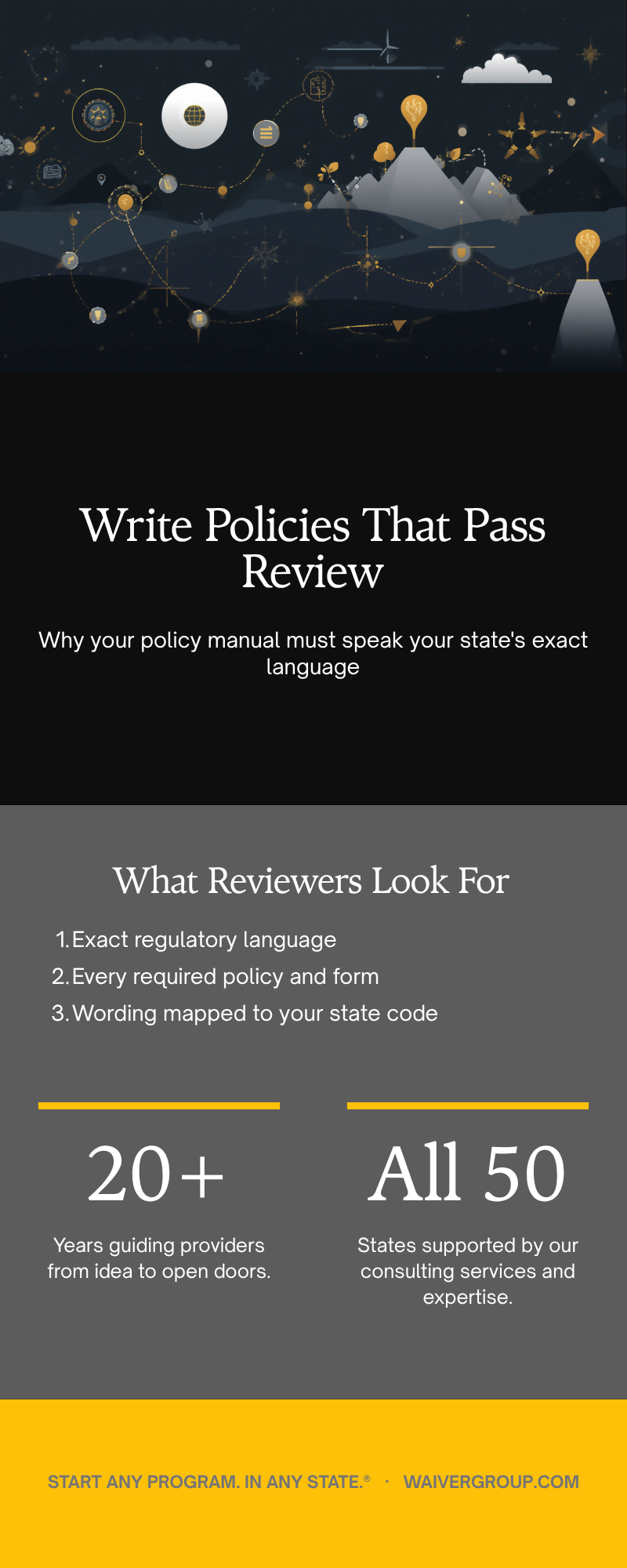
Key takeaway: Reviewers measure your policy manual against your state's exact regulatory language. Generic and untethered AI templates get denied; a manual mapped to your state's code moves your application forward.
Start Any Program. In Any State.®
Ready to take the next step? Book a video consultation at waivergroup.com/videoappointment, call 302.888.9172, or email [email protected].
Last verified: May 2024. This content is for informational purposes only and does not constitute legal or professional advice. Always consult with state-specific regulatory guidelines or professional counsel when preparing your provider application.