Why Arizona HCBS Applications Get Denied — and How to Submit a Complete One
By Fatumata Kaba · 2026-07-03 · 5 min read
Arizona HCBS provider applications are most frequently denied because of administrative gaps, missing documentation, or a failure to demonstrate full compliance with state-specific safety and settings requirements. Securing certification through the Arizona Department of Economic Security (DES) Division of Developmental Disabilities (DDD) and enrollment with the Arizona Health Care Cost Containment System (AHCCCS) requires meticulous attention to detail and a proactive approach to verification.
Understanding the Arizona HCBS Regulatory Landscape
To successfully navigate the Arizona Medicaid HCBS landscape, providers must understand the dual-pathway nature of the approval process. You are simultaneously seeking certification from the DES Division of Developmental Disabilities (DDD) and enrollment as a participating provider with AHCCCS, Arizona’s Medicaid agency. These two entities share information, meaning a failure in one department often triggers a hold or denial across the entire application.
The complexity arises from the overlap of state and federal regulations. While federal rules dictate the baseline for Home and Community-Based Services, Arizona applies stringent local standards for background checks, operational policies, and provider readiness. An incomplete application does not just trigger a request for more information; it frequently results in an outright rejection, forcing the agency to restart the submission process from the beginning.
Why Background Check Compliance is Non-Negotiable
In Arizona, the most common hurdle for new HCBS agencies involves the failure to provide exhaustive, verified background information for every owner, board member, and active staff member. A single oversight regarding a clearance card or a missing registry check is often the primary reason for a denial letter.
Arizona mandates a valid Level One Fingerprint Clearance Card issued through the Department of Public Safety (DPS). Beyond this card, you must provide proof of comprehensive background screenings. These requirements extend beyond simple criminal history checks; they encompass a rigorous review of several national and state databases. Failing to provide evidence of these checks for even one member of your leadership team creates a compliance gap that state auditors cannot overlook.
- Ensure all Level One Fingerprint Clearance Cards are current and valid for every owner and board member.
- Document all required registry checks, including the sexual-offender registry.
- Maintain a centralized file for every staff member containing their criminal history check results.
- Confirm that all background checks are dated within the state-mandated timeframe prior to service delivery.
Mastering the HCBS Settings Rule Attestation
The federal HCBS Settings Rule is designed to ensure that participants receive services in environments that promote integration, autonomy, and individual rights. Before you can be authorized to deliver services in Arizona, your agency must formally attest to compliance with these standards. Many providers mistakenly treat this as a simple checkbox, but the state requires evidence of your operational readiness to adhere to these principles.
Your attestation must clearly define how your agency will support community integration, uphold individual rights, and maintain an environment free from coercion and restraint. If this documentation is unsigned, missing, or lacks the necessary detail regarding how your specific business model meets these federal requirements, your application will be marked as incomplete. You must treat the Settings Rule not just as a policy document, but as the operational foundation of your agency.
Preparing for the AHCCCS Enrollment Process
Once you have secured your DDD certification, the AHCCCS enrollment process begins. This phase is heavily focused on financial integrity, disclosure of ownership, and verifying that your agency is properly licensed to operate in the state. AHCCCS requires specific disclosures regarding your organizational structure and any previous history with Medicaid programs in other states.
Accuracy is paramount during this stage. Any discrepancies between the information provided to the DES/DDD and the information submitted to AHCCCS will lead to delays. Ensure that your tax identification numbers, business entity names, and physical service addresses are consistent across all platforms. A lack of administrative uniformity is often interpreted as a lack of operational oversight.
Common Pitfalls in Documentation and Filing
Beyond the primary regulatory hurdles, many agencies face denial due to clerical errors. Documentation must be submitted in the specific format required by the relevant portal. If a document is scanned poorly, is missing a signature, or is submitted through the wrong channel, it risks being discarded by the intake team.
Furthermore, ensure that your agency’s policies and procedures manual is fully aligned with Arizona’s current standards. Generic policies downloaded from the internet rarely meet the specific requirements of the Arizona state contract. Your manuals must specifically address state-mandated incident reporting, staff training, and participant grievance procedures to ensure your application passes the preliminary desk review.
Frequently Asked Questions
What happens if my application is denied for missing information?
If your application is denied due to an incomplete submission, you will typically receive a notification outlining the missing items. In many cases, you will be required to rectify the gaps and re-submit your materials. Depending on the severity of the omission, you may be required to start a new application cycle entirely.
Do I need to undergo the background check process if I am already cleared in another state?
Yes. Arizona requires adherence to its own specific background check standards, including the Level One Fingerprint Clearance Card issued by the Arizona Department of Public Safety. You cannot substitute clearances from other jurisdictions for Arizona’s mandatory state-level checks.
How does the HCBS Settings Rule affect my day-to-day operations?
The HCBS Settings Rule is not just a certification requirement; it is a mandate for how you provide care. It requires that your services occur in settings that allow for full integration into the community, offer privacy, and ensure participants have the freedom to make choices about their daily lives, activities, and environment. Your operational policies must reflect these realities.
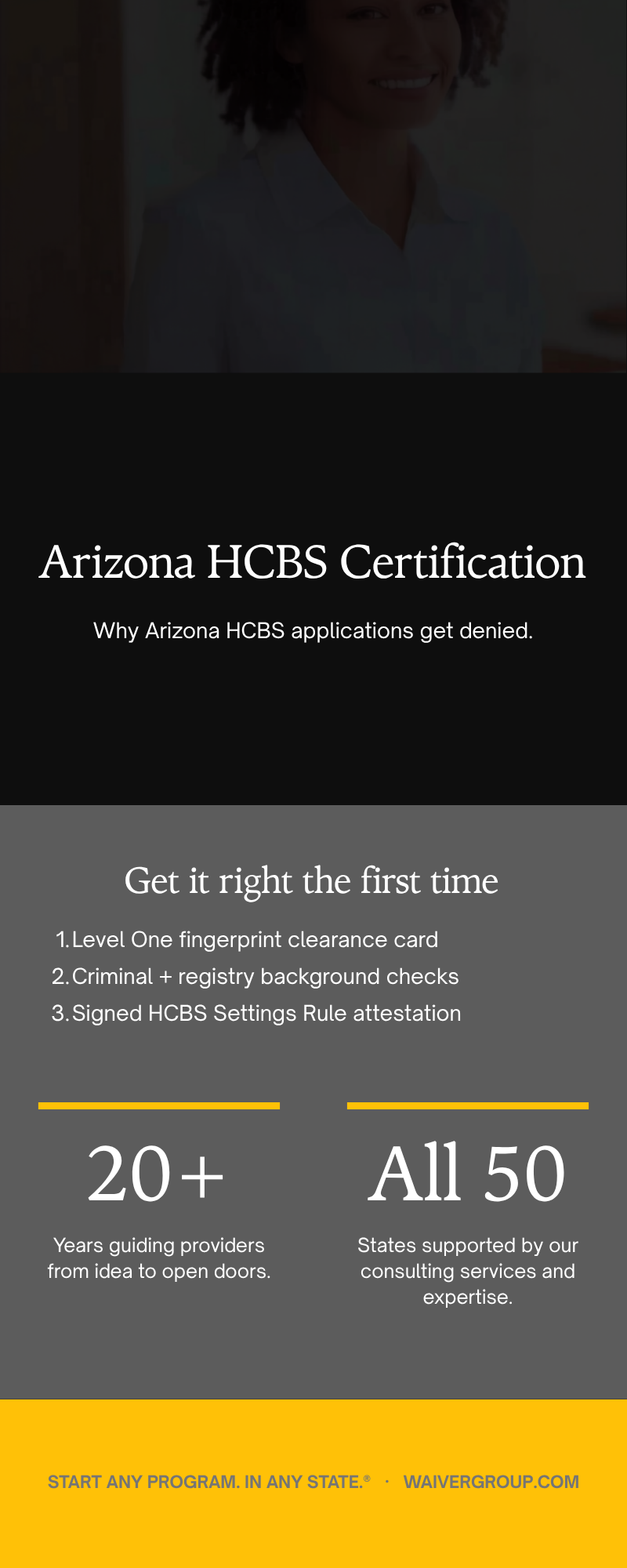
Key takeaway: Arizona applications succeed on completeness. Secure clearance cards, run every criminal and registry check, and submit a signed HCBS Settings Rule attestation.
Last verified: 2024. The information provided in this article is for educational purposes only and does not constitute legal or professional consulting advice. Requirements for Medicaid HCBS provider certification and enrollment are subject to change by state and federal authorities. Always consult with the appropriate state agencies or a qualified professional before submitting applications to ensure full compliance with current regulations.