What Vehicles Qualify for Medi-Cal NEMT in California (Wheelchair Van, Litter Van, Ambulance)
By Fatumata Kaba · 2026-07-02 · 5 min read
Medi-Cal Non-Emergency Medical Transportation (NEMT) in California requires specific vehicle configurations tailored to the physical needs of the member, categorized primarily into wheelchair vans, litter (gurney) vans, and ambulances. Providers must strictly adhere to vehicle equipment standards, safety requirements, and personnel certifications to remain compliant with the California Department of Health Care Services (DHCS) regulations and to avoid claims denials.
Distinguishing Between NMT and NEMT in California
To successfully operate a transportation agency in California, administrators must first distinguish between Non-Medical Transportation (NMT) and Non-Emergency Medical Transportation (NEMT). NMT is designated for members who are ambulatory and do not require medical assistance during transit. In contrast, NEMT is a prescribed medical service intended for members whose medical condition prevents them from traveling via public or private passenger vehicles.
NEMT services are specifically authorized for individuals who require specialized equipment or physical assistance to travel to and from covered medical services. Because these vehicles are considered an extension of the medical care environment, they are subject to rigorous inspection, vehicle maintenance logs, and strict adherence to California safety statutes. Confusing these two categories often leads to billing errors, as the provider's vehicle must match the specific level of care prescribed by the member's physician.
Defining Standards for Medi-Cal Wheelchair Vans
A wheelchair van represents the most common vehicle type in a California NEMT fleet. To meet Medi-Cal standards, the vehicle must be specifically engineered to accommodate passengers who cannot transfer from their wheelchairs. Compliance is determined by the vehicle's internal dimensions, the integrity of the securement system, and the functionality of the loading mechanism.
The following requirements must be met for a wheelchair van to be considered compliant for Medi-Cal NEMT services:
- Capacity for at least two standard-sized wheelchairs while maintaining proper spacing.
- An additional, accessible emergency exit capable of accommodating a wheelchair.
- A power-operated or manual lift or ramp rated for a minimum weight capacity of 450 pounds.
- A certified securement system that locks the wheelchair to the vehicle floor or wall.
- Personnel who have been formally trained in the safe operation of the lift and the securement of the passenger.
Regulatory Requirements for Litter (Gurney) Vans
Litter vans—often referred to as gurney vans—are designed for members who must remain in a supine or reclined position during transit. Because these members are medically fragile, the regulatory threshold for these vehicles is higher than for standard wheelchair vans. Equipment must ensure that the patient remains stable, regardless of road conditions or sudden movements.
When preparing a litter van for service, providers must verify the following structural and safety criteria:
- A loading entrance sized specifically to accommodate the dimensions of a standard medical gurney.
- A secondary emergency exit that is also wide enough to allow for the safe evacuation of a patient on a gurney.
- Approved gurney fasteners that are crash-tested and capable of securing the device during sudden stops or in the event of an overturn.
- Interior surfaces, including seating and gurney coverings, must be composed of washable, medical-grade materials to maintain sanitation standards.
- The inclusion of two staff members—a certified driver and a qualified attendant—for every trip.
Mandatory Personnel and Driver Documentation
The vehicle is only one component of compliance; the driver and attendant credentials must align with the vehicle type. California mandates that individuals operating NEMT vehicles possess specific documentation to prove they are medically and professionally fit to transport vulnerable populations. Failure to maintain these records can result in immediate disqualification of the vehicle from the Medi-Cal network.
Drivers must be prepared to present the following documentation upon request by state auditors or program administrators:
- A valid California driver's license with a clean DMV driving history.
- Current certification in First Aid and CPR.
- Proof of completion of drug and alcohol testing as required by state policy.
- Completed MCSA-5875 (Medical Examination Report) and MCSA-5876 (Medical Examiner's Certificate) forms to ensure the driver meets federal physical requirements.
Fleet Maintenance and Inspection Protocols
Maintaining a Medi-Cal compliant fleet requires more than an initial inspection; it requires a documented system of ongoing preventative maintenance. Providers must keep detailed service records for every vehicle in their fleet. These records should include dates of service, specific parts replaced, and the name of the technician who performed the work, ensuring the vehicle remains in a state of constant readiness.
Routine inspections should focus on the integrity of the lifts, the functionality of the emergency exits, and the securement hardware for wheelchairs and gurneys. If any piece of safety equipment fails during a daily pre-trip inspection, the vehicle must be removed from service immediately until repairs are verified and documented. This proactive approach prevents liability and ensures the safety of the member at all times.
Frequently Asked Questions
What is the minimum lift capacity for a Medi-Cal wheelchair van?
The lift or ramp installed on a Medi-Cal approved wheelchair van must be rated for at least 450 pounds. Providers should always maintain documentation regarding the lift's specifications to demonstrate compliance during agency audits.
Do all NEMT drivers require the same medical forms?
Yes, all drivers operating vehicles for NEMT services must have the MCSA-5875 and MCSA-5876 forms on file. These confirm that the driver has passed the required medical examination, ensuring they are physically capable of assisting passengers safely.
Is an ambulance considered a standard NEMT vehicle?
While an ambulance is a type of NEMT, it is distinct from wheelchair and litter vans. Ambulances are utilized for a higher level of medical care and are subject to their own set of state-specific regulatory standards, which are more stringent than those for standard vans.
Ensuring Compliance Through Operational Vigilance
Operating a successful NEMT business in California requires an unwavering commitment to vehicle standards and personnel documentation. From ensuring your wheelchair lift meets the 450-pound threshold to verifying that your gurney van staff holds current CPR and First Aid certifications, every detail matters. By matching the vehicle to the specific medical needs of the member and maintaining rigorous records, providers can navigate the complex regulatory landscape of the Medi-Cal program effectively.
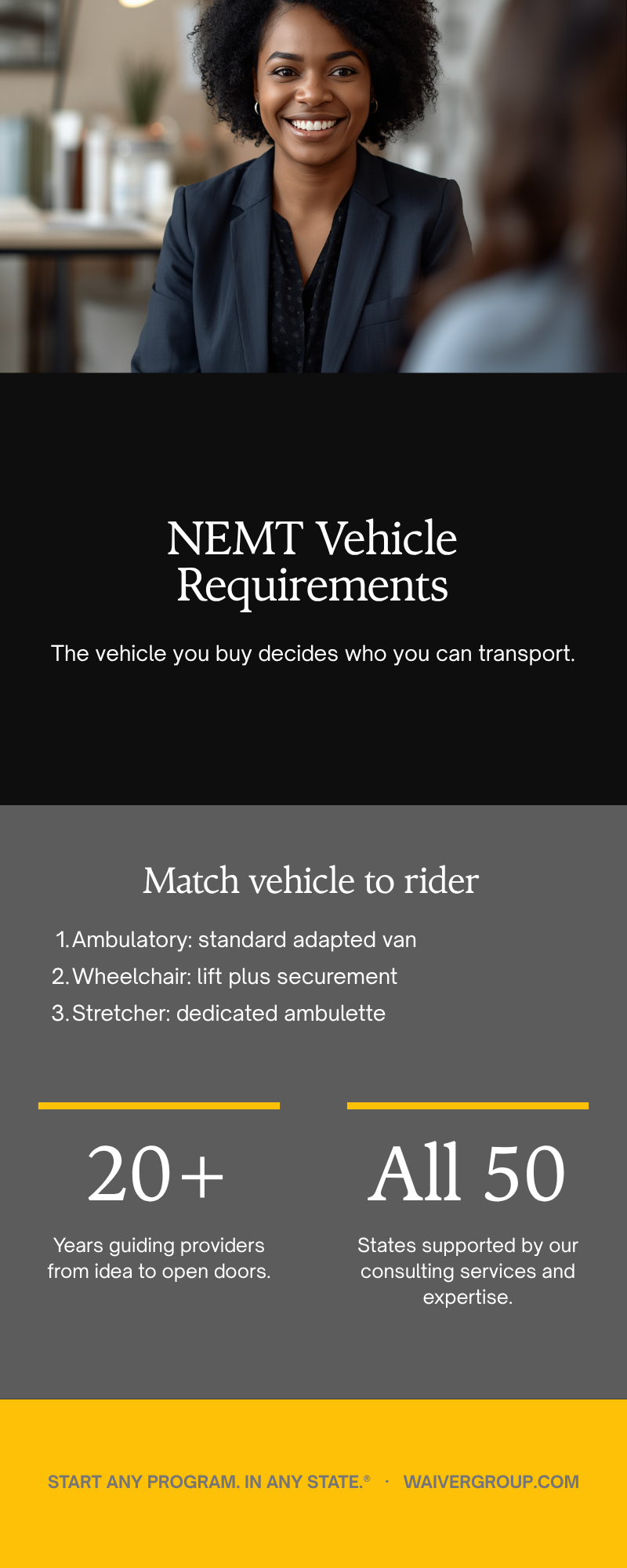
Key takeaway: In California, match the vehicle to the rider, confirm NEMT versus NMT, and meet the Medi-Cal wheelchair van and litter van standards before you buy.
Last verified: October 2023. This information is for educational purposes only and does not constitute legal or medical advice. Please consult with the California Department of Health Care Services (DHCS) or a qualified regulatory consultant before making any business or fleet decisions.