Virginia: How to License In-Home DD Waiver Services
By Fatumata Kaba · 2026-07-09 · 5 min read
To license in-home Developmental Disability (DD) waiver services in Virginia, a provider must navigate a two-tiered regulatory landscape involving the Department of Behavioral Health and Developmental Services (DBHDS) for licensure and the Department of Medical Assistance Services (DMAS) for Medicaid reimbursement. This sequenced approach ensures that your organization meets state-mandated safety, quality, and clinical standards before entering the billing ecosystem for Medicaid-funded care.
Establishing the Regulatory Foundation: DBHDS Licensure
The primary prerequisite for any entity seeking to offer Medicaid-funded DD waiver services in Virginia is obtaining a license from the DBHDS. This agency serves as the regulatory gatekeeper, ensuring that every provider organization has the administrative, clinical, and operational infrastructure necessary to support individuals with developmental disabilities. Licensure is not a generic designation; it is specific to the service category you intend to provide.
Prospective providers must utilize the DBHDS CONNECT system to initiate the application process. This digital portal is the centralized hub for all documentation submissions, site reviews, and ongoing regulatory compliance. Before beginning the application, it is essential to consult the Prospective Provider Toolkit provided by DBHDS. This toolkit outlines the regulatory requirements, documentation standards, and quality benchmarks that must be satisfied to demonstrate operational readiness.
Navigating the Specifics of Service Categories
Selecting the appropriate license category is a critical strategic decision that dictates your subsequent operational requirements. DBHDS categorizes services based on the nature of the support, the environment in which care occurs, and the level of supervision provided. Misalignment between your service model and your chosen license category can lead to significant delays, as the licensing application is specific to the service requested.
Respite services are a prime example of the need for granular accuracy in licensing. These services are licensed under distinct categories, including center-based, supportive in-home, out-of-home, and residential. Each category carries its own set of environmental and staffing standards. A provider must accurately match their business model to these definitions to ensure that they are not only licensed correctly but are also prepared for the specific audits and site visits that accompany that license type.
Meeting Staffing and Competency Standards
Regulatory compliance in Virginia extends beyond the organizational level to the individual staff level. Once you have secured your license, you must prove that your workforce is fully prepared to deliver care according to the rigorous standards mandated by the state. This involves developing comprehensive training curricula that address the specific needs of the population served under the DD waiver programs.
Your staffing plan must account for both initial onboarding and ongoing competency verification. This includes:
- Documented training on individualized service plans (ISPs).
- Evidence of mandatory background checks and central registry screenings.
- Specific competency testing for staff providing personal assistance or companion services.
- Ongoing professional development hours as required by DBHDS licensing regulations.
Transitioning from Licensure to Medicaid Enrollment
Obtaining a DBHDS license confirms that your agency is a legitimate provider of care, but it does not automatically grant you the authority to bill Medicaid. That authority is exclusively controlled by the Department of Medical Assistance Services (DMAS). Once your license is in hand, you must initiate the DMAS enrollment process to become a recognized Medicaid provider.
This process is distinct from the licensing phase and focuses on financial and claims-processing capabilities. During enrollment, you will establish the mechanisms required to submit claims for authorized services. Because Medicaid regulations and administrative requirements are subject to periodic change, it is advisable to maintain close coordination with DMAS representatives to ensure that your enrollment application reflects the most current administrative protocols.
Maintaining Compliance for Sustainable Operations
Initial licensure and enrollment are merely the start of a provider’s regulatory lifecycle. In Virginia, the ongoing maintenance of these credentials is non-negotiable. DBHDS conducts regular site visits and record audits to ensure that the practices described in your initial application remain the standard in your day-to-day operations. Failure to adhere to the initial policies or the specific requirements of your license can lead to corrective action plans or the potential loss of your license.
Providers should establish a robust internal quality management system to audit their own records frequently. By keeping meticulous documentation of staff training, service delivery logs, and incident reports, you can ensure that you are always prepared for unannounced inspections or annual renewals. Keeping these systems aligned with the current Prospective Provider Toolkit will minimize friction during future regulatory touchpoints.
Frequently Asked Questions
Can I apply for Medicaid enrollment before my DBHDS license is approved?
No. DMAS requires proof of current licensure from DBHDS before they will proceed with your Medicaid provider enrollment. Attempting to initiate the billing enrollment process before obtaining your license will result in the rejection of your application.
Is a single license sufficient for all DD waiver services?
No. DBHDS licenses providers for specific services. If you intend to expand your service offering to include new categories—for example, moving from personal assistance to residential services—you will likely need to apply for an amendment or a new license category through the CONNECT system.
How often must my staff complete competency training?
Training requirements are defined by the specific service regulations and the individual needs of the residents you serve. Most regulations require both initial training prior to client contact and periodic refresher training, as well as evidence of ongoing competency evaluations to ensure high-quality care.
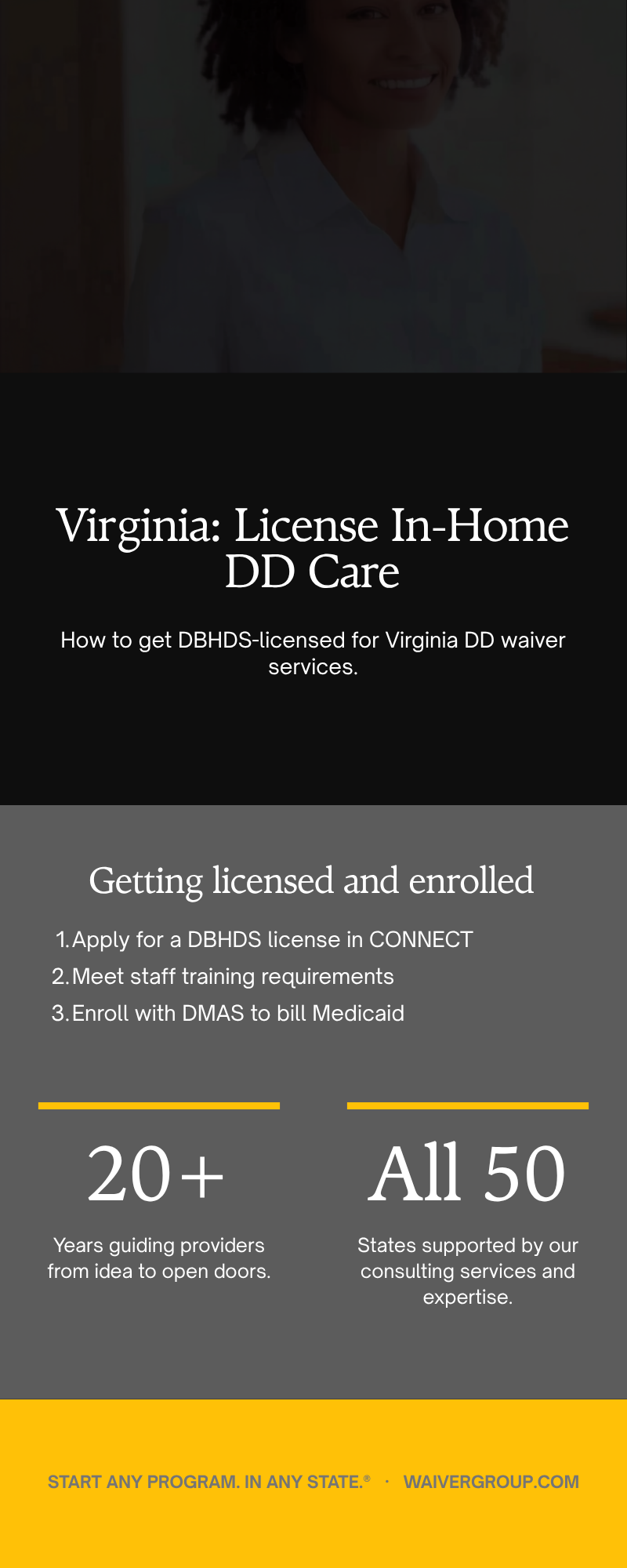
Key takeaway: In Virginia, get DBHDS-licensed through CONNECT for your specific in-home DD service, match the license type carefully, meet staff training standards, then enroll with DMAS to bill Medicaid.
Start Any Program. In Any State.®
20+ years clearing the path in all 50 states — we've done this before, and we'll do it for you. Book a video consultation at waivergroup.com/videoappointment · 302.888.9172 · [email protected].
Last verified: 2024. The information provided in this article is for educational purposes only and does not constitute legal or professional advice. Requirements for Medicaid waiver programs are subject to change. Always consult the official websites of the Department of Behavioral Health and Developmental Services (DBHDS) and the Department of Medical Assistance Services (DMAS) for the most current regulatory guidance.