VEHICLE MODIFICATION SERVICES PROVIDER IN NORTH CAROLINA
By Fatumata Kaba · 2025-09-15 · 5 min read
Enhancing Mobility and Accessibility Through Customized Vehicle Adaptations
Vehicle Modification Services in North Carolina provide essential adaptations to personal vehicles, enabling individuals with disabilities to travel safely and independently. By facilitating access to community-based activities, employment, and healthcare, these services are a critical component of North Carolina’s Home and Community-Based Services (HCBS) waiver programs, requiring specialized providers to manage complex technical and safety standards.
Understanding the Regulatory Framework and Oversight Agencies
The provision of vehicle modifications within the Medicaid framework is governed by a multi-layered structure of federal and state oversight. At the federal level, the Centers for Medicare & Medicaid Services (CMS) sets the standards for quality, safety, and person-centered care, ensuring that state-run waiver programs remain compliant with federal regulations. These guidelines ensure that modifications are medically necessary and contribute directly to the participant's independence.
Within North Carolina, the North Carolina Department of Health and Human Services (NCDHHS) serves as the primary entity responsible for administering waiver funding and overseeing the integrity of the provider network. Working in tandem, the North Carolina Division of Health Benefits (NC Medicaid) manages the operational aspects of service delivery and reimbursement, while the North Carolina Division of Vocational Rehabilitation Services (NCDVRS) provides specialized support when modifications are linked to employment goals. Providers must navigate these agencies to maintain compliance with both funding requirements and state-mandated safety protocols.
Core Scope of Vehicle Modification Services
Vehicle Modification Services encompass a comprehensive range of professional tasks designed to match a participant's functional requirements with appropriate mechanical and structural solutions. A compliant provider agency must move beyond simple installation, focusing instead on a holistic approach that includes initial needs assessment, custom engineering, and long-term maintenance of the adaptive equipment.
Approved providers are expected to deliver a standardized suite of services to ensure consistent outcomes for all participants. These services include:
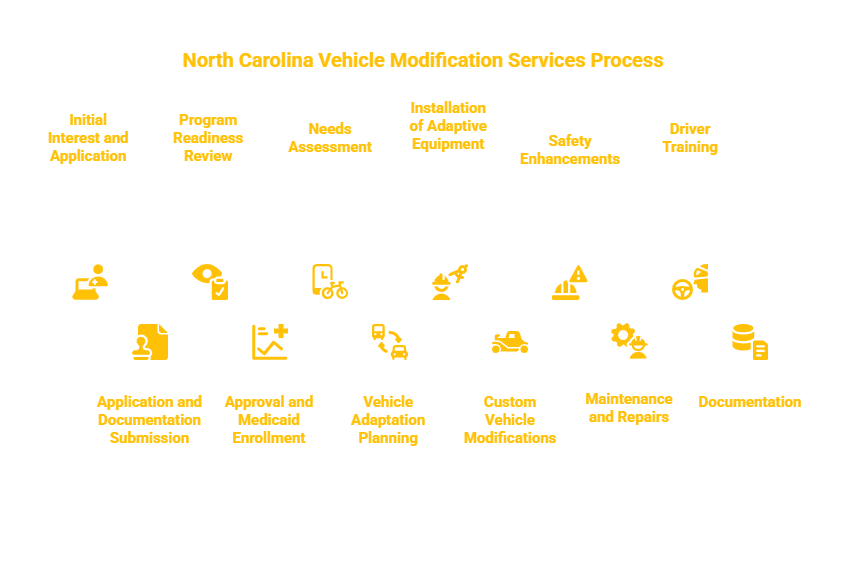
- Needs Assessment: Professional evaluation of mobility requirements and current functional capabilities.
- Vehicle Adaptation Planning: Designing modifications that align with the specific needs of the individual and the vehicle specifications.
- Installation of Adaptive Equipment: Technical integration of wheelchair lifts, hand controls, and specialized transfer seats.
- Custom Vehicle Modifications: Structural changes including lowered floors, ramp installation, and complex steering adaptations.
- Safety Enhancements: Implementation of harness systems, grab bars, and seatbelt adjustments to meet industry safety standards.
- Maintenance and Repairs: Providing ongoing support to ensure the long-term reliability and safety of the adaptive equipment.
- Driver Training: Instructing users and their caregivers on the safe operation and maintenance of the modified vehicle.
Establishing a Compliant Provider Agency in North Carolina
Launching a Medicaid-approved vehicle modification agency requires rigorous preparation, beginning with formal business formation. Prospective providers must register their entity with the North Carolina Secretary of State and secure necessary tax identifiers, including an IRS Employer Identification Number (EIN) and a Type 2 National Provider Identifier (NPI). This foundational step is critical for all future Medicaid billing and reporting activities.
Beyond initial registration, providers must develop an extensive internal infrastructure. This includes obtaining comprehensive general, professional, and vehicle modification-specific insurance policies to mitigate risks associated with automotive customization. Providers must also codify their operational protocols into a formal Policy & Procedure Manual. This document serves as the backbone of the organization, outlining internal standards for assessment, installation, safety documentation, and participant rights, all of which are subject to review during the state's readiness assessments.
The Provider Enrollment and Readiness Review Process
The pathway to becoming an authorized North Carolina Medicaid provider involves a structured sequence of applications managed primarily through the NCTracks Provider Portal. Agencies must submit all required business documentation, including Articles of Incorporation and detailed policy manuals. The accuracy of these initial submissions is paramount, as NCDHHS and NCDVRS utilize this information to evaluate the provider’s readiness to perform high-stakes modifications.
Following the submission of the application, the program readiness review phase begins. This is an intensive audit where the state evaluates the provider's physical capabilities, safety protocols, and staff credentials. Successful providers must demonstrate not only technical competence but also a clear understanding of Medicaid documentation standards, HIPAA compliance, and grievance procedures. Once these hurdles are cleared, the agency is formally enrolled and authorized to begin billing for approved services using specific Medicaid waiver codes.
Staffing, Training, and Quality Assurance
The safety of the participant depends entirely on the expertise of the staff executing the modifications. Consequently, agencies are expected to employ a qualified team led by a Vehicle Modification Program Director. This individual must possess the appropriate background in rehabilitation engineering, mechanical engineering, or healthcare administration to ensure that all technical and clinical decisions are sound and aligned with the participant’s care plan.
Technical staff, including Adaptation Specialists and Maintenance Technicians, must hold industry-recognized certifications and demonstrate ongoing competency. A robust internal training program is mandatory, covering not only the technical aspects of vehicle modification but also the legal requirements surrounding participant rights and HIPAA compliance. Agencies must maintain detailed personnel files that document background checks, training completions, and annual performance evaluations to remain in good standing with state regulators.
Frequently Asked Questions
What specific Medicaid waivers cover vehicle modifications in North Carolina?
Vehicle modification services are authorized under several state programs, including the Innovations Waiver, Community Alternatives Program for Disabled Adults (CAP/DA), Community Alternatives Program for Children (CAP/C), the Traumatic Brain Injury (TBI) Waiver, and the standard Home and Community-Based Services (HCBS) Waiver.
How long does the process typically take to become an active provider?
The launch timeline is generally structured into four phases, spanning several months. This includes 1–2 months for business formation, 2–3 months for hiring and program development, 60–90 days for the Medicaid readiness review, and 30–45 days for final billing setup and launch.
What documentation is essential for an audit?
Providers must maintain comprehensive records of all modifications. This includes the initial needs assessment, proof of insurance, signed safety inspection forms, staff training logs, and detailed invoices that reflect the specific adaptive equipment installed in compliance with Medicaid billing requirements.
Key Takeaway
Successfully operating as a North Carolina Medicaid vehicle modification provider requires a balance of mechanical precision, clinical understanding, and administrative rigor. Agencies that prioritize compliance, invest in certified staffing, and maintain disciplined documentation processes are best positioned to navigate the regulatory requirements of the NCDHHS and provide life-changing mobility solutions to the individuals served by the state's waiver programs.
WCG supports agencies in launching Medicaid-compliant Vehicle Modification Services in North Carolina, offering: Business registration, Medicaid enrollment, and licensing assistance; Policy manual development for adaptive vehicle modification and safety compliance; Staff credentialing, training program templates, and compliance documentation; Medicaid billing setup and audit-prepared financial management; Branding, website development, and client outreach strategies; Quality assurance systems for vehicle modification and compliance monitoring; and collaboration with rehabilitation engineers, healthcare providers, and community organizations.
Last verified: October 2023. Disclaimer: This information is for educational purposes and does not constitute legal or professional consulting advice. Regulations are subject to change; please consult the official North Carolina Department of Health and Human Services (NCDHHS) website and the NCTracks portal for the most current information.