TRANSPORTATION SERVICES PROVIDER IN WISCONSIN
By Fatumata Kaba · 2026-04-10 · 6 min read
Ensuring safe, reliable, and accessible transport for individuals to access essential medical, therapeutic, and community services.
Transportation services in Wisconsin are a critical component of the state’s long-term care infrastructure, enabling individuals with disabilities, chronic health conditions, and mobility limitations to maintain independence and community integration. By providing reliable access to medical appointments, employment sites, day programs, and social activities, these providers serve as a vital link in the continuity of care for participants enrolled in Wisconsin’s Medicaid programs and Home and Community-Based Services (HCBS) waivers.
To operate effectively in this sector, providers must navigate a complex regulatory environment involving the Wisconsin Department of Health Services (DHS), ForwardHealth, and various Managed Care Organizations (MCOs). Success requires not only a commitment to safety and accessibility but also a rigorous adherence to the documentation, licensing, and authorization protocols mandated by the participant’s Individualized Service Plan (ISP).
How is the transportation landscape governed in Wisconsin?
The provision of transportation services for Medicaid-eligible individuals is overseen by a structured hierarchy of state agencies and administrative entities. The Wisconsin Department of Health Services (DHS) serves as the primary regulatory body, establishing the overarching policies and guidelines for waiver-based programs. These programs include IRIS (Include, Respect, I Self-Direct), Family Care, Partnership, and the Children’s Long-Term Support (CLTS) Waiver.
Operational administration is further divided between specific entities to ensure program integrity. ForwardHealth manages the enrollment of providers and oversees reimbursements for state plan services. For specific medical appointments, the statewide Non-Emergency Medical Transportation (NEMT) benefit is administered by Medical Transportation Management, Inc. (MTM). Meanwhile, IRIS Consultant Agencies and Managed Care Organizations (MCOs) are responsible for the direct authorization of transportation services within the participant’s specific care plan.
- Wisconsin Department of Health Services (DHS): Policy oversight and waiver guideline administration.
- ForwardHealth: Provider enrollment and reimbursement oversight.
- IRIS Consultant Agencies / MCOs: Service authorization based on individual needs.
- Medical Transportation Management, Inc. (MTM): Administration of the NEMT benefit.
What are the core requirements for launching a transportation agency?
Establishing a compliant transportation business requires a methodical approach to legal and operational infrastructure. Before providing services, an agency must be properly registered with the Wisconsin Department of Financial Institutions (DFI) and possess a Federal Employer Identification Number (EIN). Furthermore, a Type 2 National Provider Identifier (NPI) is essential for billing purposes under the Medicaid framework.
Beyond the legal formation, agencies must invest in substantial risk management. This involves securing commercial vehicle insurance, implementing robust driver background check protocols, and ensuring all fleet vehicles comply with local and state standards. For providers offering wheelchair-accessible transport, strict adherence to ADA compliance is mandatory to ensure the safety and dignity of the participants served.
How does the provider enrollment process work?
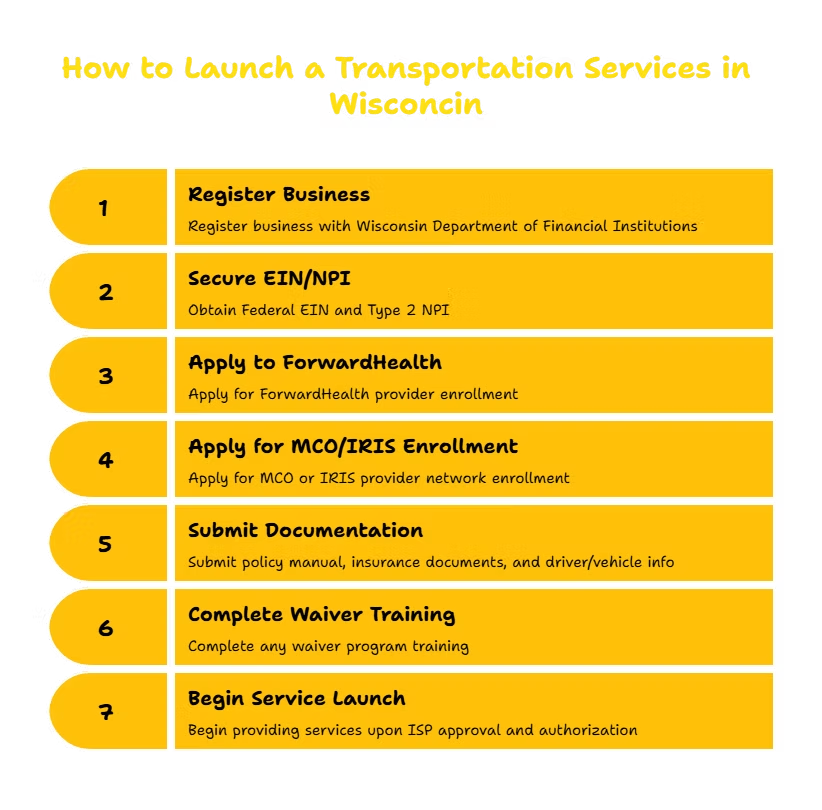
The enrollment process is a multi-stage journey that begins with establishing the business identity and concludes with active authorization in the provider network. Prospective providers must first secure their business credentials, including the EIN and NPI, before applying for enrollment through the ForwardHealth portal if they intend to serve Medicaid State Plan or CLTS Waiver participants.
Once the foundation is set, the provider must engage directly with MCOs or the IRIS program to join their respective provider networks. This phase requires the submission of comprehensive documentation, including detailed policy manuals, proof of insurance, and evidence of driver qualifications. Following any mandatory program-specific training, such as the IRIS Fiscal Employer Agent training, the provider may begin offering services once a participant's ISP has officially authorized the transportation request.
- Step 1: Business registration with the DFI and acquisition of EIN/NPI.
- Step 2: Application for ForwardHealth provider enrollment.
- Step 3: Network application to MCOs or the IRIS program.
- Step 4: Submission of mandatory policy manuals and insurance documentation.
- Step 5: Completion of required program training modules.
- Step 6: Commencement of services following formal ISP authorization.
What policies and documentation must be maintained for compliance?
Documentation is the backbone of Medicaid-compliant transportation services. Every agency is required to develop and maintain a comprehensive Transportation Services Policy & Procedure Manual. This document must clearly outline safety protocols, emergency procedures, vehicle maintenance schedules, and the specific processes for service requests and scheduling. It serves as the primary reference for staff during daily operations and is a critical document during state or MCO audits.
In addition to the policy manual, providers must maintain rigorous records for both staff and services. This includes detailed trip logs and mileage verification forms, which are necessary for billing accuracy and audit protection. Confidentiality procedures, particularly regarding HIPAA compliance, must be strictly enforced. Finally, all driver files must be kept current, containing documentation of valid licenses, medical certifications, and evidence of mandatory training sessions related to disability sensitivity and passenger assistance.
What are the essential staffing and training standards?
The quality of care provided is directly linked to the qualifications and training of the staff. Every driver must possess a valid Wisconsin driver’s license and demonstrate a clean driving record through ongoing background screenings. Because this workforce interacts with vulnerable populations, it is standard practice to mandate CPR/First Aid certification and specific training regarding abuse prevention and incident reporting.
Specialized training is a prerequisite for drivers handling wheelchair-accessible vehicles. This training must cover securement techniques, vehicle safety, and the mechanical operation of lifts or ramps. Additionally, all employees must be trained in HIPAA compliance to protect participant health information. Regular audits of these training logs are required to ensure the agency remains in good standing with state and waiver program requirements.
Frequently Asked Questions
Can a transportation provider bill both MTM and a waiver program for the same trip?
No. Transportation services must not duplicate NEMT services covered by MTM. If a trip is intended for a medical appointment covered under the NEMT benefit, it must be routed through MTM. Waiver-based transportation is reserved for services, such as community integration or employment support, that fall outside the scope of the standard medical transportation benefit and are explicitly documented in the participant's ISP.
How long should an agency expect the enrollment process to take?
The timeline varies based on the completeness of documentation and the responsiveness of the agencies involved. Generally, the phase of business registration and policy development takes 2–3 weeks, followed by 30–45 days for driver hiring and vehicle setup. Enrollment into Medicaid, MCO, or IRIS networks can take between 1 to 3 months. Services can only commence once all approvals and plan authorizations are secured.
What specific documentation is required for each trip?
Every trip must be supported by a trip verification form or log. This documentation should include the date and time of the trip, the point of origin and destination, the purpose of the trip, and verification (such as a signature) from the participant or the service provider at the destination. These logs must be archived to support billing claims and to facilitate potential audits by the DHS or MCOs.
WCG provides specialized assistance for agencies and solo providers aiming to navigate the complexities of Wisconsin’s Medicaid transportation requirements. Services include the development of robust Transportation Services P&P Manuals, guidance on ForwardHealth and waiver enrollment, and the creation of standardized trip logs, mileage forms, and incident reporting systems to ensure audit-ready compliance.
Key Takeaway: To successfully operate as a transportation provider in Wisconsin, one must maintain a strict separation between NEMT-covered medical transport and waiver-authorized community services, while ensuring all operational, insurance, and training documentation is meticulously tracked to meet state and MCO standards.
Last verified: 05/22/2024. This content is for informational purposes only and does not constitute legal or professional advice. Requirements for Medicaid waiver programs are subject to change; please consult the official Wisconsin Department of Health Services (DHS) and ForwardHealth portals for the most current regulatory updates.