TRANSPORTATION SERVICES PROVIDER IN TEXAS
By Fatumata Kaba · 2026-03-30 · 5 min read
Transportation services for individuals enrolled in Medicaid and Home and Community-Based Services (HCBS) waiver programs are essential components of the Texas social services infrastructure, enabling participants to access critical medical care, employment, and community integration. Providers in this sector operate under the regulatory framework of the Texas Health and Human Services Commission (HHSC) and the Texas Medicaid & Healthcare Partnership (TMHP) to facilitate reliable, safe transit for those with disabilities or chronic health conditions.
Establishing a transportation services provider agency in Texas requires navigating complex state and federal mandates, including specific licensing, insurance, and operational safety protocols. By understanding the distinction between Non-Emergency Medical Transportation (NEMT) and waiver-funded transportation, providers can effectively align their business models with state requirements to support the independence of the populations they serve.
Navigating the Regulatory Landscape of Texas Transportation Services
Transportation in Texas for Medicaid-eligible individuals is governed by several oversight bodies, primarily the Texas Health and Human Services Commission (HHSC). The HHSC manages Medicaid policy, authorizes transportation as a specific waiver service, and provides the necessary administrative structure for program implementation. For NEMT services, the Medical Transportation Program (MTP) coordinates access through designated regional brokers, such as Modivcare and Access2Care, which function independently from individual waiver-funded transportation providers.
At the federal level, the Centers for Medicare & Medicaid Services (CMS) oversees the broader regulations that apply to Medicaid transportation, ensuring that services remain compliant with federal HCBS standards. Providers must demonstrate strict adherence to these regulatory layers, as failure to comply with documentation or safety standards can result in the revocation of authorization to provide services within the waiver network.
Defining Scope of Service and Participant Access
Transportation services are designed to bridge the gap between home and essential community resources. For a participant to utilize these services, the transportation must be explicitly authorized in their Individual Plan of Care (IPC). This ensures that services are medically necessary or essential for the individual to remain in the community, rather than being institutionalized.
- Medical appointments including visits to doctors, dentists, and specialized therapists.
- Attendance at day habilitation centers or structured community programs.
- Transit to employment sites, job interviews, or vocational training sessions.
- Accessing Medicaid waiver service locations and local pharmacy pickups.
- Essential errands authorized within the specific scope of the participant’s care plan.
Providers may offer various types of transit based on the participant's physical and support needs. These can range from standard door-to-door transportation to specialized services involving lift-equipped vans for mobility devices. In some instances, agencies may provide accompaniment support for riders who require supervision or assistance during the trip. Alternatively, mileage reimbursement may be utilized if a participant or family member manages the transport, provided it follows the approved billing guidelines.
Establishing Your Agency and Licensing Requirements
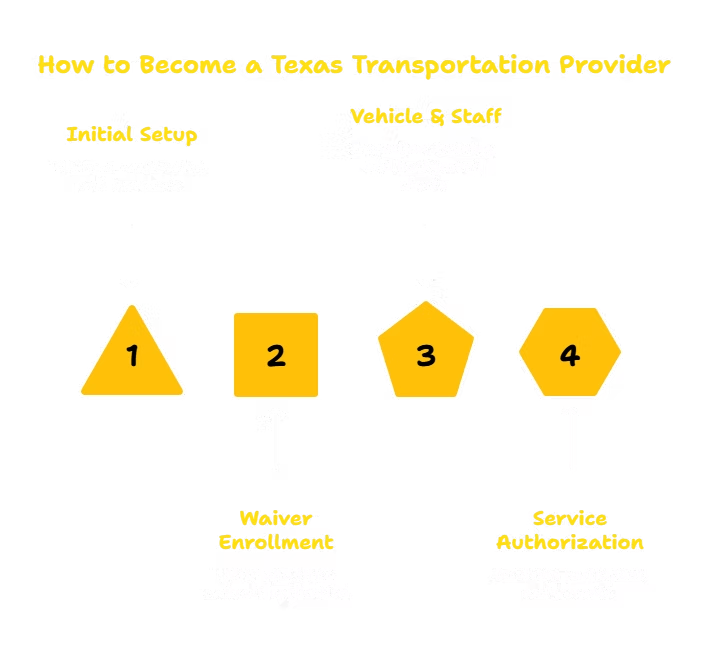
The journey toward becoming a Medicaid waiver transportation provider begins with formal legal and commercial registration. Before an agency can apply for contracts with the state, it must establish a legal entity with the Texas Secretary of State and secure a federal Employer Identification Number (EIN). Furthermore, a Type 2 National Provider Identifier (NPI) is essential for billing purposes under the Medicaid system.
Operational prerequisites are rigorous, reflecting the high standards required for transporting vulnerable populations. These include:
- Enrollment with the Texas Medicaid & Healthcare Partnership (TMHP) to facilitate claims and payments.
- Securing comprehensive commercial auto insurance, general liability, and workers’ compensation coverage.
- Compliance with Texas Department of Motor Vehicles (TxDMV) regulations regarding commercial vehicle registration.
- Developing a comprehensive Transportation Services Policy & Procedure Manual that covers safety, HIPAA compliance, and incident reporting.
The Enrollment and Readiness Review Process
Once the legal foundation is laid, providers must transition through the structured enrollment pathway. This involves submitting applications for specific waiver contracts through the HHSC, such as HCS (Home and Community-based Services), CLASS (Community Living Assistance & Support Services), or TxHmL (Texas Home Living). The agency must then demonstrate readiness through documentation of vehicle integrity, driver qualifications, and internal administrative controls.
The final phase involves a readiness review, where the state verifies that the agency can reliably execute services. This includes ensuring all administrative logs, trip reporting mechanisms, and emergency protocols are in place. Upon successful review and approval, the agency is authorized to begin accepting transport requests for participants whose plans of care include transportation services, strictly adhering to the schedules and goals established by the participant's service coordinator.
Staffing, Training, and Operational Safety
High-quality transportation service is dependent on the caliber and preparedness of agency staff. Drivers and transportation aides must be at least 21 years of age and possess a clean driving record, complemented by certifications in CPR and First Aid. Beyond driving, these personnel act as the frontline of care, often requiring training in defensive driving, passenger lift safety, and the specific physical support needs of the clients they serve.
Administrative staff, including dispatchers and program managers, are equally vital for maintaining the flow of services. Their responsibilities include scheduling, routing, and maintaining precise documentation of trip logs and mileage reports. All employees, regardless of role, must undergo mandatory training sessions on the following topics:
- HIPAA privacy standards and the protection of client information.
- Abuse and neglect prevention and reporting protocols.
- ADA-compliant vehicle operation and passenger assistance techniques.
- Emergency evacuation and incident response procedures.
- Professional communication with service coordinators and family members.
Frequently Asked Questions
What is the difference between NEMT and waiver-funded transportation?
Non-Emergency Medical Transportation (NEMT) is a broad benefit managed by MTP brokers for basic medical transport. In contrast, waiver-funded transportation is a specific support service listed in a participant's IPC (such as in HCS or CLASS), intended for community integration, vocational access, and ongoing daily support needs.
Can any transportation provider bill for Medicaid services?
No. A provider must be specifically contracted with the HHSC and enrolled through TMHP for the relevant waiver program. Only authorized providers who have completed the credentialing and readiness review process are eligible to receive reimbursement for these services.
What documentation must be kept for audit purposes?
Providers must maintain comprehensive records including, but not limited to, driver background checks, commercial insurance policies, vehicle safety inspection certificates, and detailed trip logs that verify the date, duration, destination, and the authorized participant who received the service.
Key Takeaway
Succeeding as a transportation services provider in Texas requires a commitment to administrative excellence, stringent vehicle safety, and a deep understanding of the HHSC and TMHP regulatory environment. By prioritizing the development of robust policy manuals, staff training programs, and meticulous record-keeping, agencies can ensure long-term compliance and provide essential support to the Medicaid waiver population.
Last verified: October 2023. Disclaimer: This information is for educational purposes only and does not constitute legal or professional advice. Always consult with the Texas Health and Human Services Commission (HHSC) or a qualified consultant to ensure full compliance with the most current state and federal regulations.