TRANSPORTATION SERVICES PROVIDER IN TENNESSEE
By Fatumata Kaba · 2025-10-22 · 5 min read
Becoming a transportation services provider in Tennessee is a vital step toward supporting individuals with disabilities and health needs in accessing essential medical care, community programs, and employment opportunities. By operating as a Medicaid-approved vendor, your agency plays a critical role in facilitating the non-emergency medical transportation (NEMT) and waiver-based community supports necessary for participants to maintain their health and independence.
To succeed in this sector, providers must navigate the intersection of TennCare requirements, the Department of Intellectual and Developmental Disabilities (DIDD) standards, and the operational demands of the various Medicaid waiver programs. This guide outlines the regulatory framework, essential documentation, and systematic steps required to establish and maintain a compliant transportation service entity in the Tennessee market.
1. Understanding the Regulatory Landscape and Agency Roles
Transportation services for TennCare members are divided into two distinct delivery models: the State Plan-covered NEMT system and the waiver-based community support system. Understanding which agency governs your specific service area is the first step in compliance. TennCare, the state’s Medicaid agency, maintains the overall authority for program administration, while the Department of Intellectual and Developmental Disabilities (DIDD) oversees the specialized transportation needs embedded within the Individual Support Plans (ISPs) for waiver participants.
The Centers for Medicare & Medicaid Services (CMS) sets the national standards for how these funds must be utilized, ensuring that transportation remains a safe and necessary support for habilitation and medical access. For routine NEMT, TennCare utilizes a brokerage model, most notably through ModivCare (formerly LogistiCare), which manages the scheduling and dispatching of trips for medical appointments across the state.
- TennCare: Administers the overall Medicaid program and coordinates with MCOs to ensure access to covered transportation.
- DIDD: Oversees waiver-specific transportation, ensuring that rides are appropriately integrated into the participant's ISP.
- CMS: Provides the federal regulatory framework and reimbursement guidelines for all Medicaid-funded transport services.
- ModivCare: Acts as the primary broker for TennCare State Plan NEMT, managing routine physician and clinic trip assignments.
2. Defining Service Categories and Scope of Support
Providers must distinguish between NEMT and Community-Based Transportation, as the eligibility requirements, authorization pathways, and reimbursement structures differ significantly between the two. NEMT is strictly medical in nature, focusing on getting participants to and from physician offices, dialysis centers, and other clinical facilities. In contrast, waiver-based transportation is designed to promote community integration, covering transit to day programs, vocational settings, and social activities identified in a participant's care plan.
Beyond standard rides, providers often offer specialized services that require higher levels of staff training and vehicle outfitting. This may include providing transportation with trained staff who remain with the participant, wheelchair-accessible van services, or, in certain waiver contexts, mileage reimbursement structures for family or informal caregivers. Each of these service types must be documented accurately to ensure eligibility for Medicaid reimbursement.
3. Establishing a Compliant Provider Agency
Before service delivery can commence, an agency must meet foundational business and safety prerequisites. The business must be formally registered with the Tennessee Secretary of State and hold all necessary state-level tax identifiers, including an Employer Identification Number (EIN) and a Type 2 National Provider Identifier (NPI). This organizational structure serves as the bedrock for all future contract applications with Managed Care Organizations (MCOs) and the DIDD.
Safety is the primary focus of the regulatory review process. Each vehicle in your fleet must be inspected to meet strict accessibility and safety standards, and all drivers must undergo comprehensive background screenings and mandatory training modules. Developing a robust Policy & Procedure Manual is not merely a formality; it is an essential tool for documenting your agency’s adherence to HIPAA, safety protocols, and participant rights. This document must be kept current to reflect both internal operations and evolving state regulations.
4. The Enrollment and Credentialing Process
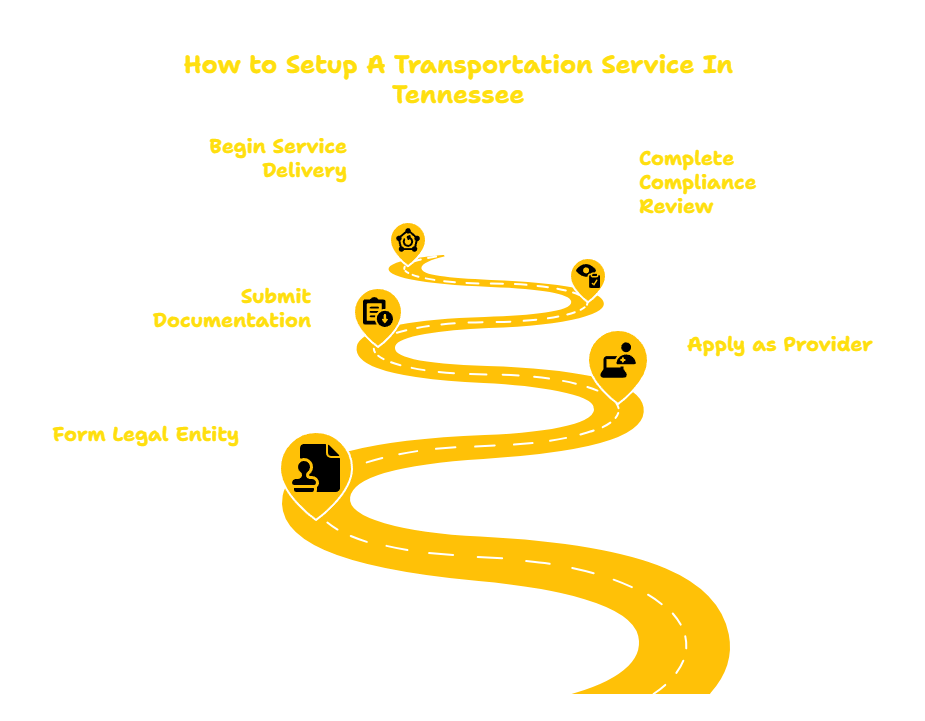
The transition from a business entity to an active Medicaid provider requires a multi-step enrollment sequence. The process typically begins by submitting a formal application to the appropriate TennCare MCOs or the DIDD depending on the population you intend to serve. Because the application involves verifying both administrative capacity and physical fleet readiness, providers should expect a thorough vetting process that evaluates their preparedness to handle vulnerable populations safely.
The timeline to launch is generally segmented into three distinct phases: initial business formation and fleet acquisition (1-2 months), formal enrollment and credentialing with state agencies (2-3 months), and final staff onboarding and vehicle inspections (30-60 days). Once these milestones are met and the provider is fully activated, they can begin receiving and fulfilling service authorizations derived from participant ISPs or, in the case of NEMT, through broker-managed assignments.
5. Essential Documentation and Staffing Requirements
Documentation is the core of Medicaid compliance. At a minimum, every driver must maintain a clean Motor Vehicle Record (MVR), possess current CPR/First Aid certification, and provide evidence of completed abuse prevention training. For the fleet, the agency must maintain consistent logs for maintenance, insurance verification, and detailed ride records that include trip start and end times, mileage, and participant signatures where required.
Staffing also plays a pivotal role in maintaining service quality. If an agency operates on a larger scale, a designated Transportation Coordinator is recommended to manage the complexities of dispatching, scheduling, and ensuring that no-show or cancellation policies are handled in accordance with contract terms. Should a participant require extra support beyond simple transport, an attendant or aide may be required, necessitating additional background clearances and training in behavioral management or mobility assistance.
6. Frequently Asked Questions
What is the difference between NEMT and Waiver-Based transportation?
NEMT is primarily for non-emergency medical appointments covered under the TennCare State Plan and is often coordinated by a broker like ModivCare. Waiver-based transportation is specific to ECF CHOICES or 1915(c) waiver participants, focusing on activities outlined in an Individual Support Plan, such as day programs and community employment.
What are the primary vehicle requirements for new providers?
Providers must ensure all vehicles are properly registered, insured, and undergo periodic safety and accessibility inspections. If providing wheelchair-accessible transportation, the vehicle must be equipped with functioning lifts or ramps that meet ADA standards and are checked regularly for mechanical safety.
Do all drivers need the same level of training?
All drivers must complete state-mandated training, which typically includes abuse prevention, HIPAA compliance, emergency response procedures, and documentation practices. If a driver is designated to serve participants with specific behavioral or physical support needs, additional specialized training is required to ensure the participant's safety during transit.
Key Takeaway: Successfully navigating the Tennessee transportation provider market requires a disciplined approach to regulatory compliance, rigorous staff and vehicle vetting, and a clear understanding of the distinct operational differences between NEMT brokers and waiver-based program requirements. By prioritizing safety documentation and administrative readiness, providers can effectively bridge the gap between participants and the essential community and medical services they rely on.
Last verified: 2024. This information is provided for educational purposes and does not constitute legal or professional advice. Always refer to the official TennCare, DIDD, and CMS policy manuals for the most current regulatory requirements, as state and federal guidelines are subject to periodic change.