TRANSPORTATION SERVICES PROVIDER IN PENNSYLVANIA
By Fatumata Kaba · 2025-10-08 · 5 min read
Transportation services for Medicaid waiver participants in Pennsylvania serve as a critical bridge between vulnerable individuals and the essential services required to maintain their health and independence. By facilitating access to medical care, community programs, and employment sites, transportation providers play a vital role in preventing social isolation and ensuring compliance with care plans managed by the Department of Human Services (DHS) and its affiliated programs.
Operating as a transportation provider in Pennsylvania requires navigating a complex regulatory landscape that involves both state-level utility oversight and federal Medicaid compliance. From securing Public Utility Commission (PUC) authority to enrolling in the PROMISe™ system and contracting with Managed Care Organizations (MCOs), providers must demonstrate rigorous operational standards, safety protocols, and administrative readiness to successfully serve the HCBS waiver population.
How Does the Pennsylvania Medicaid Transportation Regulatory Structure Work?
The Pennsylvania transportation landscape is defined by a multi-layered regulatory framework designed to ensure participant safety and fiscal accountability. The Department of Human Services (DHS) serves as the primary oversight body, coordinating funding and service delivery through the Office of Long-Term Living (OLTL) and the Office of Developmental Programs (ODP). These offices ensure that transportation services are integrated into an individual’s person-centered service plan.
Complementing state agency oversight, the Pennsylvania Public Utility Commission (PUC) acts as the primary regulatory authority for the actual operation of vehicles for compensation. Providers must obtain the appropriate Class B, C, or D PUC operating authority, which dictates the type of service and vehicle capacity permitted. Furthermore, the Medical Assistance Transportation Program (MATP) provides an essential safety net for Medicaid members who are not enrolled in Community HealthChoices (CHC), ensuring that even those outside the managed care structure have access to non-emergency medical transportation.
- Department of Human Services (DHS): Oversees OLTL and ODP waiver funding and service plan integration.
- CHC Managed Care Organizations (MCOs): Handle authorization and reimbursement for transportation services for CHC members.
- Public Utility Commission (PUC): Manages the licensing and regulatory requirements for for-hire transportation operations.
- Centers for Medicare & Medicaid Services (CMS): Sets federal compliance standards for Medicaid-funded service delivery.
What Are the Essential Requirements for Provider Enrollment?
To begin operations, a provider must establish a formal business entity and satisfy all state and federal registration mandates. This includes obtaining a Federal Employer Identification Number (EIN) and a Type 2 National Provider Identifier (NPI). These identifiers are the foundation of the billing and administrative processes necessary for PROMISe™ enrollment, which is the mandatory portal for Medicaid service providers in Pennsylvania.
Beyond administrative registration, providers must develop comprehensive Policy & Procedure Manuals that outline every aspect of their operations. These manuals are not merely compliance documents; they serve as the operational guide for staff regarding routing, billing, HIPAA compliance, and client safety. Furthermore, maintaining robust commercial liability, vehicle, and workers’ compensation insurance is a mandatory prerequisite that must be demonstrated prior to service delivery and updated regularly to remain in good standing with oversight agencies.
What Steps Are Necessary to Launch a Transportation Agency?
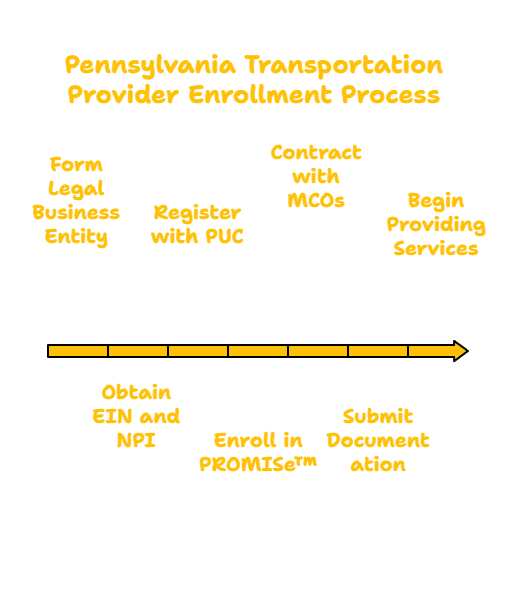
Launching a Medicaid-authorized transportation agency is a phased process that typically spans several months. The initial phase focuses on business formation and the creation of foundational operational documentation. This includes establishing the legal entity, securing the necessary PUC certificates, and drafting the policies that will govern daily driver interactions, vehicle maintenance logs, and incident reporting procedures.
Once the business is legally structured and the policies are in place, the focus shifts to the technical enrollment phase. This involves enrolling in the PROMISe™ system and actively pursuing contracts with CHC MCOs or ODP Administrative Entities (AEs). Contracting is a critical step, as it establishes the billing relationship and defines the parameters for service authorization. Only after these contracts are executed and staff credentials—including background checks and specialized training—have been verified can a provider begin accepting trip authorizations.
- Phase 1: Form legal entity, obtain EIN/NPI, and finalize insurance coverage.
- Phase 2: Secure PUC operating authority and develop the required Policy & Procedure Manual.
- Phase 3: Enroll in the PROMISe™ portal to gain Medicaid billing status.
- Phase 4: Negotiate and execute service contracts with CHC MCOs or ODP AEs.
- Phase 5: Recruit, train, and credential staff while finalizing vehicle safety inspections.
How Do Providers Manage Documentation and Compliance?
Documentation is the backbone of Medicaid reimbursement. For transportation services, agencies must maintain detailed, real-time records that substantiate every trip provided. This includes comprehensive trip logs that document pickup and drop-off times, mileage, the purpose of the trip, and the participant’s authorization for the service. Because these services are Medicaid-funded, audits are a standard part of the business environment; therefore, documentation must be precise, organized, and easily retrievable.
Beyond trip logs, providers must maintain rigorous records regarding staff and vehicle maintenance. Driver files must contain current, clean driving records, documentation of completed background checks, and certificates for specialized training such as wheelchair securement and defensive driving. Vehicle files must document regular safety inspections, routine maintenance logs, and proof of proper insurance coverage. Failure to maintain these records can result in denied claims or the revocation of provider status.
Frequently Asked Questions
Is PUC certification required if I am only providing non-emergency medical transportation?
Yes. If you are operating a transportation business for compensation in Pennsylvania, you must secure the appropriate PUC operating authority regardless of the nature of the passenger's medical appointment. The PUC regulates the safety and fitness of all carriers operating for-hire vehicles.
Can transportation providers assist participants during the trip?
Yes, providers may offer escort support if it is authorized in the participant’s care plan. This service involves a staff member accompanying the rider to assist with supervision or specific mobility or cognitive needs during the journey.
How does a provider get reimbursed for services?
Reimbursement is managed through the CHC MCOs or the state’s Medicaid system once a provider is enrolled in PROMISe™ and has secured an active contract. Providers submit claims for authorized trips based on the contracted rates and billing protocols established by the specific MCO or state agency overseeing the individual’s waiver program.
Key Takeaway
Successfully operating as a Medicaid transportation provider in Pennsylvania requires a dual commitment to regulatory compliance and reliable, compassionate service delivery. By strictly adhering to the standards set forth by the PUC, DHS, and contracted MCOs, providers can build sustainable businesses that bridge critical service gaps for individuals with disabilities and aging-related needs, ultimately fostering greater autonomy and community integration for the participants they serve.
Waiver Consulting Group provides specialized assistance to transportation providers, helping agencies navigate the complex landscape of Pennsylvania Medicaid enrollment, PUC certification, and compliance readiness. Our services cover the full spectrum of startup requirements, from drafting comprehensive Policy & Procedure Manuals to providing staff onboarding toolkits and contracting support. By leveraging professional guidance, providers can ensure their documentation, fleet management, and operational protocols meet the high standards required to maintain ongoing authorization within the HCBS waiver ecosystem.
Last verified: 2024. The information provided is for educational purposes only and does not constitute legal or financial advice. Consult with the Pennsylvania Department of Human Services, the Public Utility Commission, and qualified legal counsel to ensure your business operations comply with current state and federal regulations.