TRANSPORTATION SERVICES PROVIDER IN OREGON
By Fatumata Kaba · 2025-10-06 · 6 min read
Transportation services for Medicaid members in Oregon serve as a critical bridge, enabling individuals with disabilities, chronic health conditions, and mobility limitations to access essential medical care, gainful employment, and meaningful community integration. By operating as an approved Medicaid transportation provider, agencies play a vital role in supporting the Oregon Health Plan (OHP) and Home and Community-Based Services (HCBS) initiatives. This guide outlines the regulatory framework, enrollment requirements, and operational standards necessary for agencies looking to provide reliable, compliant transportation solutions across the state.
What Are the Governing Agencies and Regulatory Roles in Oregon?
The provision of transportation for Medicaid members in Oregon is governed by a multi-layered regulatory environment. Understanding these agencies is essential for compliance and maintaining good standing as a provider. At the state level, the Oregon Health Authority (OHA) oversees the Oregon Health Plan and is responsible for the management of Non-Emergency Medical Transportation (NEMT) brokers, who act as the intermediaries for medical appointment-related rides.
For community-based transportation, the Oregon Department of Human Services (ODHS)—specifically the Aging and People with Disabilities (APD) and Developmental Disabilities Services (DDS) divisions—holds primary authority. These departments manage the Individual Support Plans (ISP) that authorize specific transportation supports under various HCBS waivers. Additionally, providers must navigate requirements set by the Oregon Secretary of State (SOS) for business formation, the Oregon Department of Transportation (ODOT) for safety and vehicle standards, and federal oversight provided by the Centers for Medicare & Medicaid Services (CMS).
- Oregon Health Authority (OHA): Administers the Oregon Health Plan and oversees NEMT brokers and billing systems.
- Oregon Department of Human Services (ODHS): Authorizes community-based transportation under HCBS Waivers and the K Plan.
- Centers for Medicare & Medicaid Services (CMS): Provides federal oversight for Medicaid-funded programs.
- Oregon Secretary of State (SOS): Manages business registration and corporate compliance.
- Oregon Department of Transportation (ODOT): Regulates vehicle inspections and driver safety requirements.
How Do Providers Distinguish Between NEMT and HCBS Transportation?
Operational success in this sector requires a clear understanding of the two primary service delivery models: Non-Emergency Medical Transportation (NEMT) and Community-Based HCBS transportation. NEMT is specifically designed to get members to and from Medicaid-covered medical appointments. These rides are typically facilitated through regional brokers who manage the dispatching, routing, and verification of medical eligibility for the trip.
Conversely, Community-Based HCBS transportation is integrated into the individual’s long-term care plan. This type of transport is focused on social determinants of health and quality of life, covering travel to work, day programs, or community activities. While NEMT is appointment-driven and often high-volume, HCBS transportation is authorized via the ISP and focuses on consistent access to the person’s chosen community life. Providers must ensure their internal systems can track these distinct authorization types, as billing codes and requirements often vary between them.
What Are the Essential Steps for Provider Enrollment?
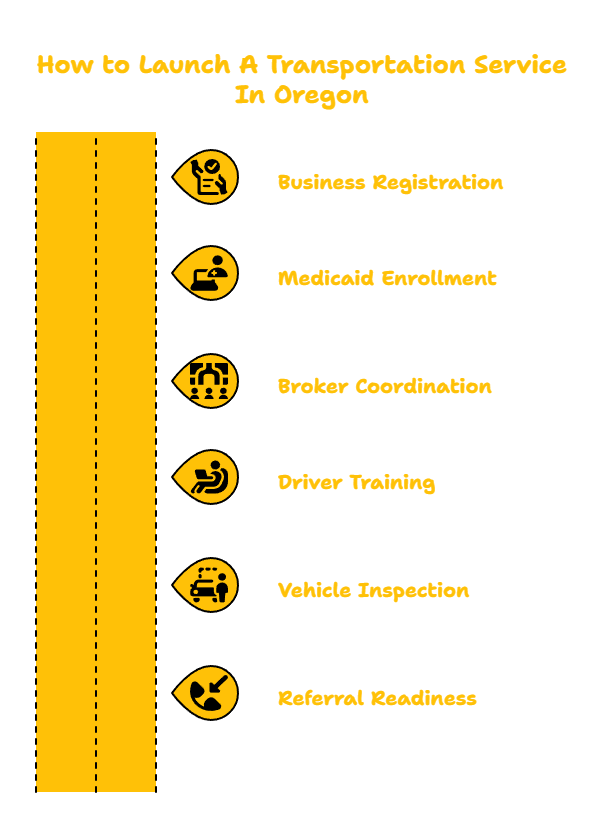
The enrollment process is a sequential journey that begins with establishing a legally sound business entity. Prospective providers must first register with the Oregon Secretary of State and secure a federal Employer Identification Number (EIN). Once the entity is formed, the business must apply for a Type 2 National Provider Identifier (NPI), which is required for all organizational billing within the Medicaid system.
Once registered, the provider must enroll with the Oregon Health Authority via their provider portal. For those targeting HCBS community-based work, it is necessary to coordinate closely with local Community Developmental Disabilities Programs (CDDPs) or case managers. Because referrals often originate from these local contacts, establishing a presence at the community level is as important as the administrative enrollment itself. Finally, all providers must demonstrate compliance by completing vehicle inspections, driver background checks, and securing the appropriate commercial auto and general liability insurance policies.
- Register the business with the Oregon Secretary of State.
- Secure an EIN from the IRS and a Type 2 NPI.
- Enroll as a Medicaid transportation provider through the OHA portal.
- Obtain approval through ODHS/DD or APD for HCBS-specific services.
- Ensure all vehicles pass safety inspections and drivers meet all training mandates.
What Documentation Is Required for Ongoing Compliance?
Medicaid audits require meticulous record-keeping. To remain in compliance, an agency must maintain a comprehensive Transportation Services Policy & Procedure Manual that covers every aspect of daily operations. This manual should serve as the source of truth for your staff and auditors, detailing everything from HIPAA-compliant data handling to the specific protocols for emergency response.
Required documentation includes active business licenses, proof of insurance, and detailed driver files, which must contain DMV records, background check results, and evidence of mandatory trainings such as CPR and First Aid. Furthermore, for each trip provided, the agency must maintain accurate trip logs. These logs must capture pick-up and drop-off times, mileage, and specific authorization details to support Medicaid billing claims and prevent clawbacks during a desk review or onsite audit.
What Are the Staffing and Training Mandates for Drivers?
The caliber of the driver is the most significant factor in the quality of service and the safety of the Medicaid member. Agencies must verify that every driver holds a valid license and maintains a clean driving record. Beyond basic driving competence, staff members—including dispatchers and program managers—must receive specific training to ensure they can meet the diverse needs of the populations they serve.
Training should include, at a minimum, HIPAA and confidentiality protocols to protect member privacy, defensive driving courses, and instruction on how to handle potential incidents during transport. For agencies providing transport to individuals with physical disabilities, staff must be proficient in the operation of lifts, ramps, and wheelchair securement systems. Annual training updates are a standard expectation to ensure that skills remain sharp and that the agency stays abreast of any changes to state or federal transportation regulations.
Frequently Asked Questions
Is it possible to provide both NEMT and HCBS transportation?
Yes, many agencies provide both, provided they meet the distinct enrollment and regulatory requirements for each. You must maintain separate systems for tracking medical-related trips (coordinated via NEMT brokers) and community-based trips (coordinated via local case managers or ISP authorizations).
What type of insurance coverage is mandatory for providers?
While requirements can vary based on individual program contracts, providers generally need robust commercial auto insurance, general liability, and workers’ compensation insurance. It is advised to consult with an insurance broker familiar with medical transport to ensure your policy limits meet the state’s contractual thresholds.
How are ride requests typically managed?
NEMT rides are typically coordinated through regional brokers like ModivCare or RideToCare, where requests come through a centralized platform. Community-based HCBS rides are usually scheduled directly with the provider by the member, their family, or their assigned case manager, according to the approved Individual Support Plan.
Key Takeaway
Becoming an approved Medicaid transportation provider in Oregon requires a rigorous commitment to administrative accuracy, safety, and regulatory compliance. By aligning your business operations with the guidelines set by the Oregon Health Authority and the Department of Human Services, you position your organization to provide essential, reliable, and high-quality services to those in the community who need them most. Focus on developing a comprehensive policy manual and fostering strong professional relationships with local case managers and brokers to ensure a sustainable and compliant launch.
Last verified: October 2023. This information is intended for educational purposes and does not constitute legal or professional advice. Always verify current state regulations and policy requirements directly through the Oregon Health Authority and the Department of Human Services official websites prior to making business decisions.