TRANSPORTATION SERVICES PROVIDER IN NEBRASKA
By Fatumata Kaba · 2025-08-08 · 5 min read
Becoming a transportation services provider in Nebraska involves navigating a structured regulatory framework designed to ensure safe, reliable mobility for individuals enrolled in Medicaid Home and Community-Based Services (HCBS) waivers. By facilitating access to medical care, vocational training, and community engagement, transportation providers play a critical role in the state's long-term care infrastructure and participant independence.
To successfully operate, agencies must demonstrate full compliance with the Nebraska Department of Health and Human Services (DHHS) and the Nebraska Medicaid and Long-Term Care (MLTC) Division. This process requires a meticulous approach to business licensing, vehicle safety standards, and rigorous administrative record-keeping to meet both state and federal oversight requirements.
What Are the Governing Agencies and Regulatory Requirements?
The delivery of transportation services within Nebraska’s HCBS waiver programs is governed by a tripartite structure of oversight. The Nebraska Department of Health and Human Services (DHHS) serves as the primary entity responsible for administering waiver funding, managing provider enrollment, and overseeing service authorization and reimbursement. Working in tandem, the Nebraska Medicaid and Long-Term Care (MLTC) Division focuses on the front-line enforcement of quality standards, service delivery protocols, and overall program compliance.
At the federal level, the Centers for Medicare & Medicaid Services (CMS) provides the overarching regulatory framework. CMS ensures that all Medicaid-funded transportation services adhere to federal guidelines regarding person-centered planning, participant protections, and the maintenance of health and safety standards. Providers must remain cognizant that compliance is not a static state but an ongoing commitment to the evolving policies mandated by these three agencies.
What Services Can Be Provided Under Nebraska Medicaid Waivers?
Transportation services are designed to address the specific mobility needs identified within a participant’s Individualized Service Plan (ISP). These services are not merely "rides," but essential support mechanisms that enable participants to live independently in their communities. Approved providers are authorized to deliver a broad spectrum of assistance tailored to the unique requirements of the individual.
Core service offerings under these waivers generally include:
- Non-Emergency Medical Transportation (NEMT): Facilitating access to medical appointments, therapeutic sessions, and pharmaceutical services.
- Community Access Transportation: Supporting social inclusion by providing rides to community activities, local events, and peer support groups.
- Essential Errands: Assisting with necessary daily tasks, such as grocery shopping and banking.
- Employment Transportation: Ensuring participants have reliable transit to vocational training or competitive employment sites.
- Specialized Transport: Utilizing vehicles specifically equipped for wheelchair access and mobility-challenged passengers.
- Accompaniment Services: Providing staff support during the transit process to ensure the physical safety and emotional well-being of the participant.
How Do You Navigate the Provider Enrollment Process?
The path to becoming an approved provider begins with establishing a formal business entity registered with the Nebraska Secretary of State. Once the business is established, the agency must secure a federal Employer Identification Number (EIN) and a Type 2 National Provider Identifier (NPI). These identifiers are foundational for all billing and administrative interactions with the state’s Medicaid system.
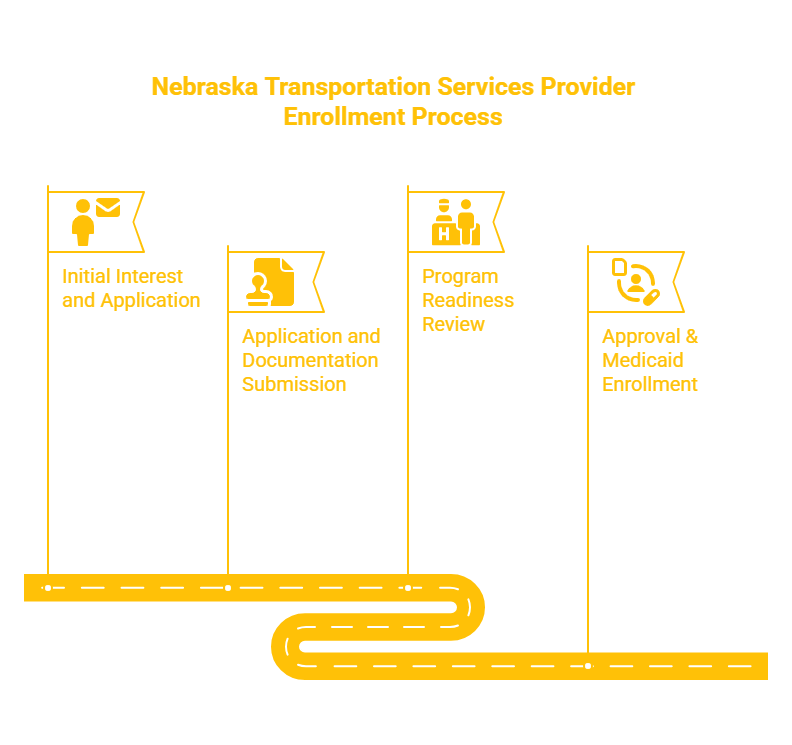
The enrollment trajectory follows a specific sequence of actions:
- Application: Submit the formal Provider Enrollment Application through the Nebraska Medicaid Provider Enrollment Portal specifically designated for HCBS waiver transportation services.
- Documentation: Compile and submit all required evidence, including Articles of Incorporation, proof of business insurance (general, professional, and vehicle liability), and verified driver/vehicle documentation.
- Readiness Review: DHHS personnel will conduct a thorough review of the provider’s readiness. This includes auditing vehicle safety protocols, verifying staff certifications, and assessing the robustness of the agency’s internal transportation policies.
- Approval: Once the readiness review is successfully cleared, the provider is authorized to bill Medicaid using the specific billing codes associated with their approved services.
Establishing organizational readiness early—specifically regarding vehicle safety, driver credentialing, and billing infrastructure—is essential to minimizing delays during the 60 to 90-day Medicaid review window.
What Administrative and Staffing Standards Must Be Maintained?
Operational success depends heavily on the maintenance of a comprehensive Policy and Procedure Manual. This document must explicitly outline procedures for client intake, ride scheduling, incident reporting, emergency response, and HIPAA compliance. Furthermore, the manual must detail rigorous vehicle maintenance schedules, sanitation practices, and infection control protocols to protect both passengers and staff.
Staffing requirements are equally stringent. The Transportation Program Director typically requires a bachelor’s degree in business administration, logistics, or a related field, alongside relevant experience. Drivers and transportation assistants must possess a valid Nebraska driver’s license (or a Commercial Driver’s License, if applicable), current CPR/First Aid certification, and must undergo cleared background checks. Dispatch coordinators must also be well-versed in customer service, safety logistics, and the specific needs of the population being served.
Frequently Asked Questions
Can transportation services be provided for any purpose?
No, transportation services must be tied to the participant's Individualized Service Plan (ISP) and focus on specific needs such as medical appointments, community access, employment, or essential daily errands. These services must be medically necessary or required to support the participant's community integration as defined by the waiver.
What vehicle safety requirements apply?
Providers must adhere to all Nebraska Department of Motor Vehicles (DMV) regulations regarding vehicle registration and safety inspections. Agencies must also implement internal policies for routine vehicle maintenance, safety checks, and specific accessibility protocols for specialized wheelchair-accessible vehicles.
How long does the entire startup process typically take?
The timeline varies based on organizational readiness, but the process generally spans several months. Business formation and compliance preparation usually take 1–2 months, followed by 2–3 months for staffing and internal development, 60–90 days for Medicaid enrollment, and 30–45 days for final billing setup and launch.
Waiver Consulting Group’s Start-Up Assistance Service
WCG supports agencies in launching Medicaid-compliant Transportation Services in Nebraska, offering structured guidance to navigate complex regulatory requirements. This includes:
- Business registration, Medicaid enrollment, and licensing support.
- Policy manual development for safe transportation and passenger care.
- Staff credentialing, training program templates, and documentation guidance.
- Medicaid billing setup and audit-prepared financial management.
- Branding, website development, and outreach strategies.
- Quality assurance systems for vehicle safety and driver compliance.
- Community networking for client referrals and partnership opportunities.
Key Takeaway: Successfully launching a transportation services provider in Nebraska requires a deep commitment to administrative excellence, strict adherence to state-mandated vehicle and driver safety standards, and a thorough understanding of the documentation required by Nebraska Medicaid. By aligning your operational procedures with DHHS requirements early in the development phase, you can ensure a smoother transition to providing essential community services.
Last verified: October 2023. Disclaimer: This information is for educational purposes only and does not constitute legal or professional advice. Always refer to the most recent Nebraska Department of Health and Human Services (DHHS) provider manuals and applicable state and federal statutes when establishing or operating a Medicaid-funded agency.