TRANSPORTATION SERVICES PROVIDER IN MAINE
By Fatumata Kaba · 2025-08-11 · 6 min read
CONNECTING INDIVIDUALS TO ESSENTIAL CARE, SERVICES, AND COMMUNITY RESOURCES THROUGH RELIABLE NON-EMERGENCY TRANSPORTATION
Transportation services in Maine function as a vital bridge between MaineCare (Medicaid) members and the essential healthcare, habilitation, and community resources they require to maintain their independence. By facilitating access for individuals with disabilities, seniors, and those managing chronic health conditions, transportation providers serve as a foundational element of the state’s Home and Community-Based Services (HCBS) ecosystem, ensuring that physical distance is not a barrier to quality of life.
Understanding the Governing Landscape of Maine Transportation Services
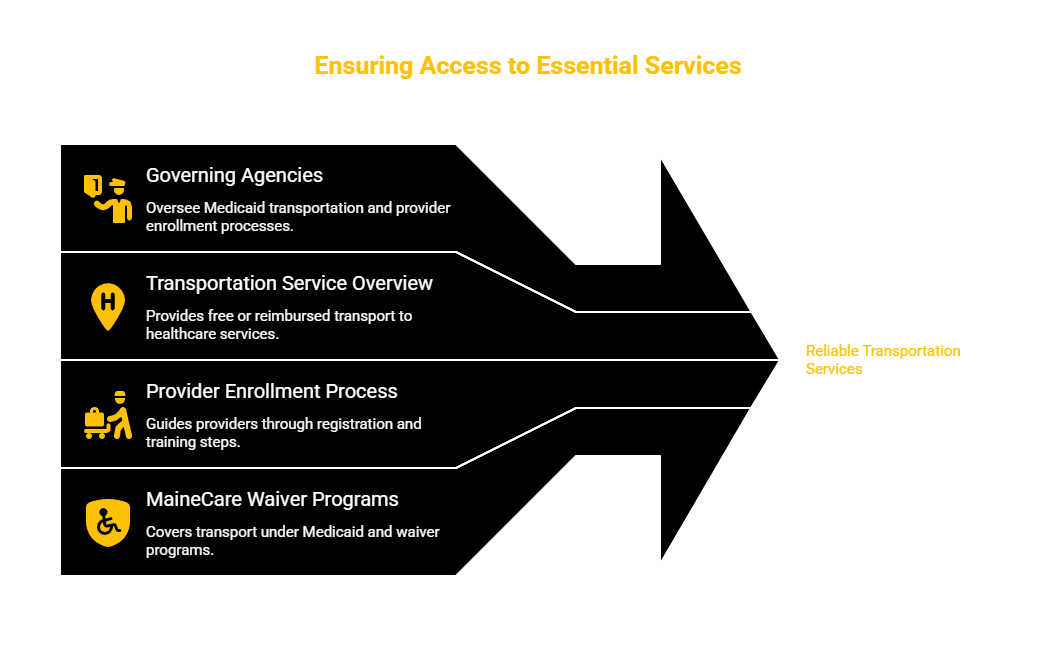
The administration of transportation services in Maine is a collaborative effort between federal oversight and state-level management. The Centers for Medicare & Medicaid Services (CMS) provides the federal framework, ensuring that transportation benefits remain accessible and cost-effective under Medicaid standards. At the state level, the Maine Department of Health and Human Services (DHHS) and the Office of MaineCare Services (OMS) oversee the policy and program requirements for all Non-Emergency Transportation (NET) services.
Day-to-day operations are decentralized through Regional Coordinating Agencies (RCAs). These brokers act as the primary interface for transportation vendors, handling trip requests, managing mileage reimbursements, and dispatching rides across specific service areas. Providers seeking to enter this space must align their operations with both the state-wide MaineCare mandates and the specific logistical requirements dictated by their regional broker.
How Maine’s Brokered Transportation Model Functions
Maine utilizes a brokered model to streamline the delivery of Non-Emergency Medical Transportation (NEMT). Because brokers manage the scheduling and dispatching of rides, independent agencies do not bill the state directly for most NEMT services; instead, they contract through the regional broker. This model is designed to maximize fleet efficiency and ensure that riders are matched with the most appropriate vehicle type for their specific health needs.
Transportation services cover a broad spectrum of essential destinations. When a provider enters the network, they may be tasked with transporting members to primary and specialty medical appointments, behavioral health and counseling sessions, dialysis and chemotherapy treatments, and various waiver-authorized habilitation or community integration activities. Depending on the member’s clinical needs, services may be rendered via passenger vehicle, wheelchair-accessible van, or public transit coordination.
- Primary and specialty medical appointments
- Behavioral health and counseling sessions
- Waiver-authorized community and habilitation activities
- Dialysis, chemotherapy, and adult day programs
- Dental, vision, and other approved health services
Essential Requirements for Licensure and Business Approval
Launching a transportation agency in Maine requires a disciplined approach to regulatory compliance. Before a provider can begin accepting trips, they must establish a formal business structure, which includes registering the business with the Maine Secretary of State and obtaining an IRS Employer Identification Number (EIN). For providers involved in waiver-funded transportation, acquiring a National Provider Identifier (NPI) may also be necessary depending on the specific billing path of the waiver program.
Operational safety is a non-negotiable prerequisite. Providers must maintain comprehensive insurance policies, including general liability, commercial auto, and specific passenger coverage. Furthermore, a provider must develop a robust Transportation Policy & Procedure Manual that addresses HIPAA compliance, rider confidentiality, incident response, and vehicle maintenance protocols. This documentation is frequently reviewed during the onboarding process with regional brokers.
Steps to Navigate the Provider Enrollment Process
The enrollment process is a sequential journey that begins with registering as a vendor through the designated regional broker. In Maine, Modivcare serves as the primary broker for the majority of the state. Prospective providers should first review the service area maps provided by Modivcare to determine the region in which they will operate and submit their business credentials accordingly.
Once registered, the provider must demonstrate compliance through the submission of driver background checks, Motor Vehicle Record (MVR) reports, and rigorous vehicle inspection documentation. After the documentation review is finalized, providers must complete mandatory orientation sessions. These sessions cover critical aspects of the broker’s dispatch portal, including how to accept ride offers, document time logs, and submit claims for reimbursement. Successful completion of this orientation triggers the activation of the provider account, allowing for the start of service delivery.
- Register as a vendor with the applicable Regional Coordinating Agency (RCA).
- Submit all required driver credentials and vehicle safety inspections.
- Attend required broker orientation regarding dispatch software and billing.
- Begin accepting trip offers and maintaining meticulous trip logs.
Staffing, Training, and Operational Documentation
A successful transportation agency relies on well-trained staff who understand the nuances of working with vulnerable populations. Whether functioning as a driver, a Direct Support Professional (DSP) for waiver-funded transport, or a dispatcher, staff members must meet specific standards. Drivers are required to hold a valid Maine driver’s license with a clean driving record and must undergo a thorough background check. Preference is often given to staff with prior experience in caregiving or professional driving roles.
Training protocols must be comprehensive to protect both the rider and the agency. Staff should be trained in defensive driving, wheelchair securement, and lift operations to accommodate passengers with varying degrees of mobility. Equally important is training in elderly and disability sensitivity, as well as HIPAA privacy requirements. Agencies must keep detailed records of this training, alongside daily vehicle maintenance logs and passenger pick-up/drop-off verification sheets, to remain in good standing.
Understanding MaineCare Waivers and Transportation Coverage
Transportation support is deeply integrated into several MaineCare programs. Beyond the standard NET Program, which covers essential medical appointments, specialized waiver programs—such as Sections 19, 20, 21, and 29—include transportation as a support service when it is specified in an individual’s Service Plan (ISP). This ensures that members can attend habilitation and community activities as part of their broader care plan.
Furthermore, Section 65 Behavioral Health Services and the Money Follows the Person (MFP) program utilize transportation services to reduce barriers to care. Whether the mode of transport is an agency fleet vehicle, a personal car for mileage reimbursement, or a public shuttle, the provider’s role is to ensure that these transportation services are rendered in strict accordance with the specific requirements of the member’s waiver or program coverage.
Frequently Asked Questions
How long does the launch process typically take?
The timeline varies based on administrative readiness. Business registration and insurance setup usually take 2–4 weeks, followed by a 30–45 day period for broker registration and credential review. Hiring and vehicle inspections add another 1–2 weeks, leading to a total projected timeline that can range from 2 to 4 months depending on individual business progress.
Do I need to be a medical professional to provide NEMT?
No, you do not need to be a medical professional. However, you must be a licensed and insured transportation provider. While clinical training is not required, your drivers must be trained in passenger safety, wheelchair securement, and sensitivity training to effectively support riders with disabilities or chronic conditions.
Can I bill MaineCare directly for all rides?
In the standard NET brokered model, you do not bill MaineCare directly. You contract with the regional broker (such as Modivcare), which handles the dispatching and coordination. Billing and reimbursement processes are conducted through the broker’s specific systems, not the MaineCare portal directly, unless your specific service contract specifies otherwise.
Key Takeaway
Providing transportation services in Maine requires a synthesis of operational efficiency, strict adherence to state and broker-level compliance requirements, and a deep commitment to the safety of the Medicaid population. By securing the necessary insurance, maintaining rigorous vehicle and driver documentation, and fostering a strong relationship with regional brokers, transportation providers can build sustainable businesses that significantly enhance the accessibility of healthcare and community support services across the state.
Last verified: 2024. This information is intended for educational purposes and should not be considered legal or medical advice. Please consult with the Maine Department of Health and Human Services (DHHS) or your regional broker for the most current regulatory requirements.