TRANSPORTATION SERVICES PROVIDER IN KENTUCKY
By Fatumata Kaba · 2025-07-25 · 6 min read
Ensuring Equitable Access to Care Through Kentucky Medicaid Transportation
Transportation services under Kentucky Medicaid are essential components of the Home and Community-Based Services (HCBS) ecosystem, ensuring that waiver participants can safely access medical appointments, adult day health centers, employment programs, and other life-sustaining community destinations. By bridging the gap between residence and necessary care, these transportation providers directly reduce barriers to healthcare engagement and support the independence of individuals enrolled in state-managed waiver programs.
Operating a transportation service in Kentucky requires navigating a multi-layered regulatory environment involving state agencies, federal compliance standards, and private-sector brokerage partnerships. For providers, success depends on a firm understanding of the Kentucky Cabinet for Health and Family Services (CHFS) guidelines, the specific requirements of the Department for Medicaid Services (DMS), and the operational mandates set by Managed Care Organizations (MCOs) and transportation brokers like Modivcare.
Who Regulates Medicaid Transportation Services in Kentucky?
The regulatory framework for Kentucky Medicaid transportation is hierarchical, involving several oversight bodies that ensure both patient safety and financial accountability. The Kentucky Cabinet for Health and Family Services (CHFS), through the Department for Medicaid Services (DMS), maintains the primary authority over Medicaid transportation policy, provider enrollment criteria, and the structures governing reimbursement for covered trips.
In addition to state-level Medicaid oversight, the Kentucky Transportation Cabinet (KYTC) plays a critical role in establishing vehicle safety standards and operational compliance. On the federal level, the Centers for Medicare & Medicaid Services (CMS) sets the standards for federal compliance, ensuring that all Medicaid-funded transportation programs remain consistent with federal law. Furthermore, the day-to-day coordination is often handled by Managed Care Organizations (MCOs) and transportation brokers, who manage authorization, dispatch, and claim processing.
- CHFS/DMS: Sets broad policy, manages provider enrollment via the Medicaid Partner Portal Application (MPPA), and determines reimbursement structures.
- KYTC: Oversees vehicle standards and ensures adherence to transportation-specific safety regulations.
- MCOs: Approve services within individual Person-Centered Service Plans (PCSP) and manage provider contracting.
- Transportation Brokers: Handle the logistical requirements, including trip scheduling, driver dispatching, and mileage tracking.
What Services Fall Under NEMT and Waiver Transportation?
Non-Emergency Medical Transportation (NEMT) provides the framework for transporting Medicaid participants to services deemed medically necessary. This includes primary care visits, specialist appointments, pharmacy trips, and diagnostic lab appointments. Beyond pure medical necessity, waiver-based transportation is specifically designed to facilitate participation in Home and Community-Based Services, such as adult day health programs, vocational training, and community engagement activities.
For these services to be reimbursable, they must be explicitly authorized within the participant’s Person-Centered Service Plan (PCSP). Providers must work closely with the assigned transportation broker to ensure that every trip is scheduled and documented according to established procedures. Depending on the waiver, some arrangements may allow for accompaniment by personal care aides or guardians, or even mileage reimbursement for self-arranged trips where permitted by program policy.
What Are the Essential Licensing and Enrollment Prerequisites?
Before an agency can begin billing for transportation services, it must establish a formal business structure and clear the required credentialing hurdles. The process begins with registering the business entity with the Kentucky Secretary of State and obtaining a federal Employer Identification Number (EIN) and a Type 2 National Provider Identifier (NPI). These are the foundational credentials required to enter the Medicaid Partner Portal Application (MPPA) system.
Once registered, the provider must navigate the complex landscape of vehicle and staff compliance. This includes registering all fleet vehicles with the KYTC, maintaining comprehensive DOT-compliant insurance, and implementing rigorous internal policies. Every driver must undergo thorough criminal background checks and driving record screenings. Furthermore, providers must develop a comprehensive Transportation Services Policy & Procedure Manual that covers every aspect of the service, from HIPAA compliance to emergency response protocols.
- Register business and obtain EIN and Type 2 NPI.
- Enroll as a provider via the Medicaid Partner Portal Application (MPPA).
- Obtain and document DOT-compliant insurance and vehicle registrations.
- Establish agreements with transportation brokers such as Modivcare.
- Develop a formal manual detailing all operational and safety procedures.
How Is the Provider Enrollment and Operational Workflow Managed?
The transition from a business entity to an active Medicaid provider occurs in distinct phases. Initially, providers must submit documentation through the MPPA, ensuring that all credentialing information—including driver records, vehicle inspections, and operational policies—is accurate and up to date. Once the provider is enrolled and credentialed with the relevant MCOs and brokers, they become eligible to receive transport referrals.
Operations management requires strict attention to detail. When a trip is authorized, the provider must coordinate the schedule with the participant and the broker. Throughout the delivery of service, the provider is responsible for maintaining accurate trip logs, documenting exact mileage, and confirming pickup and drop-off times. These records form the basis of the billing cycle; if the documentation does not align with the broker’s system or the Medicaid billing requirements, claims may be denied or audited.
Staffing, Training, and Participant Sensitivity Requirements
Staff competency is the primary metric by which transportation providers are evaluated. Beyond holding a valid Kentucky driver’s license and maintaining a clean driving record, all drivers must be trained in defensive driving, CPR, and First Aid. Because many participants in the HCBS waiver programs have complex health needs, sensitivity training is a mandatory component of the staffing requirements.
Staff must be fully versed in HIPAA regulations to protect participant confidentiality during transit. Additionally, drivers must be trained in wheelchair securement procedures and the operation of any specialized equipment installed in the fleet vehicles. Whether a staff member is acting as a driver or a dispatcher, they must be equipped to handle emergency incidents, mechanical breakdowns, and the specific communication protocols required by the transportation broker.
- Valid driver’s license and clean motor vehicle record.
- Mandatory HIPAA and confidentiality training.
- Emergency response, CPR, and First Aid certifications.
- Specialized training in sensitivity, defensive driving, and wheelchair securement.
Frequently Asked Questions
How long does it typically take to become a certified transportation provider in Kentucky?
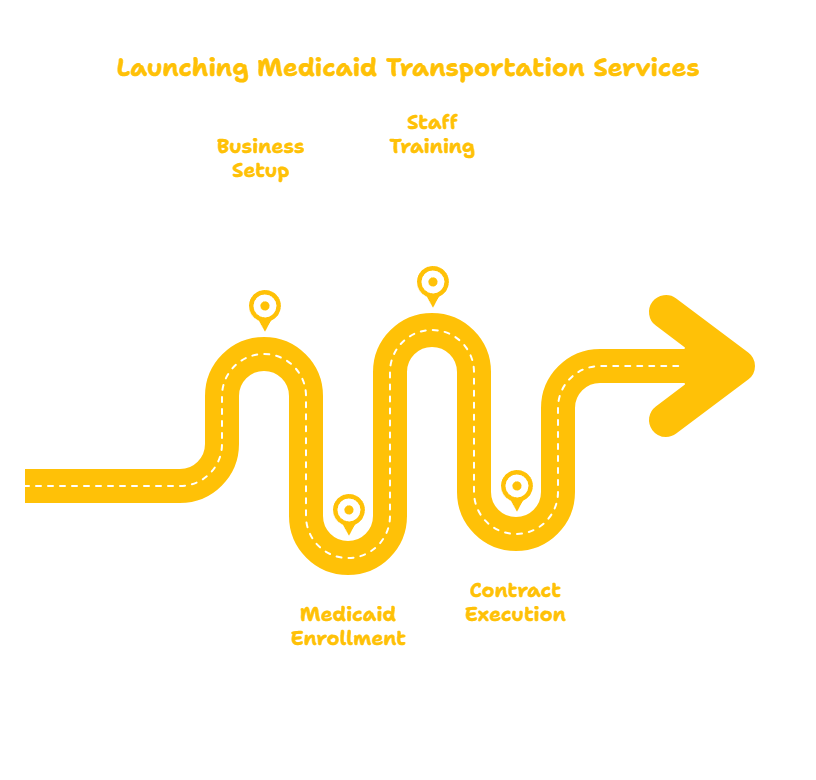
The timeline varies based on organizational readiness. Business setup and vehicle preparation typically take 1–2 months, followed by 2–3 months for Medicaid enrollment and MCO credentialing. Final preparations, including staff hiring and system setup, usually require an additional 30–60 days.
Are all Medicaid waiver programs eligible for transportation services?
Transportation is authorized under major programs including the Home and Community-Based (HCB) Waiver, the Michelle P. Waiver (MPW), the Supports for Community Living (SCL) Waiver, the Acquired Brain Injury (ABI & ABI-LTC) Waivers, and the Model II Waiver (MIIW), in addition to State Plan Medicaid services.
What happens if there is an emergency or mechanical breakdown during a trip?
Providers are required to have a written policy for emergency response and mechanical failure. This policy must be included in the provider’s operational manual, detailing how to ensure the safety of the participant, how to contact the broker, and how to facilitate an alternate ride if necessary.
Key Takeaway
Establishing a successful Medicaid transportation program in Kentucky requires a rigorous commitment to documentation, regulatory adherence, and operational excellence. By aligning business processes with the requirements of the DMS, KYTC, and transportation brokers, providers can build sustainable services that fulfill a critical need for Kentucky’s most vulnerable populations while maintaining compliance with state and federal oversight standards.
Last verified: November 2024. This information is intended for educational purposes and should not be considered legal or medical advice. Please consult with the Kentucky Department for Medicaid Services (DMS) or a qualified consultant for the most current regulatory guidance and specific program requirements.