TRANSPORTATION SERVICES PROVIDER IN INDIANA
By Watchen Roberts · 2025-08-13 · 6 min read
ENABLING ACCESS TO HEALTHCARE, EMPLOYMENT, AND COMMUNITY LIFE THROUGH SAFE, RELIABLE NON-EMERGENCY TRANSPORTATION
Transportation services for Medicaid beneficiaries in Indiana are vital components of the care continuum, designed to bridge the gap between individuals with disabilities or aging-related challenges and their essential community destinations. By providing specialized transit options—including wheelchair-accessible vehicles and door-to-door assistance—these providers ensure that participants in Indiana’s Home and Community-Based Services (HCBS) waivers and State Plan programs can consistently access medical care, employment, and social integration activities.
Becoming an approved transportation provider requires navigating complex regulatory landscapes overseen by the Indiana Family and Social Services Administration (FSSA). This guide serves as an authoritative resource for administrators and agency founders seeking to understand the foundational requirements, operational standards, and enrollment pathways necessary to launch and maintain a successful Medicaid-compliant transportation service in Indiana.
What Are the Regulatory Oversight Roles in Indiana?
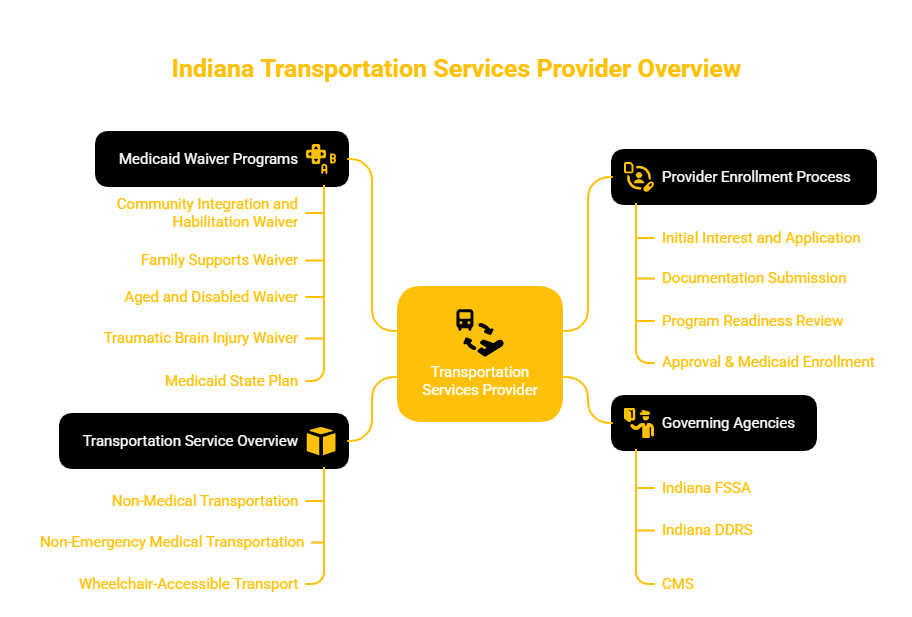
The provision of transportation services in Indiana is governed by a multi-tiered regulatory structure that ensures quality, safety, and fiscal responsibility. The Indiana Family and Social Services Administration (FSSA) and its Office of Medicaid Policy and Planning (OMPP) act as the primary administrators, overseeing the disbursement of Medicaid funding for both Non-Emergency Medical Transportation (NEMT) and HCBS waiver-funded transport. They are responsible for managing the provider enrollment process, setting reimbursement rates, and ensuring compliance with state policies.
Complementing this, the Division of Disability and Rehabilitative Services (DDRS) and the Division of Aging play active roles in authorizing and monitoring specific transportation services utilized by participants within the HCBS waiver programs. At the federal level, the Centers for Medicare & Medicaid Services (CMS) provides overarching guidance. CMS mandates that all Medicaid-funded transportation must align with person-centered care principles, facilitating independence and ensuring that services effectively support community integration rather than institutional isolation.
How Do Transportation Services Differ by Funding Source?
Providers must distinguish between the two primary pathways for reimbursement: HCBS Waiver-funded transportation and State Plan NEMT. Waiver-funded transportation is typically reserved for non-medical community integration, such as trips to adult day services, supported employment, volunteer activities, or social and recreational outings. These services must be clearly documented within the participant’s Individualized Support Plan (ISP) to be eligible for reimbursement.
Conversely, State Plan NEMT is specifically designated for transport to Medicaid-covered medical appointments, pharmacy visits, therapy, or health-related evaluations. These services are often managed via a broker model. Regardless of the funding source, providers must ensure their fleet and service delivery methods are tailored to the specific needs of the population they serve, offering flexibility between individual or group rides and maintaining high standards for curb-to-curb or door-to-door assistance for those with significant mobility impairments.
- Non-Medical Transportation (Waiver-funded): Supports community access to day programs, employment, and social engagement.
- Non-Emergency Medical Transportation (State Plan): Facilitates access to clinical, diagnostic, and therapeutic medical services.
- Adaptive Features: Utilization of wheelchair-accessible vehicles is often a requirement for serving populations with physical disabilities.
What Are the Prerequisite Steps for Provider Approval?
The road to becoming a Medicaid provider begins with formal business and administrative readiness. An organization must first establish its legal standing by registering with the Indiana Secretary of State and obtaining a federal Employer Identification Number (EIN). Following this, the agency must secure a Type 2 National Provider Identifier (NPI), which is essential for all Medicaid billing activities. Without these baseline credentials, the agency cannot initiate the enrollment process with the Indiana Medicaid Provider Enrollment Portal.
Beyond administrative setup, physical and operational readiness is paramount. Providers must maintain robust commercial auto insurance, general liability insurance, and vehicle liability coverage. Furthermore, all vehicles must adhere to Indiana Department of Transportation (IDOT) safety standards and maintain full compliance with Americans with Disabilities Act (ADA) requirements. Success hinges on the development of comprehensive internal policies covering vehicle maintenance logs, emergency protocols, and specific participant interaction standards.
How Is the Enrollment and Credentialing Process Structured?
The enrollment journey is divided into the initial application, document verification, and a potential program readiness review. Applicants must submit their registration through the Indiana Medicaid Provider Portal. If the agency intends to provide NEMT under the State Plan, they will likely need to undergo additional credentialing through the state’s assigned broker, such as Southeastrans. This process requires the submission of Articles of Incorporation, proof of insurance, and detailed documentation of the agency’s standard operating procedures.
During the program readiness review, FSSA or the NEMT broker will evaluate the provider's operational integrity. This includes verifying driver qualifications, reviewing the agency’s internal safety manuals, and ensuring that all administrative systems—such as trip dispatch and billing logs—are prepared to handle the requirements of the Medicaid program. Once the agency passes this review, they are granted the authority to bill for mileage or trip-based services under their designated provider codes.
What Are the Essential Staffing and Training Mandates?
Transportation service agencies are only as reliable as their drivers and support staff. A Transportation Program Manager or supervisor must oversee the logistics of the fleet, ensuring that scheduling, dispatching, and record-keeping align with Medicaid requirements. Drivers, who serve as the face of the organization, must possess a valid Indiana driver’s license and maintain a clean driving record. Their role demands more than just navigation skills; they must be proficient in the safe operation of specialized equipment, including wheelchair securement systems.
Continuous training is a mandatory aspect of staff management. All personnel are required to complete training modules focused on HIPAA compliance, participant confidentiality, and the prevention of abuse and neglect. Furthermore, because these staff members operate in a clinical-adjacent environment, they must be trained in defensive driving, ADA-compliant loading procedures, and emergency response. Annual background screenings and recurring driving record checks are required to maintain the safety and integrity of the service provider’s network.
Frequently Asked Questions
How long does the total process take from business registration to service launch?
The timeline typically spans 6 to 9 months. Business formation and safety policy development require 1–2 months, followed by 1–2 months for staffing. The Medicaid and broker enrollment phase often takes 60–90 days, with an additional 30–45 days for final billing setup and system testing.
What specific documentation must be kept for audit purposes?
Providers must maintain comprehensive records, including articles of incorporation, proof of insurance, vehicle maintenance and safety inspection logs, and detailed trip-verification logs. Additionally, all training logs for drivers and staff, including HIPAA and CPR/First Aid certifications, must be readily available for review.
Can a provider bill for both State Plan and Waiver-funded transportation?
Yes, provided the agency has enrolled under the appropriate categories in the Medicaid portal and satisfied the credentialing requirements for both the FSSA for waiver services and the NEMT broker for State Plan services. Each service must be billed according to its specific codes and authorization requirements.
Key Takeaway: Success in the Indiana Medicaid transportation landscape requires a disciplined focus on administrative readiness, rigorous compliance with safety and ADA standards, and an unwavering commitment to the participant’s individualized care plan. By establishing clear policies and maintaining precise documentation, providers can effectively navigate the enrollment process and contribute to the essential infrastructure that empowers individuals with disabilities across Indiana.
Last verified: September 2024. This information is for general educational purposes only and does not constitute legal or professional consulting advice. Requirements for Medicaid waiver programs are subject to change; always refer to the official Indiana Family and Social Services Administration (FSSA) and CMS policy manuals for the most current regulatory guidance.