TRANSPORTATION ASSISTANCE SERVICES PROVIDER IN MICHIGAN
By Fatumata Kaba · 2025-07-27 · 6 min read
Supporting Individuals with Access to Community and Healthcare Services
Transportation Assistance Services in Michigan serve as a critical link for individuals with disabilities, older adults, and those managing chronic health conditions by providing reliable, safe transit to medical appointments, community programming, and essential life services. These services are authorized under the Michigan Home and Community-Based Services (HCBS) Medicaid Waivers, requiring providers to operate in strict alignment with protocols established by the Michigan Department of Health and Human Services (MDHHS) to ensure participant safety and program integrity.
Founding a transportation agency in this sector involves navigating a complex regulatory landscape that balances operational logistics with federal and state compliance mandates. Whether facilitating non-emergency medical transportation (NEMT) or supporting community integration, providers act as an extension of the participant's care plan, necessitating a robust administrative foundation and a unwavering commitment to service quality.
Who are the Governing Agencies and What is the Regulatory Framework?
The provision of transportation assistance under Michigan’s Medicaid waivers is governed by a hierarchical structure of oversight designed to protect vulnerable populations. The Michigan Department of Health and Human Services (MDHHS) serves as the primary regulatory body, maintaining authority over provider enrollment, service authorization, and ongoing Medicaid compliance. By establishing specific standards for providers, MDHHS ensures that every ride provided meets the safety and accessibility expectations required by the waiver programs.
At the federal level, the Centers for Medicare & Medicaid Services (CMS) provides the overarching regulatory framework for all HCBS waiver activities. This ensures that Michigan’s programs adhere to federal laws regarding service delivery, participant rights, and financial accountability. Additionally, the Michigan Medicaid Agency plays a direct role in the logistical aspects of the business, specifically overseeing the provider enrollment process and the subsequent reimbursement mechanisms for services rendered to eligible beneficiaries.
- Michigan Department of Health and Human Services (MDHHS): Responsible for policy development, provider enrollment, and audit compliance.
- Michigan Medicaid Agency: Manages claims, billing, and the technical aspects of provider reimbursement.
- Centers for Medicare & Medicaid Services (CMS): Sets federal standards and approves the waiver structures that allow these services to exist.
What Services Constitute Transportation Assistance Under HCBS Waivers?
Transportation Assistance Services are defined by their ability to foster independence and access for individuals who cannot utilize traditional public transit or who require specialized support. Beyond basic transport, the service is intended to facilitate the goals outlined in an individual's specific person-centered service plan, ensuring they have the means to reach essential services that support their health and quality of life.
Approved providers often deliver a spectrum of support that goes beyond simply driving a vehicle. This may include non-emergency medical transportation (NEMT) for routine check-ups, specialized transportation for social and community engagement, and vehicle adaptations that accommodate mobility devices. In many instances, the service includes an element of direct assistance, such as helping a participant board or disembark, or providing companion services during the transit process to ensure safety and comfort.
- Non-emergency medical transportation (NEMT) to health facilities.
- Transportation to community activities, grocery shopping, or social services.
- Wheelchair-accessible and assisted ride options.
- Escort or companion services to assist with transition during the trip.
- Comprehensive documentation of all trips, including mileage and client satisfaction metrics.
How Do You Meet the Licensing and Operational Requirements?
Establishing a transportation agency in Michigan requires a structured approach to business registration and operational readiness. Before a provider can apply to MDHHS, they must first satisfy the fundamental business requirements established by the state. This includes legal formation through the Michigan Department of Licensing and Regulatory Affairs (LARA), obtaining a federal Employer Identification Number (EIN), and securing a National Provider Identifier (NPI) in the Type 2 category.
Beyond the legal entity, the physical and logistical aspects of the business must be formalized. Providers are expected to maintain a physical office or dispatch center within Michigan that serves as the base of operations. Furthermore, the fleet itself must be compliant with all state vehicle safety standards. This includes maintaining proper registration, comprehensive insurance, and the physical vehicle adaptations necessary to serve the specific needs of the Medicaid population.
What is the Step-by-Step Provider Enrollment Process?
The enrollment process is a multi-phased endeavor that begins with a formal expression of interest through the MDHHS application packet. Applicants are required to submit a comprehensive business and service plan that details how the organization will manage transportation logistics, driver oversight, and client safety. This document acts as the blueprint for the agency’s operations and is a primary factor in the approval process.
Once the application is submitted, the agency undergoes a credentialing phase. This involves rigorous background checks for all drivers and staff who will interact with participants. The department will verify that all drivers hold valid licenses and clean driving records, as well as proof that they have received mandatory training in passenger assistance and emergency protocols. The final phase, the Program Readiness Review, ensures that the applicant can demonstrate the existence of maintenance logs, trip documentation systems, and safe, consistent pickup and drop-off procedures.
What are the Core Staffing and Documentation Mandates?
Staffing a transportation agency involves more than just hiring drivers; it requires a commitment to a culture of safety and professionalism. A designated Transportation Coordinator is essential to manage the logistics of scheduling and client coordination, ensuring that no participant is left without service due to administrative error. Drivers must be vetted and trained annually on defensive driving, client rights, and ethics to maintain their eligibility.
Documentation serves as the backbone of Medicaid compliance. Providers must maintain a detailed Policy & Procedure Manual that covers every aspect of the organization. This includes emergency response plans, incident reporting, vehicle safety protocols, and robust financial tracking systems. Because Medicaid is a publicly funded program, the ability to produce accurate, timely records regarding every mile driven and every client served is non-negotiable.
- Driver Qualifications: Valid license, clean driving history, and successful completion of passenger assistance training.
- Policy Manual Requirements: Detailed procedures for scheduling, incident management, and reporting.
- Financial Integrity: Accurate logs tracking mileage, staff hours, and service utilization for billing purposes.
Frequently Asked Questions
Which Medicaid Waivers include Transportation Assistance Services?
Transportation Assistance is a key component of several Michigan programs, most notably the MI Choice Waiver, the Habilitation Supports Waiver, and the Children’s Waiver Program.
How long does the launch process generally take?
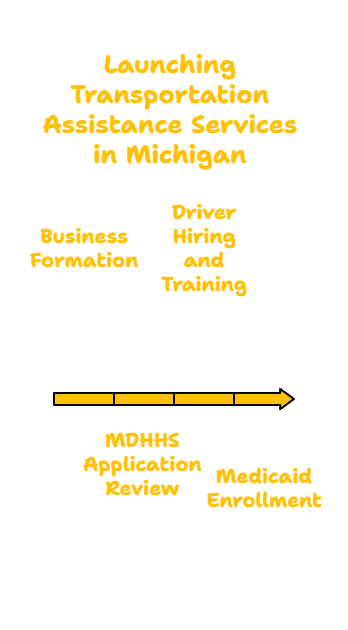
The process is divided into phases: business formation (0–1 week), MDHHS application review (60–90 days), driver hiring and training (30–60 days), and final Medicaid enrollment (60–90 days).
What is required for the Program Readiness Review?
You must demonstrate that you have established protocols for client transit, that your vehicle safety inspections are current, and that your dispatch and reporting systems are functional and ready for live operations.
Waiver Consulting Group provides comprehensive start-up assistance for new providers entering the Michigan HCBS transportation market. Our services include business formation (LLC, EIN, NPI), MDHHS provider application guidance, policy and procedure manual development, driver training protocol design, and operational support to ensure your agency meets all state and federal compliance standards from day one.
Last verified August 2024. Disclaimer: This article is for informational purposes only and does not constitute legal or professional medical advice. Always refer to the latest Michigan Department of Health and Human Services (MDHHS) bulletins and federal CMS guidelines for the most current regulatory requirements.