TRANSPORTATION ASSISTANCE SERVICES PROVIDER IN MASSACHUSETTS
By Fatumata Kaba · 2025-08-07 · 6 min read
Transportation Assistance Services (TAS) in Massachusetts serve as a critical bridge between vulnerable populations and the essential services required to maintain health, independence, and community integration. By providing specialized, non-emergency transportation, provider agencies enable Medicaid beneficiaries—including those enrolled in Home and Community-Based Services (HCBS) waivers—to attend medical appointments, participate in adult day health programs, and engage in meaningful community-based employment and social activities.
Operating a transportation service in Massachusetts requires a sophisticated understanding of both state-level regulatory requirements and the specific operational frameworks established by MassHealth and the Human Service Transportation (HST) Office. Success in this sector depends on a provider's ability to maintain rigid compliance with Department of Public Utilities (DPU) mandates while demonstrating the logistical precision necessary to satisfy regional broker requirements and waiver-specific care plan goals.
How Do Governing Agencies Regulate Transportation Services?
The regulatory environment for transportation services in Massachusetts is multi-layered, involving both state-level oversight of public utilities and healthcare-specific administration by the Executive Office of Health and Human Services (EOHHS). MassHealth functions as the primary payor, authorizing the use of Medicaid funds for transportation that directly supports the health and welfare of eligible members. Within this structure, the HST Office acts as a vital coordinator, contracting with regional brokers to manage the actual scheduling, dispatching, and quality oversight of Non-Emergency Medical Transportation (NEMT) across the Commonwealth.
Furthermore, providers must navigate the specific mandates of the Department of Public Utilities (DPU), which serves as the gatekeeper for safety and operational legality regarding livery and paratransit vehicles. For services provided through HCBS waivers such as the Acquired Brain Injury (ABI), Money Follows the Person (MFP), or Department of Developmental Services (DDS) waivers, the Centers for Medicare & Medicaid Services (CMS) requires that states maintain strict documentation regarding the delivery of services. Compliance is not optional; it is the cornerstone of continued authorization to participate in the Massachusetts Medicaid ecosystem.
- MassHealth (Massachusetts Medicaid): Funds and authorizes transportation services for eligible members.
- Executive Office of Health and Human Services (EOHHS): Oversees Medicaid transportation operations and waiver compliance.
- Human Service Transportation (HST) Office: Contracts with regional brokers to coordinate and schedule NEMT services.
- Centers for Medicare & Medicaid Services (CMS): Provides federal oversight for transportation services funded through 1915(c) waivers.
- Massachusetts Department of Public Utilities (DPU): Regulates commercial and livery vehicles, including licensing and safety standards.
What Are the Essential Requirements for Provider Enrollment?
Before an agency can begin accepting referrals or billing for services, it must establish a formal legal and operational foundation. This begins with registering the business entity with the Massachusetts Secretary of the Commonwealth and obtaining an Employer Identification Number (EIN) and a Type 2 National Provider Identifier (NPI). These are the fundamental precursors to any interaction with the MassHealth Provider Online Service Center.
Beyond administrative registration, providers must secure the appropriate DPU operating authority. This process ensures that the entity is authorized to provide livery or paratransit services within the state. A provider must also procure comprehensive commercial auto liability insurance and maintain workers’ compensation coverage to mitigate organizational risk. Finally, every vehicle in the fleet must pass rigorous safety inspections that meet or exceed the standards set forth by the DPU and the HST Office. Without these prerequisites, an agency cannot demonstrate the reliability or safety required to transport individuals with disabilities.
How Do You Navigate the Two Primary Enrollment Pathways?
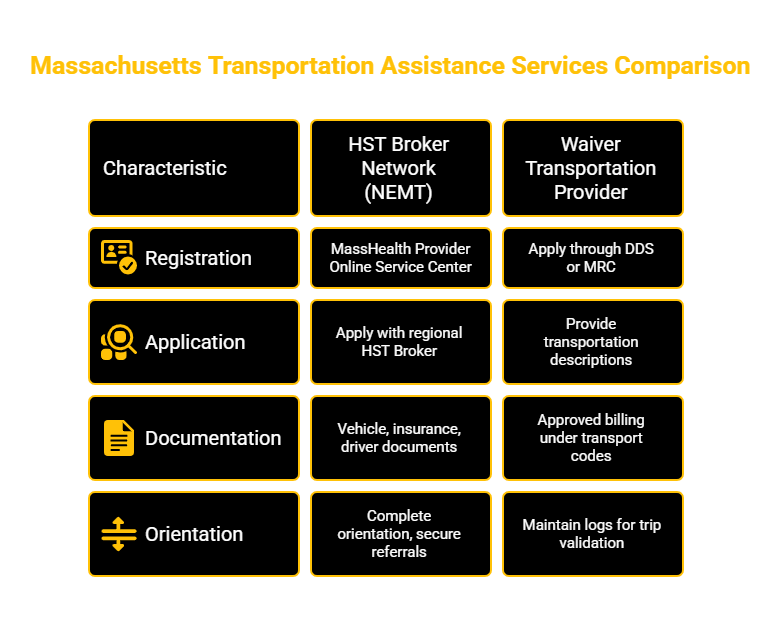
The path to becoming an active provider depends on whether the agency intends to serve the general NEMT population through regional brokers or focus on waiver-specific populations managed by agencies like the DDS or the Massachusetts Rehabilitation Commission (MRC). Option A, the NEMT pathway, requires participation in the broker network. Providers must register through the MassHealth portal and then apply directly to regional brokers—such as MART or GATRA—who act as the operational point of contact for daily ride requests.
Option B, the waiver provider pathway, is more specialized and involves proving that the transportation services provided are directly linked to a member's Individual Support Plan (ISP) or Plan of Care (POC). This involves obtaining approval through the specific department overseeing the waiver. Regardless of the pathway, the provider must demonstrate the ability to maintain meticulous trip logs and billing records. These documents are subject to audit, and failing to provide validation for a trip can result in clawbacks or the suspension of billing privileges.
What Are the Key Staffing and Training Mandates?
The quality of a transportation provider is measured largely by the competency of its personnel. Drivers are the frontline representatives of the agency and must hold a valid Massachusetts driver’s license, complemented by a clean driving record that is verified through regular Criminal Offender Record Information (CORI) and Registry of Motor Vehicles (RMV) checks. Beyond driving ability, staff must be proficient in passenger assistance, which often involves specialized training in lift operations, wheelchair securement, and the safe transfer of individuals with complex physical or cognitive needs.
Administrative staff, specifically dispatchers and transportation managers, play a crucial role in maintaining operational efficiency and safety. They are responsible for coordinating complex schedules while ensuring that HIPAA-protected information remains confidential during the dispatch process. Both drivers and managers must undergo mandatory training in abuse and neglect reporting, disability awareness, and emergency protocols. This ensures that the organization is not only compliant with state regulations but is also fostering an environment of dignity and safety for every rider.
- Valid Massachusetts driver’s license and clean driving record.
- CPR and First Aid certification.
- Mandatory training in HIPAA, passenger safety, lift operations, and cultural competency.
- Proficiency in incident reporting and emergency response protocols.
WAIVER CONSULTING GROUP’S START-UP ASSISTANCE SERVICE — MASSACHUSETTS TRANSPORTATION PROVIDER
WCG helps local entrepreneurs and agencies launch Medicaid-approved transportation services that connect people to the care and independence they need.
Frequently Asked Questions
How long does the provider enrollment process typically take?
The timeline is variable based on the readiness of the applicant. Generally, business registration and licensing take about one month, DPU certification and insurance setup require two to three weeks, and Medicaid or HST broker enrollment ranges from 30 to 60 days. Factors such as document accuracy and background check processing speeds can impact these estimates.
What type of documentation is required for auditing?
Providers must maintain comprehensive, HIPAA-compliant records. This includes daily trip logs, rider rosters, vehicle safety inspection checklists, incident reports, and staff onboarding records. Billing records must be easily cross-referenced with authorized service plans to ensure audit readiness for MassHealth and waiver programs.
Are escort services covered under transportation assistance?
Escort assistance is a specific service component that may be provided if it is formally authorized in the individual’s care plan. Providers must ensure that if they are offering escort services, they are appropriately billing for that specific service code and that their staff are trained in the necessary support functions to assist the rider beyond simple transit.
Key Takeaway
Launching a transportation assistance service in Massachusetts requires careful alignment with the directives of the HST Office, MassHealth, and the DPU. By prioritizing administrative compliance, rigorous driver training, and accurate record-keeping, provider agencies can effectively meet the needs of waiver participants while maintaining a sustainable and compliant business model.
Last verified: September 2023. Disclaimer: This article is for informational purposes only and does not constitute legal or professional advice. Always verify current requirements with the MassHealth Provider Online Service Center and relevant state regulatory bodies before initiating business operations.