TRANSPORTATION ASSISTANCE SERVICES PROVIDER IN LOUISIANA
By Fatumata Kaba · 2025-08-12 · 6 min read
Enabling Access to Healthcare and Community Integration: Transportation Assistance Services in Louisiana
Transportation Assistance Services in Louisiana are a critical component of the state’s Home and Community-Based Services (HCBS) framework, facilitating non-emergency medical transportation (NEMT) for Medicaid participants. These services ensure that individuals with disabilities, chronic health conditions, or mobility limitations can access essential medical appointments, waiver-funded day programs, and community integration activities, thereby promoting independence and preventing institutionalization.
For service providers, operating in this space requires a rigorous commitment to state compliance, safety, and logistical efficiency. By managing the complexities of Medicaid reimbursement, MCO coordination, and fleet maintenance, providers act as a vital link in the continuum of care, ensuring that participants remain connected to their treatment plans and community support systems.
What Are the Roles and Responsibilities of Governing Agencies in Louisiana?
The regulatory landscape for transportation assistance in Louisiana is multi-tiered, involving both state departments and private-sector managed care entities. The Louisiana Department of Health (LDH), specifically the Bureau of Health Services Financing (BHSF), maintains ultimate oversight of the Medicaid State Plan and waiver-based transportation benefits. Their role is to establish the standards for service delivery, ensure program integrity, and oversee the equitable distribution of access across the state.
Managed Care Organizations (MCOs) under the Bayou Health program serve as the primary coordinators for most NEMT services. MCOs are responsible for authorizing individual trips, managing scheduling vendors, and adjudicating claims for reimbursement. Additionally, the Medicaid Management Information System (MMIS), administered through partners like Molina Medicaid Solutions, serves as the operational backbone for provider enrollment, billing, and systematic payment processing. Federal oversight is provided by the Centers for Medicare & Medicaid Services (CMS) to ensure that all services align with national mandates for Medicaid access and participant equity.
- LDH-BHSF: Sets policy and oversees state-wide service standards.
- MCOs (Bayou Health): Coordinate authorizations, scheduling, and provider payments.
- MMIS/Molina: Facilitates provider enrollment and core billing systems.
- CMS: Ensures federal compliance and quality assurance standards.
How Do Providers Define and Deliver Transportation Assistance?
Transportation Assistance, often categorized as NEMT or Waiver Transportation, is defined by the specific needs of the participant as identified in their individual care plan. At its core, the service is a door-to-door or curb-to-curb solution that removes barriers to care. Providers are expected to maintain versatile fleets capable of handling diverse participant requirements, ranging from standard ambulatory transport to specialized wheelchair-accessible van services.
The operational scope for an approved provider includes not only the physical transport of participants but also the administrative management of those trips. This includes complex scheduling, real-time coordination with medical facilities or day programs, and meticulous mileage tracking. When approved within a participant's care plan, providers may also be required to offer escort services or provide assistance during waiting periods, ensuring that vulnerable individuals are never left unsupervised during the course of their medical or community engagements.
What Are the Prerequisites for Licensing and Provider Enrollment?
Launching a transportation agency in Louisiana is a sequential process that begins with legal and structural formation. Providers must first register their business entity with the Louisiana Secretary of State and secure an IRS Employer Identification Number (EIN) and a Type 2 National Provider Identifier (NPI). These are non-negotiable prerequisites for entering the state’s healthcare procurement system. Once these foundations are in place, the provider must obtain a Non-Emergency Medical Transportation Permit, which is issued by the LDH or relevant local regulatory authorities.
Compliance with insurance and safety standards is the next critical phase. Every provider must maintain valid Louisiana commercial vehicle insurance that meets state-mandated coverage limits. Furthermore, all vehicles used for wheelchair services must be fully ADA-compliant. The provider must also develop a comprehensive Transportation Policy & Procedure Manual. This document is essential for internal training and external audits, as it must clearly articulate how the agency handles HIPAA compliance, participant safety protocols, and daily trip documentation.
- Register legal entity and secure IRS/NPI credentials.
- Obtain required LDH/local NEMT operating permits.
- Procure commercial auto and general liability insurance.
- Formalize a comprehensive Transportation Policy & Procedure Manual.
- Ensure all fleet vehicles meet ADA requirements for accessibility.
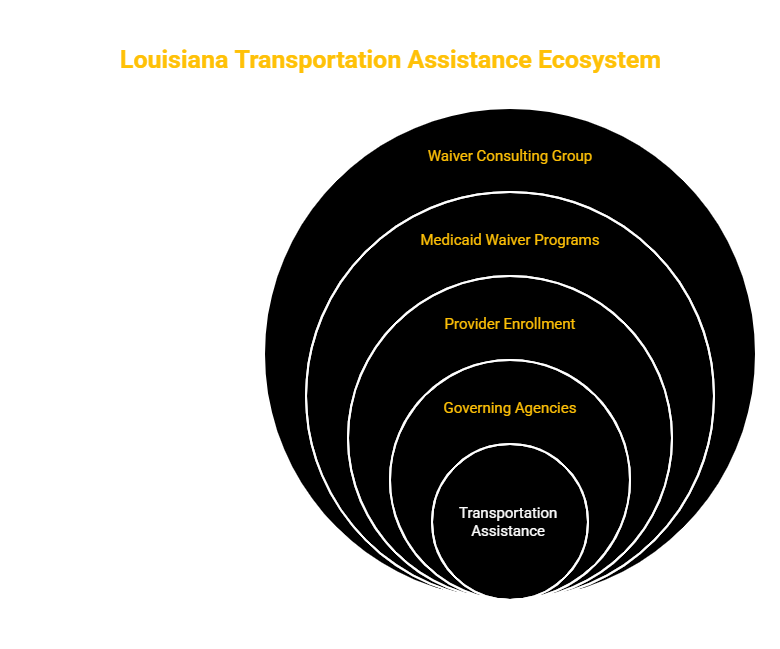
Navigating the Enrollment Pathways: NEMT vs. Waiver Transportation
There are two primary pathways for providers looking to enter the Louisiana transportation market. The first is the NEMT Provider pathway, which focuses on State Plan or MCO-assigned rides. This requires enrollment through the Louisiana Medicaid Provider Enrollment Portal at https://www.lamedicaid.com. Following state enrollment, the provider must enter into a credentialing agreement with MCO transportation brokers, such as Modivcare. This process involves the submission of detailed fleet information, driver certifications, and insurance verification to be eligible for ride assignments.
The second pathway is the Waiver Transportation Provider. This is specifically for agencies providing transport under HCBS waivers like the New Opportunities Waiver (NOW) or the Supports Waiver. In this model, providers often coordinate directly with support coordinators or MCO waiver care teams to ensure that the transportation services provided align perfectly with the participant’s approved Plan of Care. Regardless of the pathway, the provider must demonstrate the capacity to manage the documentation required for audit-ready compliance.
What Documentation and Staffing Standards Are Required?
Documentation is the primary method by which the state monitors the quality and necessity of transportation services. Providers must maintain robust, audit-ready logs. This includes detailed trip sheets that record pick-up and drop-off times, mileage, participant signatures, and any relevant incident reports. Additionally, staff training logs, vehicle maintenance records, and proof of HIPAA-compliant record storage must be kept current. These records are not merely administrative tasks; they are essential evidence for securing reimbursement and maintaining a positive provider standing with the LDH.
Staffing requirements are equally stringent to ensure participant safety. All drivers must hold a valid Louisiana driver’s license and pass both a rigorous background check and a drug screening. Beyond basic driving capabilities, staff should be trained in CPR, First Aid, and ADA-compliant assistance techniques. Furthermore, if the agency employs dispatchers, these individuals must be well-versed in the scheduling software and the specific communication protocols required by Medicaid and the MCOs to ensure seamless service delivery.
Frequently Asked Questions
How long does the startup process typically take?
The timeline varies depending on the provider's readiness. Generally, business registration and vehicle setup take 2–3 weeks. Medicaid enrollment and MCO broker credentialing are the most time-intensive, often requiring 60–90 days. Developing internal policies and hiring staff typically takes an additional 2–4 weeks.
What is the difference between MCO-assigned rides and waiver-based transport?
MCO-assigned rides are usually managed through transportation brokers (like Modivcare) for medical appointments and are often episodic. Waiver-based transport is typically scheduled for recurring needs, such as attending day programs or employment support, and is integrated directly into the participant’s individual service plan.
Are transportation providers required to have ADA-compliant vehicles?
Yes, any provider offering wheelchair-accessible transportation must ensure their vehicles meet all ADA compliance standards. This includes proper lift mechanisms, securement systems for wheelchairs, and overall vehicle safety features to ensure the safe transport of individuals with mobility limitations.
Key Takeaway
Success as a transportation assistance provider in Louisiana hinges on strict adherence to LDH regulations, proactive MCO credentialing, and the maintenance of rigorous, audit-ready documentation. By prioritizing participant safety, ADA accessibility, and seamless communication with care teams, providers can build a sustainable, compliant operation that fills a critical gap in the Louisiana healthcare landscape.
Last verified: August 2024. This information is provided for educational purposes only and does not constitute legal or professional advice. Requirements for Medicaid participation are subject to change. Consult the official Louisiana Medicaid Provider Enrollment Portal and your specific MCO contracts for the most current rules and regulations.