TRANSPORTATION ASSISTANCE SERVICES PROVIDER IN IOWA
By Fatumata Kaba · 2025-07-22 · 5 min read
Transportation Assistance Services in Iowa provide a vital lifeline for individuals who are unable to drive or utilize standard public transit due to disability, chronic illness, or age-related conditions. By facilitating access to Medicaid-covered medical appointments, community activities, and employment, these providers ensure that participants can maintain independence and receive the essential care authorized under the Iowa Department of Health and Human Services (HHS) Medicaid State Plan and Home and Community-Based Services (HCBS) Waiver programs.
How Do Iowa Medicaid Transportation Programs Function?
Transportation assistance is bifurcated into two primary operational models within the state of Iowa. The first is Non-Emergency Medical Transportation (NEMT), which is governed by the Medicaid State Plan and managed by MTM, the designated Iowa NEMT broker. This system is strictly for travel to Medicaid-covered medical appointments, therapy sessions, and prescription pick-ups, requiring providers to meet specific credentialing standards established by the broker.
The second model encompasses HCBS Waiver transportation. This service is designed to support the participant's goals as outlined in their Individualized Service Plan (ISP). These rides typically facilitate community integration, such as travel to adult day programs, supported employment sites, or social activities. Unlike NEMT, which is trip-focused on medical care, waiver transportation is often integrated into the participant's broader service plan, requiring close coordination with case managers to ensure compliance with federal and state regulations.
What Are the Governing Agencies and Oversight Roles?
Navigating the Iowa Medicaid landscape requires understanding the hierarchy of oversight. The Iowa Department of Health and Human Services (HHS) and the Iowa Medicaid Enterprise (IME) serve as the primary administrative bodies. They oversee provider enrollment, policy development, and the disbursement of Medicaid funding for waiver-based services. They ensure that all services provided align with the state’s commitment to high-quality care and participant protection.
MTM acts as the specialized broker for NEMT services in Iowa. Their role involves managing transportation requests, vetting provider credentials, and maintaining network adequacy for medical transit. On a federal level, the Centers for Medicare & Medicaid Services (CMS) provides the overarching regulatory framework. CMS ensures that Iowa’s Medicaid program complies with federal access-to-care standards, which mandates that participants have reliable ways to reach necessary healthcare services, regardless of their mobility level or geographic location.
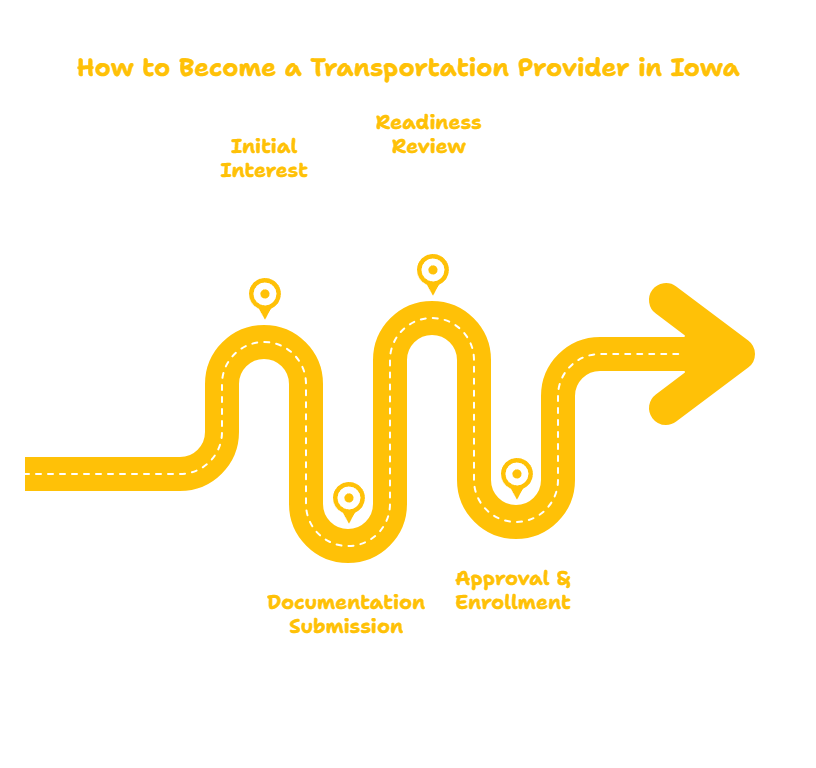
What Is the Process for Provider Enrollment and Credentialing?
Becoming an approved transportation provider is a multi-step process that requires separate actions for waiver services and NEMT. For waiver transportation, the organization must first register with the Iowa Secretary of State and secure an EIN and Type 2 NPI. Once these foundational business requirements are met, the provider must enroll in the Iowa Medicaid Portal Access (IMPA) system. This portal acts as the central hub for billing and administrative management for all HCBS services.
For those seeking to provide NEMT services, the provider must undergo a distinct credentialing process directly through MTM. This involves demonstrating that the agency meets specific safety, insurance, and vehicle standards. After an agency is enrolled and credentialed, they must configure their billing systems to match the appropriate service codes—often based on mileage or per-trip metrics—to ensure timely reimbursement from either the state or the broker.
What Are the Operational and Staffing Requirements?
Effective management of a transportation service requires a rigorous commitment to safety and compliance. A Transportation Program Manager is essential for overseeing logistics, incident reporting, and the continuous verification of service delivery. Drivers must hold a valid Iowa driver’s license, maintain a clean driving record, and pass comprehensive background screenings. Furthermore, all staff should be trained in CPR, first aid, defensive driving, and HIPAA compliance to protect sensitive participant information.
- Annual driver record checks and vehicle safety inspections.
- Mandatory training on abuse prevention and reporting procedures.
- Development of robust safety policies, including emergency evacuation plans for vehicles.
- Maintenance of detailed logs for vehicle upkeep, mileage, and incident reports.
- Implementation of door-to-door or curb-to-curb assistance protocols based on ISP requirements.
What Documentation Is Required for Ongoing Compliance?
Regulatory compliance is sustained through diligent documentation. A provider must maintain a comprehensive Policy & Procedure Manual that outlines every aspect of their operations, from the scheduling of rides to the handling of client grievances. This manual must be available for audit by the Iowa Medicaid Enterprise (IME) at any time. Documentation of insurance is equally critical, as providers must maintain commercial auto, vehicle liability, and general liability coverage that meets state-mandated minimums.
Beyond insurance and policy manuals, accurate record-keeping of every trip is mandatory for valid billing. Providers should maintain logs that include the driver’s identity, the time and date of service, the starting and ending locations, and proof of vehicle maintenance. These records serve as the primary evidence during audits to demonstrate that services were provided to the correct participant, at the correct time, and in accordance with the authorization in the participant's ISP.
Frequently Asked Questions
Is a special vehicle license required to provide Medicaid transportation in Iowa?
Providers must comply with all Iowa Department of Transportation requirements regarding commercial vehicles and for-hire permits. Vehicles must be equipped for the specific needs of the population served, particularly regarding ADA-compliant accessibility features like lifts or ramps if the provider specializes in transporting individuals with mobility impairments.
How long does the provider enrollment process typically take?
The timeline varies based on organizational readiness, but providers should generally anticipate a 60–90 day window for Medicaid enrollment and MTM credentialing. The overall launch, including business formation, staff training, and system setup, typically spans 4 to 6 months depending on the speed of documentation submission and review cycles.
Can a single provider offer both Waiver and NEMT services?
Yes, many agencies provide both. However, they must maintain distinct operational procedures for each. Waiver transportation is governed by the state’s HCBS guidelines and ISP requirements, while NEMT services are managed under the specific policies of the state broker, MTM. Providers must be prepared to maintain dual-billing systems and comply with the distinct reporting requirements for each entity.
Key Takeaway: Successfully launching a Transportation Assistance Service in Iowa requires a dual focus on rigorous business compliance and efficient operational logistics. By adhering to the distinct requirements set forth by the Iowa Medicaid Enterprise for waivers and MTM for medical transportation, providers can build a sustainable and reliable service that meets the critical needs of Iowa's HCBS population.
Last verified: 2024-05-22. Disclaimer: This information is for educational purposes only and does not constitute legal or professional advice. Always verify current state regulations and policy manuals through the official Iowa Medicaid Enterprise (IME) and MTM websites.