TRANSPORTATION ASSISTANCE SERVICES PROVIDER IN ARKANSAS
By Fatumata Kaba · 2025-07-04 · 6 min read
Transportation Assistance Services in Arkansas serve as a vital link for individuals with developmental disabilities, ensuring they can access essential Community and Employment Supports (CES) Waiver services, medical appointments, and community-based activities. By providing safe, reliable, and non-emergency mobility support, these providers play an essential role in fostering independence and maintaining the continuity of care required for participants to thrive within their own communities.
Operating a transportation service within the Arkansas Medicaid framework requires strict adherence to regulatory standards established by the Department of Human Services (DHS). This guide outlines the operational, clinical, and administrative requirements necessary for agencies aiming to become authorized providers under the CES Waiver program.
Understanding the Governance and Regulatory Landscape
The provision of transportation assistance is governed by a hierarchical structure of agencies that ensure safety, fiscal responsibility, and alignment with federal Home and Community-Based Services (HCBS) standards. Success in this sector requires an understanding of how these entities interact to facilitate service delivery.
The Arkansas Department of Human Services (DHS), specifically the Division of Developmental Disabilities Services (DDS), serves as the primary regulatory body. DDS is responsible for approving CES Waiver providers, monitoring regulatory compliance, and ensuring that transportation services meet the specific needs of the population served. Parallel to this, the Division of Medical Services (DMS) manages Medicaid provider enrollment and the reimbursement processes that sustain these operations.
At the federal level, the Centers for Medicare & Medicaid Services (CMS) provides oversight to ensure all transportation services align with HCBS community integration mandates. Compliance with these federal standards is non-negotiable, as they ensure that transportation facilitates the inclusion of participants into the community rather than isolating them. Providers must stay informed of updates from both state and federal agencies to maintain their standing.
Defining Scope and Service Delivery Requirements
Transportation Assistance Services are designed to provide non-emergency, door-to-door support for individuals attending authorized waiver activities. The service is not merely about movement; it is about ensuring that participants can reach their habilitation, employment, or day programs safely and in accordance with their individualized service plans (ISP).
Approved providers are responsible for a comprehensive set of operational duties that extend beyond simply driving a vehicle. This includes the implementation of rigorous vehicle safety inspections, the maintenance of detailed logs, and the verification of driver credentials. Whether providing direct transport or coordinating with third-party drivers, the agency remains responsible for the quality of the service.
- Transportation to and from habilitation, employment, or day programs
- Mileage-based reimbursement for agency-provided rides
- Supervised, scheduled rides aligned with ISP goals
- Vehicle safety inspections and regular maintenance tracking
- Documented verification of driver credentials and ongoing training
- Comprehensive documentation of mileage, trip purpose, and client attendance
Navigating Licensing and Provider Enrollment
Becoming an approved transportation provider is a multi-step process that begins with establishing a formal business entity. Providers must register their business with the Arkansas Secretary of State, obtain an Employer Identification Number (EIN) from the IRS, and secure a Type 2 National Provider Identifier (NPI). These foundational steps provide the legal and administrative structure necessary to interact with the Medicaid system.
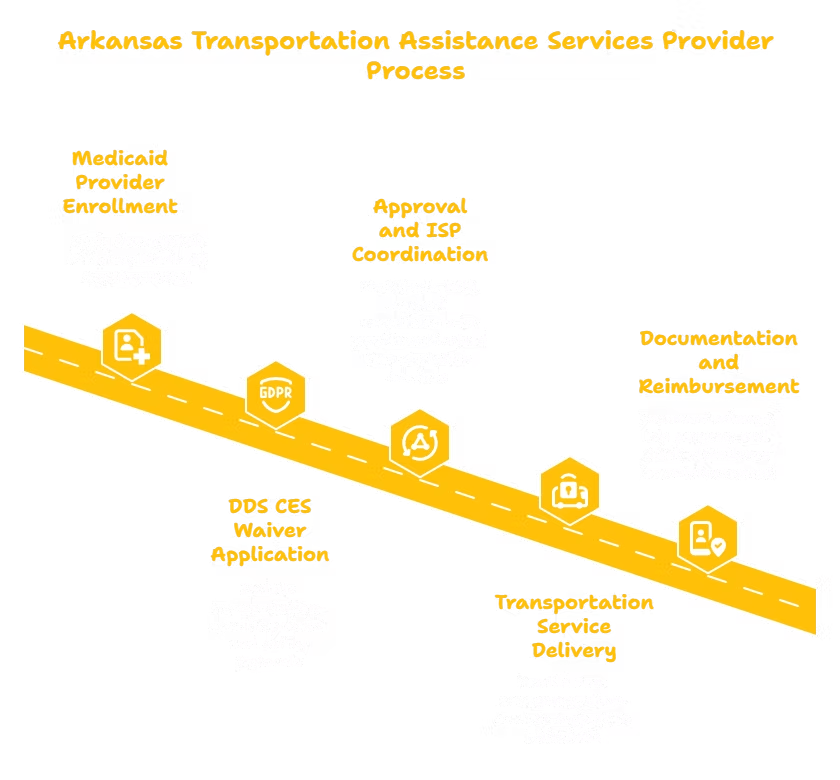
Following business formation, the enrollment process involves two primary phases. First, providers must enroll through the Arkansas Medicaid Provider Portal by submitting business documentation, electronic funds transfer (EFT) information, and designating CES Waiver services. Second, providers must submit a specific CES Waiver Provider Application to DDS, which includes detailed policies regarding vehicle safety, driver training, and incident response protocols.
Ongoing compliance is required to maintain enrollment. Agencies must maintain commercial vehicle insurance and ensure that all fleet registrations are current. Documentation of internal policies is a major component of the initial application and will be reviewed during periodic audits to ensure that the agency meets the safety and ethical standards expected of Medicaid-funded services.
Developing Essential Documentation and Operational Policies
A robust policy and procedure manual is the backbone of a compliant transportation agency. This document serves as a roadmap for daily operations and as a critical piece of evidence during state-level audits. It must explicitly detail how the agency handles the logistical, safety, and privacy aspects of transport services.
Beyond standard business documents like Articles of Incorporation, the manual must include specific workflows for dispatching, tracking mileage, and reporting incidents. Because these services involve vulnerable populations, strict adherence to HIPAA and client confidentiality protocols is essential. Providers must also demonstrate a clear process for onboarding and training drivers, including how they will respond to emergencies or vehicle accidents.
- Vehicle maintenance and comprehensive inspection logs
- Driver onboarding, credentialing, and recurring training procedures
- Trip scheduling, dispatching, and communication workflows
- Standardized mileage documentation and Medicaid billing forms
- Participant rights, confidentiality protocols, and informed consent forms
- Emergency preparedness, accident protocols, and incident reporting systems
Staffing, Training, and Professional Development
The quality of service delivered by a transportation agency is largely dependent on the competence of its staff. The roles of a Transportation Coordinator and the drivers themselves require different skill sets. A Coordinator must be adept at logistics and possess a thorough understanding of Medicaid transportation policies, while drivers must focus on the physical safety and emotional well-being of the passengers.
All staff involved in transporting participants must hold a valid Arkansas driver’s license, pass comprehensive background checks, and demonstrate a clean driving record. Furthermore, ongoing training is mandatory. This training must cover CPR/First Aid, defensive driving, and passenger assistance techniques, particularly for those with mobility challenges. Annual reviews of documentation practices and ethics are also required to keep the staff aligned with the evolving needs of the CES Waiver program.
Frequently Asked Questions
How does the CES Waiver transportation service differ from the general Non-Emergency Transportation (NET) program?
The CES Waiver transportation service is specifically tailored to support participants in reaching their individualized waiver activities and habilitative services. While the state’s NET program is a broader system often managed through transportation brokers for general medical appointments, CES Waiver transportation is integrated directly into the participant’s ISP and is overseen by the Division of Developmental Disabilities Services.
What is the typical timeline for becoming an approved transportation provider?
The entire process typically spans several months. Business formation generally takes one to two weeks, while the Medicaid and CES Waiver enrollment process requires 45 to 90 days. Additional time, ranging from 30 to 45 days, is needed for fleet registration and staff hiring, followed by final service coordination setup, which takes another two to four weeks.
What documentation is required to prove compliance during an audit?
Providers must maintain organized records of vehicle maintenance, driver training logs, and specific trip records. Auditors typically look for mileage logs that correlate with the participant’s ISP-authorized services, incident reports that were filed within required timeframes, and proof that drivers have undergone all mandatory annual training and background screenings.
WAIVER CONSULTING GROUP'S START-UP ASSISTANCE SERVICE — ARKANSAS TRANSPORTATION ASSISTANCE SERVICES PROVIDER
We help transportation providers and community agencies establish Medicaid-compliant transportation services under Arkansas’s CES Waiver program. Our scope of work includes business registration assistance, CES Waiver and Medicaid enrollment support, and the development of comprehensive policy and procedure manuals. We also provide templates for driver logs, mileage tracking, vehicle inspections, and staff credentialing trackers to ensure your agency is audit-ready from day one. Additionally, we assist with client intake packets, incident reporting systems, and referral networking to connect your services with case managers and support coordinators.
Key Takeaway: Establishing a successful transportation assistance service in Arkansas requires a dual focus on operational logistics and strict regulatory compliance. By aligning business processes with the specific requirements of the CES Waiver and maintaining diligent, up-to-date documentation, providers can effectively bridge the gap between participants and the essential community services they rely upon for their independence.
Last verified: October 2023. This content is for informational purposes only and does not constitute legal or professional advice. Always verify current requirements with the Arkansas Department of Human Services (DHS) and relevant federal agencies before initiating business operations.