TRANSITION SERVICES PROVIDER IN NEBRASKA
By Fatumata Kaba · 2025-09-02 · 5 min read
Transition Services in Nebraska are specialized Medicaid-funded supports designed to empower individuals with disabilities, chronic conditions, or those aging out of the foster care system to move successfully from institutional settings to independent community-based living. By providing comprehensive planning, skill development, and resource coordination, these services ensure that participants achieve a seamless and sustainable transition into their own homes or community environments under the framework of Nebraska Medicaid Home and Community-Based Services (HCBS) waivers.
How Do Governing Agencies Regulate Transition Services?
The delivery of Transition Services in Nebraska is governed by a multi-tiered regulatory structure that ensures program integrity and participant safety. The Nebraska Department of Health and Human Services (DHHS) serves as the primary oversight body, managing the operational aspects of Medicaid waiver funding. Their role encompasses the administration of provider enrollment, the formal authorization of services for eligible participants, and the processing of claims for reimbursement.
Supporting the DHHS is the Nebraska Medicaid and Long-Term Care (MLTC) Division, which focuses on the granular details of service quality and compliance. This division ensures that all providers adhere to established HCBS standards and that service delivery remains consistent with the person-centered planning philosophy mandated by state and federal requirements. At the highest level, the Centers for Medicare & Medicaid Services (CMS) provides federal oversight, confirming that all Nebraska Medicaid-funded activities align with national benchmarks for quality, participant protection, and the integration of individuals into the community.
What Are the Core Components of Transition Services?
Transition Services are built upon the foundation of the Individualized Service Plan (ISP), a document that outlines the specific objectives and needs of the participant. Approved providers are responsible for delivering a suite of services that address the practical, social, and logistical challenges of moving from institutional care or transitioning from youth to adult services. These services are intended to foster long-term independence and continuity of care.
Approved providers may deliver the following essential supports:
- Transition Planning: Developing individualized plans that map out specific goals and the resources required to meet them.
- Skill Building: Teaching fundamental independent living skills, including personal care, budgeting, and cooking.
- Housing Support: Assisting participants in navigating the market to find and secure accessible, community-based housing.
- Employment Preparation: Providing job readiness training, resume development, and interview practice to enhance vocational outcomes.
- Educational Continuity: Coordinating with existing school systems and training programs to ensure no lapse in educational attainment.
- Healthcare Coordination: Facilitating the setup of medical appointments, medication management, and ongoing continuity of care.
- Family and Caregiver Support: Providing education and resources to families to help them effectively support the participant's transition.
What Are the Licensing and Provider Approval Requirements?
Becoming an approved Medicaid waiver provider in Nebraska requires a rigorous adherence to administrative and operational prerequisites. Before initiating service delivery, a business entity must be formally registered with the Nebraska Secretary of State. Once the legal entity is established, the provider must obtain a Federal Employer Identification Number (EIN) from the IRS and a Type 2 National Provider Identifier (NPI) to function within the healthcare system.
Operational compliance is equally critical. Providers must maintain robust general and professional liability insurance policies to protect both the agency and the participants. Furthermore, organizations are expected to develop comprehensive internal policies that govern transition planning, skill development, and community integration. A significant portion of the approval process involves establishing rigorous hiring protocols, ensuring that all staff members undergo comprehensive background checks, health screenings, and mandated training to meet the quality standards expected by the DHHS.
How Is the Provider Enrollment Process Structured?
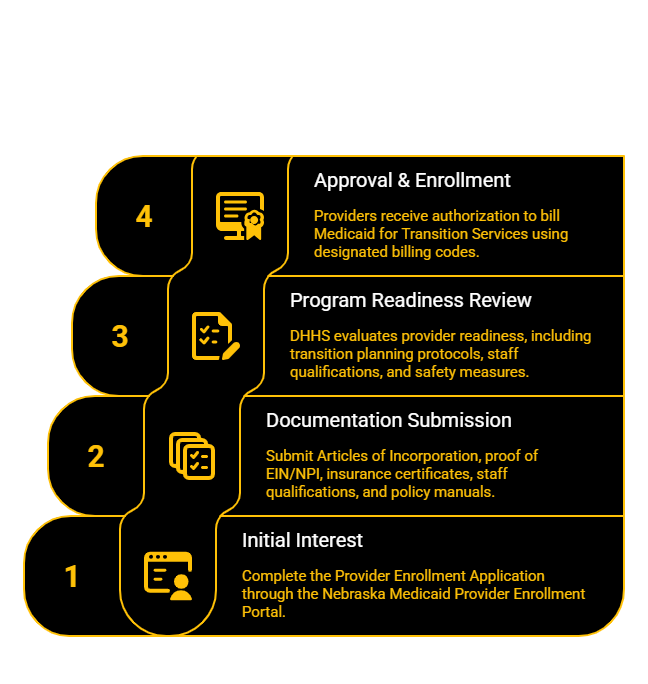
The enrollment process for Nebraska Medicaid Transition Services follows a systematic progression designed to vet the readiness and capability of potential providers. Initial interest begins with the submission of a formal application through the Nebraska Medicaid Provider Enrollment Portal. This stage requires the applicant to demonstrate the capacity to manage the administrative, clinical, and financial responsibilities associated with Medicaid waiver services.
Following the initial application, providers must submit an extensive document package. This package typically includes the Articles of Incorporation, proof of valid EIN and NPI, current insurance certificates, detailed staff qualification records, and comprehensive policy manuals. Once submitted, the DHHS conducts a Program Readiness Review to evaluate the provider’s protocols for service delivery, staff training, and participant safety. Upon successful completion of this review, the provider receives official authorization to bill Medicaid for services rendered using the appropriate billing codes.
What Are the Staffing and Documentation Requirements?
Staffing requirements are designed to ensure that participants receive support from qualified professionals who understand the complexities of transition management. The Transition Program Director must typically possess a Bachelor’s degree in social work, human services, or a related field, along with documented experience in transition planning or community-based services. Similarly, Transition Specialists, as well as Employment and Housing Support Coordinators, must meet specific educational or experience thresholds, including the completion of thorough background clearances.
Documentary compliance is a continuous obligation for providers. The following items must be maintained and ready for audit:
- Articles of Incorporation and business licenses.
- Verified IRS EIN and NPI documentation.
- Proof of professional and general liability insurance.
- A detailed Transition Services Policy & Procedure Manual, covering HIPAA compliance, grievance handling, participant rights, and risk management.
- Comprehensive records of staff credentialing, ongoing training, and annual competency evaluations.
- Documentation standards that track participant progress and ensure accurate Medicaid billing records.
Frequently Asked Questions
What waivers cover Transition Services in Nebraska?
Transition Services are available under several Nebraska Medicaid waivers, including the Aged and Disabled (AD) Waiver, the Traumatic Brain Injury (TBI) Waiver, the Developmental Disabilities (DD) Waiver, the Children with Disabilities Waiver, and the standard Home and Community-Based Services (HCBS) Waiver.
How long does the provider enrollment process take?
The total timeline can vary, but generally includes 1–2 months for business formation, 2–3 months for staff hiring and program development, 60–90 days for the Medicaid Readiness Review, and 30–45 days for final billing setup and launch.
What type of staff training is mandatory?
All staff are required to complete training in person-centered planning, transition facilitation, HIPAA compliance, participant rights, crisis management, and conflict resolution, supplemented by annual professional development.
Key Takeaway
Launching a Transition Services agency in Nebraska requires a deep commitment to administrative precision, adherence to Medicaid regulatory standards, and a focus on person-centered outcomes. By carefully managing the phases of business development—from credentialing and policy formulation to the final Medicaid readiness review—providers can successfully establish a sustainable operation that facilitates meaningful community integration for some of Nebraska’s most vulnerable populations.
Waiver Consulting Group (WCG) supports agencies in launching Medicaid-compliant Transition Services in Nebraska. Services include business registration, Medicaid enrollment assistance, the development of robust policy manuals for transition planning, staff credentialing support, and the establishment of audit-prepared financial management systems to ensure long-term program viability. Our Client Portal offers a wealth of resources that you can explore related to various programs and state requirements.
Last verified: 05/22/2024. This information is for educational purposes only and does not constitute legal or professional advice. Always consult directly with the Nebraska Department of Health and Human Services (DHHS) or qualified legal counsel regarding specific program requirements and state regulations.