TRANSITION AND SUPPORT SERVICES PROVIDER IN OHIO
By Fatumata Kaba · 2025-09-17 · 5 min read
Transition and Support Services in Ohio represent a vital component of the state’s commitment to community-integrated care, enabling individuals to successfully exit institutional settings and thrive in home-based environments. As a provider, launching these services requires a rigorous adherence to person-centered planning protocols and strict compliance with the oversight standards established by the Ohio Department of Medicaid, the Department of Developmental Disabilities, and the Department of Aging.
What Are Transition and Support Services in the Ohio HCBS Context?
Transition and Support Services are specialized Medicaid Home and Community-Based Services (HCBS) designed to bridge the gap between restrictive institutional settings—such as nursing homes, hospitals, and intermediate care facilities—and the independence of community living. These services focus on the high-stakes period of relocation, ensuring that the move is not only physically safe but also sustainable long-term to prevent the risk of re-institutionalization.
The service model is built upon the principle of person-centered support, which prioritizes the individual’s goals, preferences, and unique clinical needs. By providing structured transition planning, housing navigation, and community orientation, providers act as the primary support system for participants during what can be an overwhelming life change. Success in this field is measured by the participant's ability to maintain their health, safety, and integration within their chosen community setting.
How Do Governing Agencies Regulate Transition Providers?
The regulatory landscape for Ohio transition services is multi-faceted, involving both federal oversight and state-level administration. The Centers for Medicare & Medicaid Services (CMS) sets the overarching federal standards for quality and safety, ensuring that all HCBS programs meet federal requirements for community integration and participant rights. Agencies must align their internal operations with these federal expectations to maintain program eligibility.
At the state level, the Ohio Department of Medicaid (ODM) maintains ultimate authority over provider enrollment and Medicaid billing processes. Depending on the population served, providers must also coordinate with the Ohio Department of Developmental Disabilities (DODD) for intellectual and developmental disability-specific waivers, or the Ohio Department of Aging (ODA) for programs like PASSPORT and MyCare Ohio. Compliance with these agencies involves consistent reporting, adherence to state-specific policies, and readiness for periodic audits.
What Are the Core Responsibilities of an Approved Provider?
Approved providers are responsible for the end-to-end lifecycle of the transition process. This includes pre-transition planning, where the provider assesses the individual’s needs and assists in locating suitable, accessible housing. Once a site is identified, the provider facilitates housing navigation, which can include managing the procurement of basic furniture and household supplies to ensure the new living space is functional upon move-in.
Following the move, the provider continues to play a critical role through community orientation and life skills development. This involves teaching the participant how to navigate local transportation, access community services, and manage daily tasks like personal care and meal preparation. Crucially, providers must also implement a follow-along support system, which involves regular check-ins and re-assessments to proactively address any barriers to stability and to coordinate ongoing HCBS services such as homemaker support.
- Transition Planning: Formalizing goals and assessing community placement options.
- Housing Navigation: Securing accessible housing and essential household setup.
- Community Integration: Training on public transit, local services, and health/safety management.
- Follow-Along Support: Ongoing stabilization checks and documentation of progress.
What Are the Essential Requirements for Provider Certification and Enrollment?
The path to becoming a certified provider begins with formal business formation, which includes registering the entity with the Ohio Secretary of State and obtaining an Employer Identification Number (EIN) and a Type 2 NPI. Once the business foundation is established, prospective providers must navigate the specific enrollment portal for their target population, such as the DODD Provider Certification Portal or the Ohio Medicaid Provider Network (MPN).
During the enrollment phase, applicants must demonstrate organizational readiness through comprehensive policy manuals. These documents must detail procedures for transition planning, risk management, and HIPAA compliance. Because this service involves vulnerable populations, proof of general and professional liability insurance is mandatory. The review process conducted by ODM, DODD, or ODA is designed to verify that the provider’s operational infrastructure—including staff training and emergency response protocols—is robust enough to support complex transitions.
How Are Staffing Requirements and Competencies Structured?
Successful transition programs rely on a multi-disciplinary team capable of addressing both clinical and practical needs. The Transition Services Coordinator, who often leads the planning process, is typically required to hold a degree in social work or human services, bringing expertise in discharge planning and HCBS coordination. This role is supported by Community Integration Specialists and Direct Support Professionals (DSPs) who provide the day-to-day assistance needed for life skills development.
All staff members are subject to rigorous training requirements to ensure the delivery of high-quality, person-centered care. Before interacting with participants, personnel must complete mandatory training modules covering HIPAA, participant rights, emergency response, and the nuances of the specific waiver programs they support. Ongoing professional development and annual performance reviews are required to maintain compliance, ensuring that all staff members remain current on best practices in advocacy and personal care.
Frequently Asked Questions
Which Medicaid waiver programs cover Transition and Support Services?
These services are authorized under several Ohio Medicaid waivers, including the Individual Options (IO) Waiver, Level One Waiver, SELF Waiver, PASSPORT Waiver, Ohio Home Care Waiver, and MyCare Ohio, which covers managed long-term services and supports.
What is the typical timeline for launching a transition services agency?
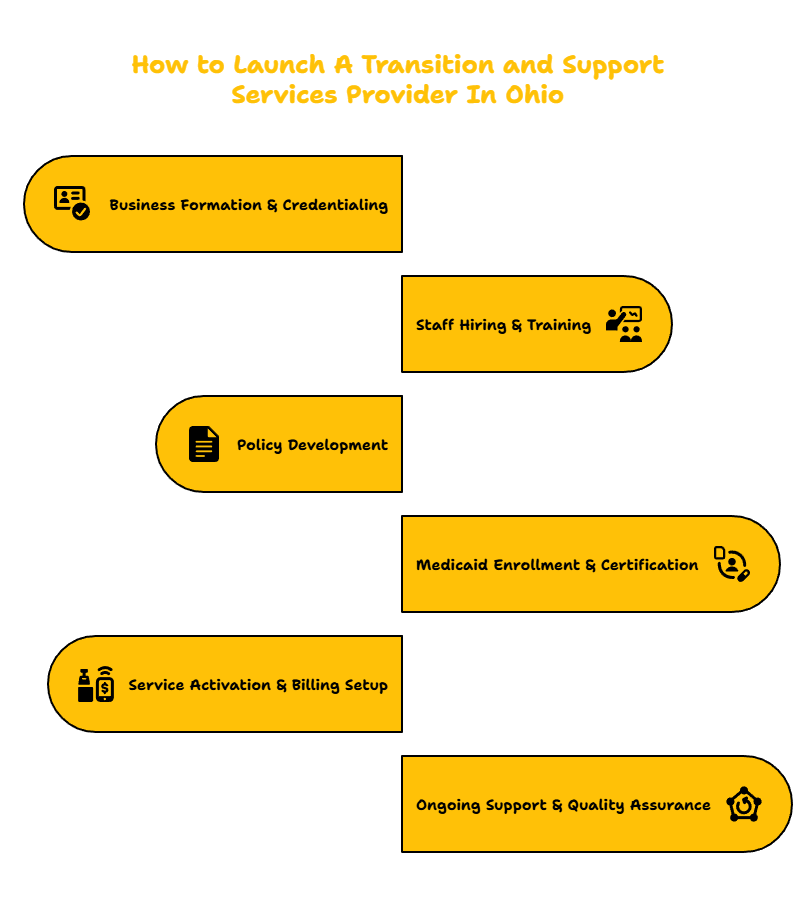
The launch process generally spans several months, typically requiring 1–2 months for business formation, 2–3 months for policy development and staffing, 60–90 days for Medicaid enrollment and certification, and 30–45 days for final billing setup and service activation.
What documentation is required during the provider enrollment process?
Providers must submit organizational documents such as Articles of Incorporation, IRS EIN confirmation, NPI registration, and insurance certificates. Additionally, a detailed Policy and Procedure Manual covering transition protocols, HIPAA, staff training, and quality assurance is required for state review.
Key Takeaway
Establishing a successful Transition and Support Services agency in Ohio is a complex process that demands meticulous attention to regulatory compliance, staff training, and the nuanced delivery of person-centered care. By strictly adhering to the standards set forth by ODM, DODD, and ODA, providers can effectively bridge the gap for individuals moving into community living, ensuring their safety, independence, and long-term success. Careful preparation, from the initial business registration to the implementation of robust internal policies, is essential for maintaining the operational stability required to serve these vulnerable populations effectively.
Last verified: May 2024. This content is for informational purposes only and does not constitute legal or professional advice. Always refer to the official Ohio Department of Medicaid and waiver-specific manuals for the most current regulatory requirements.