Told You Can't Open a Group Home Directly? Welcome to Gated Entry
By Fatumata Kaba · 2026-06-26 · 5 min read
If you are attempting to launch a residential group home and have been blocked from applying for a license directly, you are encountering a modern regulatory shift known as the “gated entry” model. State Medicaid agencies are increasingly restricting initial provider participation, requiring new businesses to demonstrate operational capacity through lower-acuity services before allowing them to move into high-acuity residential care.
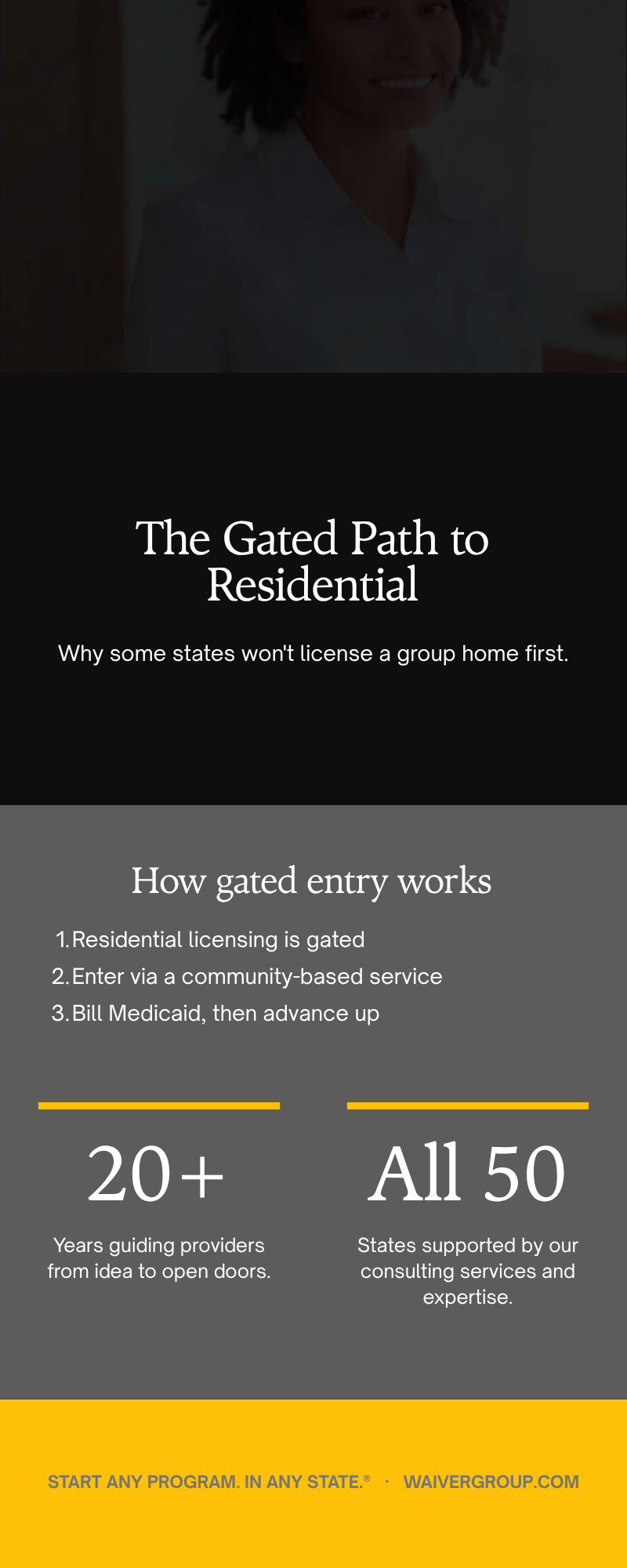
This strategy is designed to ensure that only providers with a proven track record of Medicaid compliance and service delivery are entrusted with 24-hour residential oversight. Understanding this required sequence is essential; bypassing it or attempting to apply out of order often results in automatic denials, lost application fees, and months of unnecessary administrative delays.
Why States Have Adopted the Gated Entry Model
State Medicaid agencies and Home and Community-Based Services (HCBS) departments face increasing pressure to ensure participant safety and fiscal integrity. By implementing a gated entry model, regulators create a probationary period where a provider must prove their competence on a smaller scale before being permitted to operate a residential facility.
The philosophy is simple: residential care represents a higher risk and higher financial liability. When a provider enters the system via a community-based service—such as personal supports or day habilitation—they must navigate the rigorous Medicaid enrollment and audit processes. This ensures that when the provider eventually applies for residential licensing, they are already familiar with the state’s billing systems, documentation requirements, and incident reporting protocols.
Identifying the Correct Gateway Service
The specific service designated as the “gateway” varies significantly by state, but these services typically share common characteristics. They are generally community-focused, have lower physical plant requirements than group homes, and involve fewer complexities regarding overnight staffing and emergency management.
Common entry points include:
- Community Participation Supports: Focused on social integration and daily living skills in a non-residential setting.
- Supported Living/Independent Living Skills: Focused on training participants to live in their own homes, rather than the provider owning or leasing the facility.
- Personal Care or Respite Services: Often the most accessible entry points due to their high demand and essential nature.
It is vital to identify your state’s specific gateway service during the early business planning phase. Selecting the wrong service to launch with can result in a mismatch between your business trajectory and the state’s regulatory expectations, effectively wasting your initial capital and operational focus.
Step-by-Step Sequence to Reach Residential Licensing
Transitioning from a gateway service to residential care requires a deliberate, documented, and proactive strategy. You cannot simply apply for the residential license once you feel ready; you must demonstrate that you have fulfilled the requirements of the entry-level service and maintained compliance for a set period.
The typical path follows this trajectory:
- Business entity formation and regulatory alignment.
- Successful completion of all required provider training modules for the chosen gateway service.
- Obtaining the specific Medicaid provider enrollment credentials necessary to bill for that entry-level service.
- Active service delivery and clean billing cycles.
- Performance monitoring, where the state assesses your ability to meet documentation and reporting requirements.
- Application for residential licensure once eligibility criteria are met.
Navigating Credentials and Endorsements
Each gateway service possesses its own unique set of training requirements, professional certifications, and Medicaid enrollment hurdles. A common mistake among new founders is assuming that one set of credentials applies across all HCBS services. In reality, state programs treat residential and community-based services as distinct silos.
When preparing to launch your gateway service, ensure your staff and administrative team meet the specific endorsement requirements for that program. This often includes background checks, specific educational qualifications for direct support professionals, and state-mandated training sessions. By prioritizing these credentials early, you build a foundation of organizational legitimacy that will be essential when you petition the state for a residential license later.
The Importance of Billing History and Compliance
Medicaid departments view your billing history as an indicator of your organizational maturity. If you are inconsistent with your claims or fail to maintain the necessary documentation to support your services, the state will be unwilling to approve your expansion into residential care. The gated entry model acts as a stress test for your back-office operations.
Focus on maintaining meticulous records, staying updated on the state’s provider bulletins, and participating in any available training webinars offered by the local Medicaid agency. High compliance scores and a record of error-free billing provide the necessary evidence to state regulators that your agency is stable, reliable, and prepared for the increased demands of a residential environment.
Frequently Asked Questions
Does operating a community-based service guarantee I will eventually get a residential license?
No. While the gated entry model provides the necessary path to apply for residential licensing, it does not guarantee approval. The state will still assess your agency’s performance, capacity, and current needs of the waiver program in your specific region before approving a residential license application.
How long should I expect to operate in the gateway phase?
The duration of the gateway phase depends on your state’s specific regulations and your ability to maintain consistent compliance. Most states require several months of active billing and service delivery to ensure the provider is stable, but this timeline is dictated by the specific state agency, not by your own business goals.
Can I apply for multiple services simultaneously if one is a gateway service?
Generally, you must focus on the primary gateway service to gain your initial enrollment. Adding additional services simultaneously often complicates the application process and can trigger secondary reviews or delays in your initial enrollment, which is detrimental to your timeline.
Key Takeaway
In a gated entry state, you cannot start with residential licensing. You must enter through a designated community-based service, successfully enroll and bill under it, and maintain operational compliance to build the necessary track record. Acknowledging this sequence and following the state’s defined path is the only way to avoid systemic delays and secure your eventual move into residential care.
Start Any Program. In Any State.®
Ready to talk it through? 20+ years clearing the path in all 50 states — we've done this before, and we'll do it for you. Book a video consultation at waivergroup.com/videoappointment, call 302.888.9172, or email [email protected].
Last verified: May 2024. The information provided in this article is for educational purposes and does not constitute legal or professional advice. Always consult with your state’s specific Medicaid agency or a qualified professional regarding current program requirements, as regulations are subject to change.