THERAPY SERVICES PROVIDER IN TEXAS
By Fatumata Kaba · 2026-03-30 · 5 min read
Establishing a therapy services agency in Texas requires navigating a complex regulatory landscape governed by the Texas Health and Human Services Commission (HHSC) and the Texas Medicaid & Healthcare Partnership (TMHP). Providing rehabilitative and habilitative therapies within the state’s Home and Community-Based Services (HCBS) waiver programs involves rigorous licensure, credentialing, and programmatic compliance to support the functional independence, mobility, and communication needs of individuals with disabilities.
This guide serves as a foundational roadmap for prospective provider agencies aiming to deliver Physical Therapy (PT), Occupational Therapy (OT), and Speech-Language Pathology (SLP) services under Texas waiver programs like HCS, CLASS, TxHmL, DBMD, and MDCP. By adhering to federal guidelines overseen by the Centers for Medicare & Medicaid Services (CMS) and meeting specific state-level enrollment milestones, providers can build sustainable, compliant operations that meet the critical needs of the Texas Medicaid population.
What are the Core Regulatory Agencies and Oversight Requirements?
The provision of therapy services in Texas is managed through a multi-tiered regulatory framework. The Texas Health and Human Services Commission (HHSC) acts as the primary authority, managing waiver programs, authorizing service delivery, and contracting with qualified providers. Prospective agencies must maintain active, good-standing contracts with HHSC to receive referrals and bill for services provided to individuals enrolled in specific 1915(c) HCBS waiver programs.
Beyond HHSC oversight, individual practitioners must adhere to the professional standards enforced by the Texas Department of Licensing and Regulation (TDLR) and the relevant state boards of examiners for PT, OT, and SLP. These boards ensure that all therapists maintain active, valid licenses to practice in Texas. Furthermore, all operations must remain consistent with federal Medicaid guidelines established by CMS, which define the parameters of medically necessary rehabilitative and habilitative interventions.
How to Differentiate Between Rehabilitative and Habilitative Therapy Services?
Waiver-funded therapy services are distinctly categorized based on the goal of the intervention. Rehabilitative services are designed to restore a function or skill that was lost due to illness, injury, or a health condition. These interventions focus on returning an individual to their prior level of performance, emphasizing recovery and the re-establishment of physical or cognitive capabilities.
Conversely, habilitative services focus on teaching skills that the individual has not yet acquired, which is a frequent requirement when supporting individuals with developmental disabilities. Whether the intervention is rehabilitative or habilitative, every therapy service must be prescribed by a physician and explicitly linked to the individual’s Individual Plan of Care (IPC) or Person-Centered Plan (PDP). Examples of covered services include:
- Physical Therapy (PT): Focused on improving mobility, balance, core strength, and coordination.
- Occupational Therapy (OT): Targeting fine motor skills, activities of daily living (ADLs), and sensory integration strategies.
- Speech-Language Pathology (SLP): Addressing communication barriers, speech production, swallowing difficulties, and the implementation of augmentative and alternative communication (AAC) devices.
What are the Essential Steps to Enroll as a Texas Medicaid Therapy Provider?
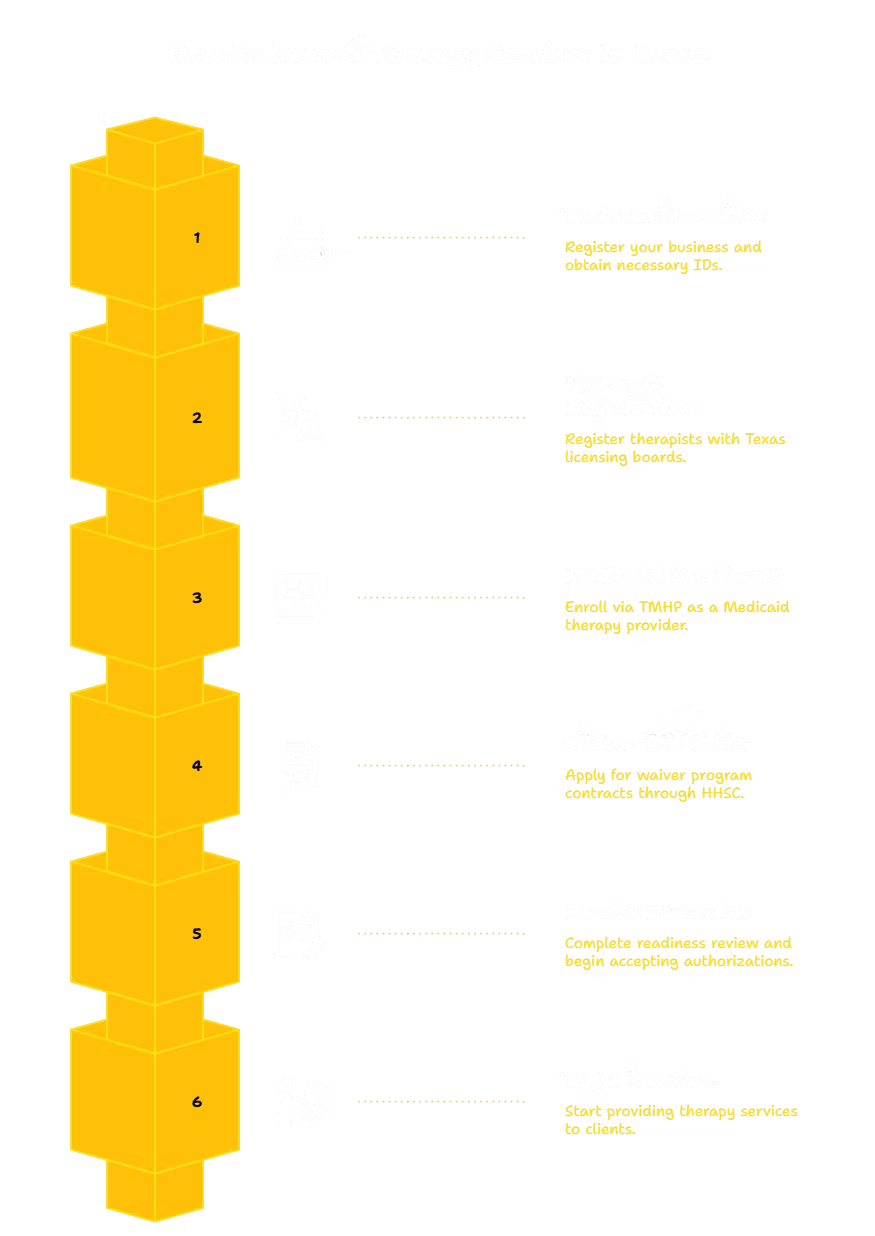
The enrollment process is a structured, sequential journey that requires meticulous attention to detail. Initially, a provider must formalize their business entity with the Texas Secretary of State and obtain a Federal Employer Identification Number (EIN) and a Type 2 National Provider Identifier (NPI). These foundational steps provide the legal and financial infrastructure required for all subsequent administrative filings.
Following entity formation, the provider must navigate the enrollment process through TMHP. This involves registering as a Medicaid therapy provider and applying for specific waiver program contracts through HHSC. The final phase of enrollment requires a readiness review to ensure that the agency possesses the necessary policies, procedures, and staffing capabilities to handle authorizations. Successful completion of this phase authorizes the agency to begin receiving service referrals and executing care plans.
What Operational Documentation is Required for Compliance?
Maintenance of a comprehensive Policy & Procedure Manual is a mandatory requirement for any therapy services agency operating under Texas Medicaid waivers. This documentation serves as the operational backbone of the organization, demonstrating to auditors and state agencies that the provider adheres to legal and ethical standards. Key elements that must be integrated into this manual include:
- Detailed protocols for service plan development and systematic tracking of treatment goals.
- Standardized templates for progress notes and mandatory reassessment schedules.
- Strict adherence to physician order documentation and timely renewal cycles.
- Comprehensive HIPAA compliance strategies, including robust consent forms and privacy protections.
- Emergency protocols and defined risk mitigation strategies for home and community settings.
- Structured billing logs and internal auditing systems for service authorization management.
What are the Staffing and Credentialing Obligations?
The quality of care is directly tied to the qualifications of the therapy staff. Every Physical Therapist, Occupational Therapist, and Speech-Language Pathologist must hold an active Texas license. When utilizing therapy assistants—such as PTAs, OTAs, or SLPAs—the agency must ensure that these staff members are not only licensed but also operate under the required supervision of a licensed primary therapist as mandated by state board regulations.
Beyond licensure, agency leadership must ensure that all staff undergo specific waiver-related training. This includes instruction on Medicaid-specific documentation standards, person-centered planning, and alignment with the individual’s ISP (Individual Support Plan) goals. Additionally, all personnel must stay current with HIPAA privacy laws, abuse prevention reporting protocols, and emergency readiness requirements such as CPR and First Aid certifications.
Frequently Asked Questions
How long does the provider enrollment process typically take?
The timeline for launch is generally divided into phases: 1–2 months for business formation and manual development, 2–3 months for TMHP enrollment and HHSC contracting, and 30–60 days for staff credentialing and readiness reviews. Actual service commencement follows the successful receipt of service authorizations and ISP alignment.
Which Medicaid waiver programs cover therapy services in Texas?
Therapy services are provided through several key programs, including HCS (Home and Community-Based Services), CLASS (Community Living Assistance & Support Services), TxHmL (Texas Home Living), DBMD (Deaf Blind with Multiple Disabilities Program), MDCP (Medically Dependent Children Program), and the YES Waiver for youth with serious emotional disturbances.
What is the role of Waiver Consulting Group (WCG) in this process?
WCG provides specialized start-up assistance to help therapists and agencies navigate the complex landscape of Texas HCBS and waiver populations. Services include support for TMHP and HHSC enrollment, the creation of robust Therapy Services Policy & Procedure Manuals, and the development of ISP-aligned documentation templates and billing guides.
Key Takeaway
Successfully operating as a therapy services provider in Texas requires a commitment to rigorous regulatory compliance, precise documentation, and a deep understanding of the unique requirements of the 1915(c) waiver programs. By integrating high standards for professional licensure, meticulous record-keeping, and proactive administrative planning, agencies can successfully bridge the gap between essential therapy services and the individuals who rely on them for functional independence and community integration.
Last verified: September 2023. Disclaimer: This article is for informational purposes only and does not constitute legal or professional advice. Always consult directly with the Texas Health and Human Services Commission (HHSC) and official state regulatory boards for the most current program requirements and legal guidance.