THERAPY SERVICES PROVIDER IN OHIO
By Fatumata Kaba · 2025-09-17 · 5 min read
Becoming a therapy services provider in Ohio involves navigating a complex intersection of Medicaid regulatory requirements, professional licensure standards, and person-centered service delivery models. As a specialized provider, your agency will facilitate essential physical, occupational, and speech-language therapies that enable individuals with disabilities and chronic health conditions to achieve greater independence within their homes and communities.
To successfully launch and operate, organizations must maintain compliance with the Ohio Department of Medicaid (ODM), the Ohio Department of Developmental Disabilities (DODD), and the Centers for Medicare & Medicaid Services (CMS). This guide outlines the operational frameworks, enrollment requirements, and administrative protocols necessary to provide high-quality therapeutic interventions under the state’s Home and Community-Based Services (HCBS) waiver programs and State Plan benefits.
What Governing Agencies Oversee Therapy Services in Ohio?
The regulatory environment for therapy services is multi-tiered, requiring providers to demonstrate adherence to both state and federal mandates. The Ohio Department of Medicaid (ODM) serves as the primary authority, overseeing Medicaid coverage policies, billing authorizations, and the rigorous documentation standards required for reimbursement. Failure to align clinical documentation with ODM guidelines is a common cause for audit findings, making it essential for providers to understand current administrative rules.
Complementing the ODM, the Ohio Department of Developmental Disabilities (DODD) coordinates the integration of therapy supports directly into the Individual Service Plans (ISPs) of waiver participants. Furthermore, the Ohio Department of Health (ODH) maintains oversight of professional licensure and the operational standards for outpatient therapy clinics. Finally, all services must ultimately align with the federal guidelines established by the Centers for Medicare & Medicaid Services (CMS) to ensure that every intervention provided meets the threshold of medical necessity.
What Clinical Interventions Are Authorized Under Medicaid Waivers?
Therapy services are designed to improve functional abilities, promote community living, and support developmental milestones. These services may be delivered in a participant's home, a clinical facility, or other authorized community settings. Providers must ensure that all services are prescribed based on documented medical needs and that the delivery of care directly supports the goals outlined in the participant’s service plan.
Approved providers typically offer a comprehensive suite of interventions, including:
- Physical Therapy (PT): Focused on improving mobility, strength, balance, and range of motion.
- Occupational Therapy (OT): Enhancing daily living skills such as dressing, eating, and grooming to increase autonomy.
- Speech-Language Therapy (SLP): Addressing communication, speech clarity, and swallowing function.
- Feeding and Swallowing Therapy: Specifically targeting dysphagia to ensure safe oral intake.
- Sensory Integration Therapy: Supporting individuals with sensory processing challenges.
- Augmentative and Alternative Communication (AAC): Assessment and training for individuals utilizing communication devices.
- Developmental and Early Intervention: Promoting critical skill acquisition for children and youth.
How Do Providers Navigate the Enrollment and Licensing Process?
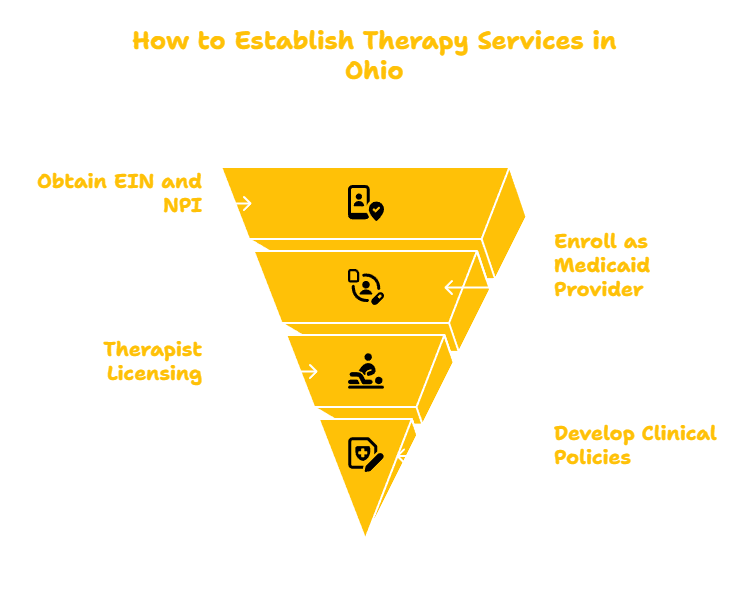
The path to becoming an approved provider begins with establishing the legal business entity and ensuring all clinical staff hold the appropriate credentials. Organizations must register with the Ohio Secretary of State and obtain an Employer Identification Number (EIN) from the IRS, followed by a Type 2 NPI registration. Once the business is established, the agency must enroll through the Ohio Medicaid Provider Enrollment Portal.
The enrollment process is extensive and requires meticulous attention to detail. Agencies must submit proof of licensure, business registrations, insurance certificates, and comprehensive policy manuals. During this phase, state agencies may conduct a Readiness Review to evaluate site safety, the adequacy of credentialing records, and the robustness of clinical compliance plans. Final approval allows the provider to receive Medicaid billing credentials and begin service delivery.
What Documentation and Compliance Standards Must Be Maintained?
Maintaining a high standard of documentation is the cornerstone of a sustainable therapy practice. Providers are expected to maintain an exhaustive Therapy Services Policy & Procedure Manual that covers evaluation protocols, person-centered therapy planning, and session tracking. Every intervention must be tied to a clear, measurable goal that is updated as the participant progresses.
Beyond clinical notes, the agency must ensure institutional compliance regarding HIPAA, emergency response, and infection control. Documentation must include:
- Articles of Incorporation and proof of active business licensure.
- Verification of therapist licenses and cleared background checks.
- Session tracking templates that capture the start and end times, specific interventions, and participant responses.
- Quality assurance tools, including internal audits and client satisfaction surveys.
- Informed consent procedures that outline the participant’s rights and the nature of the therapy provided.
What Are the Staffing and Training Requirements?
The clinical integrity of an agency depends on the qualifications of its staff. A Clinical Director, typically a licensed PT, OT, or SLP with supervisory experience, is necessary to oversee the clinical program. All therapists must hold current state licenses and should possess specific experience relevant to the Medicaid or waiver populations they serve. For assistants (PTAs, COTAs, SLPTAs), work must be performed under the direct supervision of a licensed therapist, with documented oversight maintained in the staff file.
Ongoing education is mandatory to keep staff informed of evolving state regulations. All personnel must complete training in HIPAA compliance, rights-based service delivery, and emergency response procedures. Additionally, therapists must remain current with their annual Continuing Education Units (CEUs) and ensure their professional licenses are renewed in accordance with the Ohio OT/PT/AT Board or the Ohio Speech and Hearing Professionals Board.
Frequently Asked Questions
Can therapy services be delivered in a school or community setting?
Yes, provided the service location is included in the Individual Service Plan (ISP) and meets the clinical and regulatory requirements for safe, effective delivery as defined by the participant's specific waiver program and the state’s guidelines.
How does a provider ensure compliance with billing?
Compliance is achieved by ensuring that every billed unit of service is supported by a corresponding clinical note that details the specific medical necessity, the goal being addressed, and the participant's progress during the session. Regular internal audits of these notes against the ISP goals are recommended.
What is the typical timeframe for agency startup?
The launch process generally spans several months, typically requiring 1–2 months for business registration, 2–3 months for policy development, and a further 60–90 days for Medicaid enrollment and potential Readiness Reviews. Agencies should factor in an additional 30–45 days for final billing activation.
Waiver Consulting Group’s Start-Up Assistance Service
WCG provides structured support for new and growing providers looking to establish a Medicaid-compliant therapy practice. This assistance covers the foundational elements of business setup, including Medicaid enrollment and therapist credentialing, alongside the creation of robust policy manuals that align with current PT, OT, and SLP standards. WCG helps agencies implement clinical documentation systems, billing templates, and quality assurance mechanisms designed for audit preparedness and long-term operational success.
Key Takeaway: Successfully operating as a therapy services provider in Ohio requires a dual commitment to clinical excellence and rigorous administrative compliance. By meticulously following the requirements set forth by ODM and DODD, maintaining thorough documentation, and ensuring staff remain trained and credentialed, providers can deliver vital, life-changing services that enable participants to thrive in their communities.
Last verified: October 2023. This document is for informational purposes only and does not constitute legal or professional advice. Always refer to the latest Ohio Medicaid rules and regulatory handbooks for current compliance requirements.