THERAPY SERVICES PROVIDER IN NORTH DAKOTA
By Fatumata Kaba · 2025-09-18 · 5 min read
PROMOTING WELL-BEING THROUGH THERAPEUTIC INTERVENTIONS AND SUPPORT
Therapy Services in North Dakota are essential components of the state’s Home and Community-Based Services (HCBS) ecosystem, designed to provide individuals with disabilities, chronic conditions, or age-related challenges access to clinical care that fosters independence and improves quality of life. By integrating physical, cognitive, and emotional interventions into a person-centered framework, these services enable participants to remain in their homes and communities rather than in institutional settings.
Authorized under North Dakota Medicaid HCBS waiver programs, these services require providers to adhere to rigorous state and federal standards for care delivery, documentation, and compliance. Navigating the regulatory landscape—from initial Medicaid enrollment via the North Dakota Medicaid Management Information System (MMIS) to the ongoing management of clinical protocols—is a foundational requirement for any agency looking to enter this sector.
What Are the Governing Agencies and Oversight Frameworks?
The delivery of therapeutic interventions in North Dakota is governed by a multi-tiered regulatory structure that ensures quality, safety, and fiscal integrity. At the state level, the North Dakota Department of Human Services (NDDHS) serves as the primary administrator, overseeing Medicaid waiver funding, provider enrollment, and reimbursement protocols. Working in tandem, the North Dakota Medical Services Division (MSD) manages the operational aspects of Medicaid waiver services and maintains strict oversight of provider participation requirements.
For services specifically targeting the elderly or adults with disabilities, the North Dakota Division of Aging Services provides specialized oversight to ensure that interventions are appropriately tailored to these populations. Additionally, the Centers for Medicare & Medicaid Services (CMS) provides federal oversight, setting the overarching standards for person-centered care and quality assurance that all state-level programs must meet. Understanding these agencies is critical for any agency administrator, as compliance with each body is mandatory for ongoing program authorization.
Which Therapy Services Are Approved Under HCBS Waivers?
Therapy Services are categorized by their specific focus on improving physical, cognitive, and emotional outcomes. Approved providers are expected to deliver targeted techniques that move beyond general support to address specific clinical challenges. The following list details the core disciplines permitted under the waiver, each requiring its own unique set of professional credentials and individualized care planning:
- Physical Therapy (PT): Focused on improving mobility, strength, and coordination through structured physical exercises.
- Occupational Therapy (OT): Dedicated to developing daily living skills and teaching adaptive techniques that promote personal independence.
- Speech and Language Therapy (SLT): Addresses communication disorders and clinical issues such as dysphagia (swallowing difficulties).
- Behavioral and Cognitive Therapy: Implements strategies to manage challenging behaviors and assists with memory, problem-solving, and cognitive function.
- Creative and Recreational Therapy: Utilizes music, art, and structured physical activities to enhance social participation and emotional well-being.
- Mental Health and Trauma-Informed Counseling: Provides specialized emotional support for individuals navigating trauma or complex psychological challenges.
What Are the Prerequisites for Licensing and Provider Enrollment?
Before an agency can begin billing for therapy services, it must successfully navigate the North Dakota Medicaid enrollment process. This begins with formal business entity registration through the North Dakota Secretary of State and the procurement of an IRS Employer Identification Number (EIN). Furthermore, the agency must secure a Type 2 National Provider Identifier (NPI) to function as an organizational billing entity within the Medicaid system.
Operational readiness is a key factor in the approval process. Providers must maintain comprehensive general and professional liability insurance to protect both the agency and the participants. Before the formal application is submitted, an agency must develop a robust Policy and Procedure Manual. This document serves as the foundation for the agency’s operations, outlining everything from client safety and infection control to HIPAA compliance and the management of participant grievances.
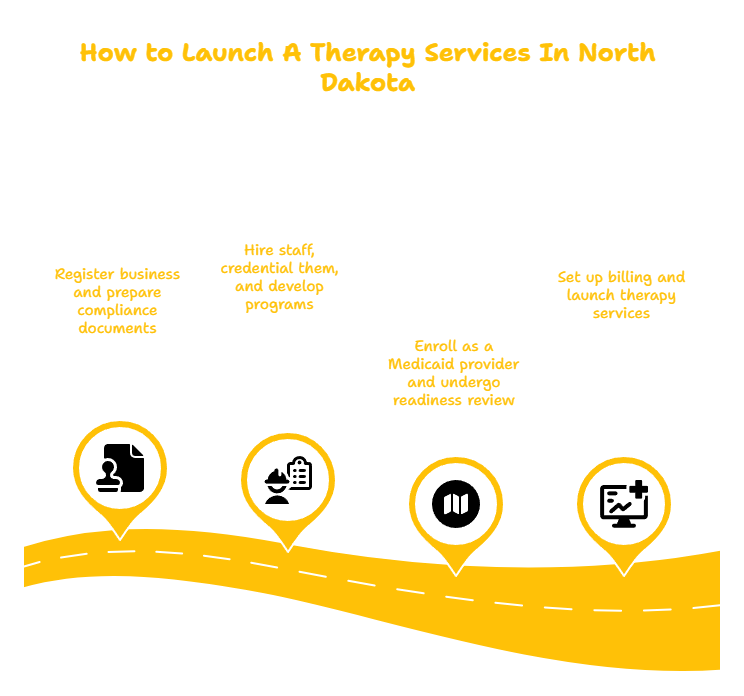
How Do Agencies Navigate the Enrollment and Readiness Process?
The path to becoming an approved North Dakota Medicaid provider is a structured, phase-based journey. Initially, the applicant must complete the Provider Enrollment Application via the North Dakota MMIS specifically for Therapy Services. This stage requires the submission of all corporate and insurance documentation, which the NDDHS and MSD will subsequently review. It is vital to ensure that every document, from Articles of Incorporation to staff licensure, is precise and up-to-date to avoid delays.
Following the document submission, the agency undergoes a Program Readiness Review. During this phase, state officials evaluate the agency’s ability to deliver care, assessing the validity of care protocols, safety measures, and staff qualifications. Successful completion of this review results in official authorization to bill for services using specific Medicaid billing codes. It is highly recommended that administrators treat this period as an audit-readiness phase, ensuring that all record-keeping systems are fully operational before the first service is delivered.
What Are the Essential Staffing and Training Requirements?
The quality of therapeutic care is entirely dependent on the credentials and ongoing training of the staff. Each clinical role carries specific educational requirements: a Therapy Program Director must be a licensed therapist with a Master’s or Doctorate degree, while specialized roles like Physical Therapists (DPT), Occupational Therapists (Master’s level), Speech-Language Pathologists (ASHA certified), and Behavioral Therapists (BCBA) must maintain current state licensure and certifications.
Beyond initial hiring, the agency is responsible for an ongoing training infrastructure. All staff members must receive regular education regarding HIPAA compliance, participant rights, and emergency response procedures. Annual competency evaluations are required to ensure that therapy techniques remain aligned with current best practices. Maintaining a centralized repository of training records is essential for demonstrating compliance during periodic state audits.
Frequently Asked Questions
Which Medicaid waivers currently include therapy services?
Therapy services are covered under several North Dakota programs, specifically the Aged and Disabled Waiver, the Technology Dependent Waiver, the Developmental Disabilities Waiver, and the general Home and Community-Based Services (HCBS) Waiver.
What is the typical timeline for launching a therapy agency?
The process generally takes 6 to 10 months. This includes 1–2 months for business formation, 2–3 months for staff hiring and credentialing, 60–90 days for Medicaid enrollment and readiness reviews, and 30–45 days for final billing setup.
What must be included in the Policy and Procedure Manual?
The manual must detail therapeutic intervention protocols, individualized care planning, staff credentialing procedures, documentation standards for Medicaid billing, HIPAA compliance, participant rights, grievance handling, and infection control and safety practices.
Waiver Consulting Group provides comprehensive start-up assistance for agencies looking to enter the North Dakota market. This support includes business registration, Medicaid enrollment navigation, development of policy manuals, creation of staff training templates, and the implementation of quality assurance systems designed to ensure long-term compliance and audit readiness. By professionalizing the foundational elements of the agency, providers can focus on the delivery of high-quality therapeutic care.
Key Takeaway: Success in the North Dakota Therapy Services sector requires a rigorous commitment to the documentation and clinical standards set forth by the NDDHS and CMS. By prioritizing regulatory compliance, credentialed staffing, and organized Medicaid billing, agency administrators can build a sustainable, person-centered service model.
Last verified June 2024. This information is for educational purposes only and does not constitute legal or professional consulting advice. Always consult with the North Dakota Department of Human Services or legal counsel for the most current regulations and specific compliance requirements.