THERAPY SERVICES PROVIDER IN NEW YORK
By Fatumata Kaba · 2025-09-04 · 6 min read
Therapy Services in New York are specialized clinical and rehabilitative interventions authorized under Medicaid Home and Community-Based Services (HCBS) waiver programs to support individuals with developmental, physical, or mental health challenges. These services are delivered in home, community, or clinical environments to foster independence, improve functional abilities, and enhance the overall quality of life for eligible participants. Becoming a provider requires strict adherence to regulatory standards set by the New York State Department of Health (NYSDOH), the Office for People With Developmental Disabilities (OPWDD), and the Office of Mental Health (OMH).
What Are the Governing Bodies and Regulatory Frameworks?
The delivery of therapy services within New York’s Medicaid ecosystem is governed by a multi-layered regulatory framework. The New York State Department of Health (NYSDOH) serves as the primary administrator, overseeing Medicaid waiver funding, provider enrollment protocols, and the critical reimbursement structure. Compliance with state regulations is non-negotiable, as NYSDOH ensures that all services meet federal quality and safety benchmarks.
In addition to NYSDOH, two primary offices provide specialized oversight depending on the service population. The Office for People With Developmental Disabilities (OPWDD) regulates therapy services for individuals with intellectual and developmental disabilities, while the New York State Office of Mental Health (OMH) maintains compliance standards for programs focused on behavioral and mental health needs. At the federal level, the Centers for Medicare & Medicaid Services (CMS) provides oversight to ensure that these state-administered, Medicaid-funded programs adhere to national standards for person-centered care and participant safety.
How Do Providers Define and Deliver Core Therapy Services?
Therapy services are designed to achieve measurable functional improvements. Approved providers are responsible for delivering evidence-based interventions that span physical, cognitive, and emotional domains. The service model must be person-centered, ensuring that the care plan is tailored to the unique needs of the individual participant, whether they are recovering from an injury or navigating a lifelong developmental challenge.
Providers must maintain rigorous documentation for every aspect of care, from initial intake and assessment to ongoing progress tracking and discharge planning. The following list outlines the primary service modalities supported under New York’s Medicaid waivers:
- Physical Therapy (PT): Focused on improving mobility, physical strength, and motor coordination through structured therapeutic exercises.
- Occupational Therapy (OT): Dedicated to enhancing daily living skills, fine motor functions, and adaptive techniques to foster greater independence.
- Speech and Language Therapy (SLT): Addressing communication disorders, speech delays, and swallowing difficulties.
- Behavioral Therapy: Implementing specialized strategies to manage challenging behaviors and improve interpersonal social skills.
- Mental Health Counseling: Providing professional support for emotional well-being and the development of healthy coping mechanisms.
- Rehabilitation Therapy: Assisting participants in restorative care following a traumatic injury or acute illness.
- Music and Art Therapy: Utilizing creative modalities to encourage self-expression and emotional processing.
- Sensory Integration Therapy: Addressing sensory processing sensitivities to improve daily functioning and comfort.
What Are the Essential Prerequisites for Provider Approval?
The journey to becoming an authorized provider begins with formal business and administrative readiness. Before applying for Medicaid enrollment, an organization must establish a solid legal and operational foundation. This includes registering the business entity with the New York Department of State and securing a federal Employer Identification Number (EIN) and a Type 2 National Provider Identifier (NPI).
Operational readiness is evaluated through a strict review of internal policies and insurance coverage. Providers must obtain comprehensive general liability and professional liability insurance to protect both the agency and the participants. Furthermore, an applicant must develop robust internal policies that govern therapy planning, client safety, and professional practice standards. Ensuring that all therapists possess valid state licenses and have passed necessary background checks is a fundamental requirement for maintaining enrollment status.
How Does the Provider Enrollment Process Function?
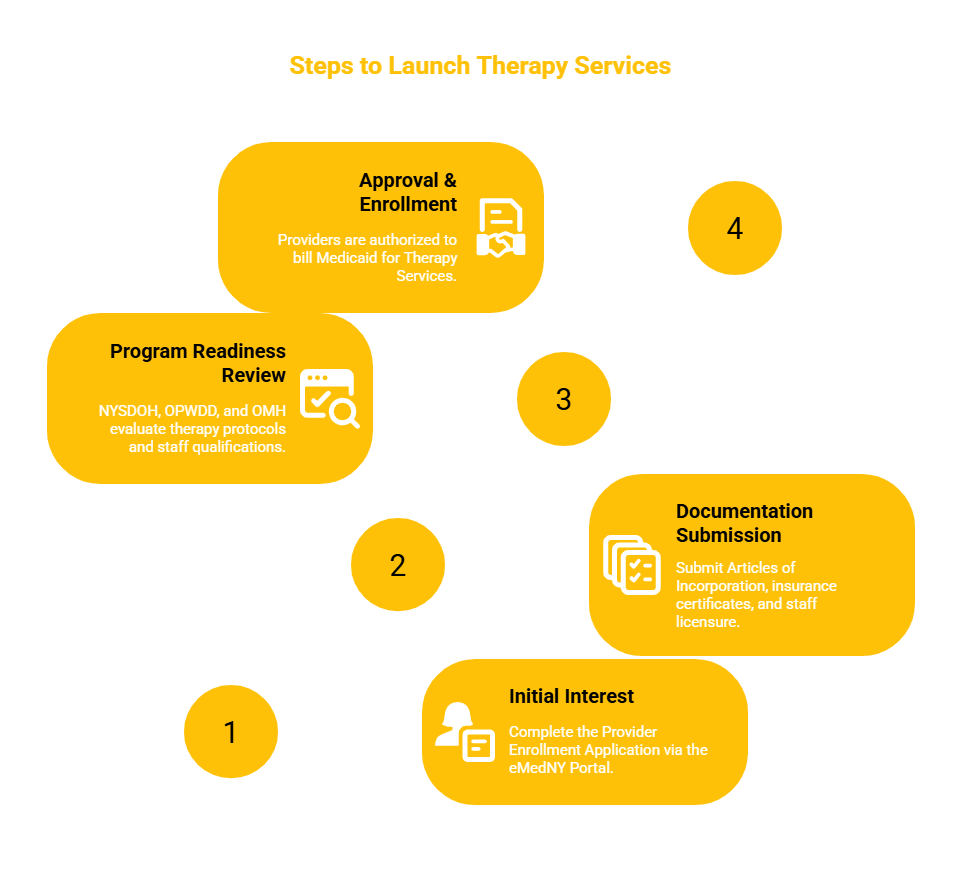
The enrollment process is a structured sequence that requires meticulous attention to detail. It begins with the submission of a formal application through the New York Medicaid Provider Enrollment Portal (eMedNY). During this phase, the applicant must provide extensive documentation, including Articles of Incorporation, proof of EIN/NPI, and comprehensive policy manuals that demonstrate the agency's readiness to deliver compliant care.
Following the submission, the relevant agencies—NYSDOH, OPWDD, or OMH—conduct a Program Readiness Review. This review assesses the provider's capability to deliver high-quality, safe services. Once the regulatory authorities verify that the agency meets all state and federal requirements, the provider is officially enrolled and granted the authority to bill Medicaid using designated service codes. The timeline from the initial application to final approval is typically an intensive, multi-month process requiring close adherence to state instructions.
What Are the Mandatory Staffing and Documentation Requirements?
Success as a therapy provider hinges on the qualifications of the clinical staff and the integrity of the documentation systems. A Therapy Program Director is required to oversee clinical operations, ensuring that all therapeutic interventions align with state-mandated standards. This director must be a licensed therapist—such as a PT, OT, or SLP—who possesses a Master’s or Doctorate degree in a relevant field and substantial management experience.
Every clinical staff member, from Physical Therapists and Occupational Therapists to Board Certified Behavior Analysts (BCBAs), must maintain active licensure and be compliant with continuous education and training requirements. Essential internal documentation that must be audit-ready includes:
- Clinical Records: Detailed logs of therapy assessments, treatment plans, and ongoing progress notes.
- Credentialing Files: Verified records of staff licensure, background checks, and annual competency evaluations.
- Compliance Manuals: Policies covering HIPAA, participant rights, grievance procedures, and incident reporting.
- Safety Protocols: Detailed measures for home and community-based safety, including crisis management and infection control.
WAIVER CONSULTING GROUP’S START-UP ASSISTANCE SERVICE — NEW YORK THERAPY SERVICES PROVIDER
WCG supports agencies in launching Medicaid-compliant Therapy Services in New York, offering:
- Business registration, Medicaid enrollment, and licensing assistance
- Policy manual development for therapy protocols and client safety
- Staff credentialing, training program templates, and compliance documentation
- Medicaid billing setup and audit-prepared financial management
- Branding, website development, and community outreach strategies
- Quality assurance systems for therapeutic interventions and compliance monitoring
- Collaboration with healthcare providers, therapy specialists, and community organizations
Frequently Asked Questions
Which Medicaid waiver programs cover these therapy services?
Therapy services are accessible through several specific New York waivers, including the OPWDD Comprehensive Waiver, the Home and Community-Based Services (HCBS) Waiver, the Nursing Home Transition and Diversion (NHTD) Waiver, the Traumatic Brain Injury (TBI) Waiver, and the Children’s Waiver.
What is the typical timeline for launching a therapy agency?
The entire process generally spans several months. Business formation and compliance preparation take roughly 1–2 months, followed by 2–3 months for staff hiring and credentialing. The formal Medicaid provider enrollment and readiness review typically require 60–90 days, with an additional 30–45 days required for finalizing billing systems.
How do providers maintain compliance after initial enrollment?
Ongoing compliance is maintained through annual competency evaluations for staff, adherence to HIPAA regulations, consistent record-keeping, and participation in quality assurance monitoring. Providers must remain updated on any changes issued by NYSDOH, OPWDD, or OMH to ensure their practices remain aligned with current Medicaid standards.
Key Takeaway
Establishing a successful Therapy Services provider agency in New York requires a deep commitment to regulatory compliance and person-centered care. By strictly adhering to the requirements set by the NYSDOH, OPWDD, and OMH, and by maintaining rigorous standards for staffing and documentation, agency founders can build a sustainable organization that significantly improves the well-being of individuals within the Medicaid waiver system.
Last verified: November 2024. This article is for informational purposes only and does not constitute legal or professional advice. Readers should consult directly with the New York State Department of Health, the Office for People With Developmental Disabilities, or the Office of Mental Health for the most current regulatory requirements and guidance specific to their business entity.