THERAPY SERVICES PROVIDER IN NEVADA
By Fatumata Kaba · 2025-09-04 · 5 min read
Therapy Services in Nevada are specialized, individualized interventions designed to enhance the physical, cognitive, and emotional well-being of individuals with disabilities, chronic conditions, or complex recovery needs. These essential services are authorized under various Nevada Medicaid Home and Community-Based Services (HCBS) Waiver programs, allowing eligible participants to receive care in their homes and communities rather than in institutional settings.
As a provider, navigating the regulatory environment requires a deep understanding of the requirements set forth by the Nevada Department of Health and Human Services (DHHS), the Aging and Disability Services Division (ADSD), and federal standards mandated by the Centers for Medicare & Medicaid Services (CMS). This guide provides an authoritative overview of how to establish and manage a therapy services agency that meets the rigorous demands of the Nevada Medicaid landscape.
What Are the Governing Agencies and Oversight Requirements?
The successful delivery of Medicaid-funded therapy services is governed by a hierarchical structure of oversight. The Nevada Department of Health and Human Services (DHHS) serves as the primary administrator, managing the allocation of Medicaid waiver funding, overseeing provider enrollment, and regulating reimbursement processes to ensure financial integrity.
Supporting this infrastructure is the Aging and Disability Services Division (ADSD), which is responsible for the granular management of quality standards and compliance. ADSD ensures that service delivery aligns with state regulations and that providers maintain the necessary competencies to support participants effectively. At the federal level, the Centers for Medicare & Medicaid Services (CMS) provides overarching guidance, ensuring that all Nevada programs adhere to person-centered planning, participant protection standards, and HCBS quality requirements.
Which Therapeutic Interventions Are Approved Under HCBS Waivers?
Therapy services are defined by their goal-oriented nature, focusing on helping participants develop skills, manage symptoms, and achieve greater independence. Providers must ensure that all delivered care is directly tied to the participant's Individualized Service Plan (ISP), which dictates the specific therapeutic goals and frequencies of service authorized for that individual.
Approved providers may offer a wide range of specialized interventions, including:
- Physical Therapy (PT): Focused on enhancing mobility, strength, and coordination through targeted exercises and manual therapy.
- Occupational Therapy (OT): Supporting the mastery of daily living skills, fine motor coordination, and the use of adaptive equipment.
- Speech-Language Therapy (SLP): Addressing critical needs in communication, swallowing, and language processing.
- Behavioral Therapy: Utilizing clinical strategies to address maladaptive behaviors and foster positive coping mechanisms.
- Recreational, Music, and Art Therapy: Employing creative and structured activities to improve emotional health, social integration, and cognitive function.
- Aquatic Therapy: Utilizing water-based environments to promote physical rehabilitation and pain management.
How Do Providers Meet Licensing and Enrollment Prerequisites?
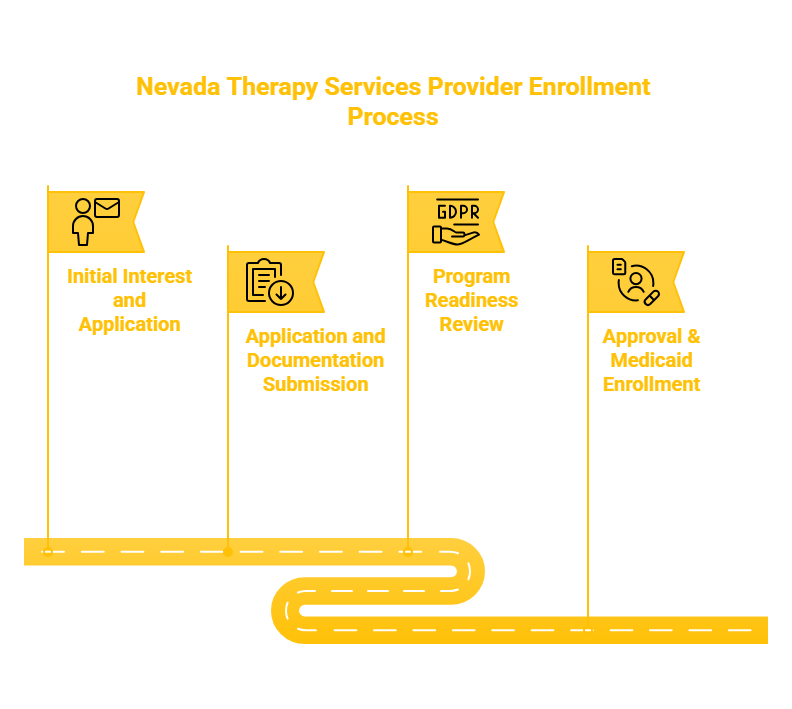
Before an agency can begin billing for services, it must navigate a multi-stage enrollment process. This begins with the formal establishment of a business entity through the Nevada Secretary of State, followed by obtaining a federal Employer Identification Number (EIN) and a Type 2 National Provider Identifier (NPI). These foundational steps are necessary to interact with the Nevada Medicaid Provider Enrollment Portal.
Compliance is not limited to business filings; it extends to operational readiness. Providers must obtain appropriate licensure for the specific therapy disciplines they intend to offer and secure comprehensive general and professional liability insurance. Furthermore, an agency must develop robust internal policies that govern the entirety of their therapeutic operations, from intake assessment and safety protocols to the nuances of documentation required for Medicaid reimbursement.
What Is the Required Documentation and Staffing Structure?
Documentation is the backbone of Medicaid compliance. A comprehensive Policy and Procedure Manual is required to demonstrate that the agency can maintain standards in HIPAA compliance, participant rights, grievance handling, and infection control. Additionally, all clinical staff, including licensed therapists (PT, OT, SLP) and their assistants (PTA, OTA, SLPA), must maintain active state licensure and undergo regular background checks and competency evaluations.
Leadership roles, particularly the Therapy Program Director, require a Master’s degree in a relevant field and prior supervisory experience. This director is responsible for ensuring that all staff meet continuous training requirements, which include ongoing education on therapeutic best practices and participant safety. Because these services are delivered in home and community settings, emergency preparedness and clear documentation standards for progress tracking are essential for successful audits.
What Is the Typical Timeline and Process for Launch?
The journey from concept to active service delivery generally follows a staged timeline. The initial phase involves business formation and compliance preparation, which typically spans one to two months. This is followed by a period of two to three months dedicated to hiring qualified staff, obtaining necessary credentials, and finalizing internal program policies.
Once the agency is ready, it enters the official Medicaid Provider Enrollment and Readiness Review, which usually takes 60 to 90 days. During this time, DHHS and ADSD review the provider's operational readiness. Finally, the setup of Medicaid billing systems concludes the process, requiring an additional 30 to 45 days. Adherence to this timeline ensures that the agency is fully prepared to provide quality care while avoiding common administrative pitfalls.
Frequently Asked Questions
Are all therapy types covered under every Nevada Medicaid Waiver?
While therapy services are integral to HCBS waivers, the specific types of therapy authorized may vary depending on the specific program (e.g., HCBS-IDD, Frail Elderly, or TBI Waivers). Always verify the specific scope of services allowed under the waiver for which the participant is enrolled.
What defines a "ready" provider in the eyes of ADSD?
A "ready" provider is one who has successfully demonstrated, through documentation and audit, that they have staff qualified to perform the tasks, safety protocols for home-based delivery, and an internal quality assurance system that ensures billing and service delivery align with the ISP.
What is the role of the Individualized Service Plan (ISP)?
The ISP is the legally binding document that outlines the medical necessity and the specific therapeutic objectives for the participant. Providers must align every intervention with the goals listed in the ISP to remain compliant with Medicaid reimbursement requirements.
WAIVER CONSULTING GROUP’S START-UP ASSISTANCE SERVICE — NEVADA THERAPY SERVICES PROVIDER
WCG supports healthcare agencies in launching Medicaid-compliant Therapy Services in Nevada, offering:
- Business registration, Medicaid enrollment, and licensing support
- Policy manual development for therapy planning and client care
- Staff credentialing, training program templates, and compliance documentation
- Medicaid billing setup and audit-prepared financial management
- Branding, website development, and client engagement strategies
- Quality assurance systems for therapy compliance and client safety
- Collaboration with healthcare professionals and community organizations
Key takeaway: Launching a therapy services agency in Nevada requires a balance of clinical expertise, rigid administrative compliance, and careful coordination with DHHS and ADSD to ensure that Medicaid-funded services meet the needs of vulnerable populations in the community.
Last verified: October 2023. This information is provided for educational purposes and should not be considered legal or medical advice. Please consult official government resources and regulatory documents for the most current information regarding Medicaid compliance.