THERAPEUTIC INTEGRATION SERVICES PROVIDER IN MARYLAND
By Fatumata Kaba · 2025-09-02 · 5 min read
Therapeutic Integration Services in Maryland represent a specialized, community-based support framework designed for children and adolescents with intellectual and developmental disabilities (IDD). By leveraging funding through the Maryland Developmental Disabilities Administration (DDA) waivers, service providers can offer structured, therapy-informed programming that promotes essential socialization, adaptive behavioral skills, and meaningful community participation.
For agency founders, navigating the regulatory environment requires a deep understanding of the Maryland Department of Health’s requirements and the specific operational standards for the Family Supports, Community Supports, and Community Pathways Waivers. This guide outlines the essential pathway to establishing a compliant, high-quality Therapeutic Integration program that meets the needs of Maryland’s most vulnerable youth.
What are the core objectives of Therapeutic Integration Services?
Therapeutic Integration (TI) services are designed to bridge the gap between clinical intervention and daily community living. Unlike standard after-school care, TI programs are specifically formulated to support the Person-Centered Plan (PCP) of each participant. The primary objective is to cultivate an environment where children and adolescents can practice communication, peer interaction, and emotional regulation in a supervised, group-oriented setting.
These services typically occur outside of standard school hours—including after-school, weekends, and summer breaks—to ensure consistent support for families. By focusing on sensory needs, social-emotional learning, and community engagement, TI providers help youth transition toward greater independence. The success of these programs is measured by the participant's ability to generalize skills learned during sessions to their broader life experiences in the community.
- Incorporation of therapy-informed activities tailored to developmental age.
- Fostering peer-to-peer relationships and prosocial communication.
- Building adaptive behavioral skills through guided group participation.
- Providing structured outings to facilitate community integration and safety awareness.
Which agencies oversee the Therapeutic Integration landscape in Maryland?
The regulatory structure for TI services in Maryland is multi-layered, ensuring that programs adhere to both state-level quality standards and federal Medicaid mandates. The Maryland Department of Health (MDH) holds overall authority, while the DDA acts as the primary administrative body for the waivers under which these services are authorized.
Providers must coordinate with several entities to maintain compliance. The Office of Long-Term Services and Supports (LTSS Maryland) serves as the digital hub for tracking service delivery, documenting outcomes, and processing Medicaid billing. Furthermore, as these services are often funded through Medicaid-backed waivers, providers must remain cognizant of federal standards established by the Centers for Medicare & Medicaid Services (CMS) regarding Home and Community-Based Services (HCBS).
- Maryland Department of Health (MDH): Responsible for establishing and enforcing regulatory standards.
- Developmental Disabilities Administration (DDA): Oversees the Family Supports and associated waivers.
- LTSS Maryland: The mandatory platform for data tracking and Medicaid billing operations.
- Centers for Medicare & Medicaid Services (CMS): Sets federal compliance benchmarks for HCBS.
What are the fundamental requirements for provider approval?
Becoming an approved DDA provider is a rigorous process that demands meticulous preparation. Before seeking enrollment, an agency must establish a formal business structure, including registration with the Maryland Department of Assessments and Taxation (SDAT), and secure both an Employer Identification Number (EIN) and a Type 2 National Provider Identifier (NPI). These credentials serve as the foundation for all subsequent Medicaid billing and state reporting activities.
Physical site readiness is another critical component. If the provider operates from a facility-based location, the site must meet strict safety, accessibility, and zoning requirements. Applicants are required to submit comprehensive policy manuals that detail behavioral management, emergency procedures, and curriculum design. Furthermore, staff must meet specific educational and training benchmarks, including DDA Core Competency training and background checks, to ensure the safety and well-being of the youth in their care.
How is the provider enrollment and site-approval process structured?
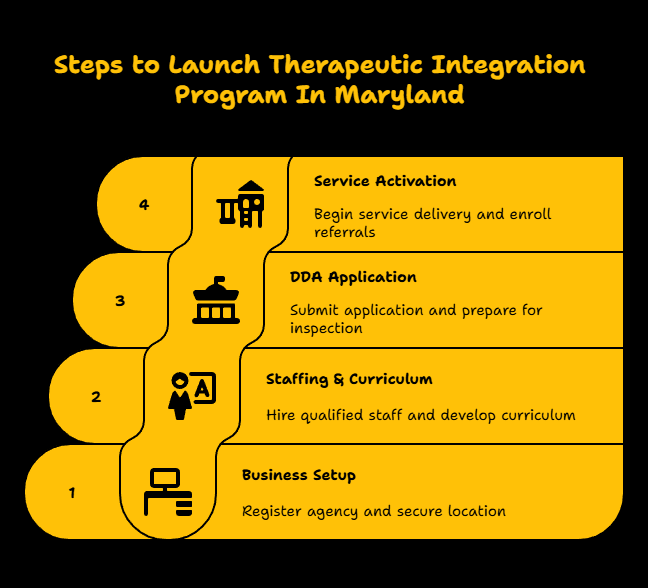
The transition from a business concept to an active, service-providing agency occurs in four distinct phases. First, the provider must finalize the program design, clearly defining the therapeutic scope, intended participant-to-staff ratios, and specific behavioral support practices. This documentation forms the basis of the DDA Provider Application, which is submitted via the official DDA portal.
Once the application is submitted, the agency moves into the review phase, which often involves a DDA pre-approval site visit for facility-based programs. During this inspection, state officials review safety compliance, such as fire exit accessibility and environment safety documentation. Upon receiving final approval, the provider may begin accepting referrals from Coordination of Community Services (CCS) agencies to begin service delivery.
What staffing standards apply to Therapeutic Integration programs?
Staffing quality is paramount in Therapeutic Integration, as these professionals act as both mentors and behavioral supports. The Therapeutic Integration Specialist or Direct Support Professional (DSP) must hold at least a high school diploma or GED and possess documented experience working with youth or individuals with disabilities. All staff must undergo mandated training, which includes DDA Core Competencies, CPR/First Aid, and, critically, trauma-informed care and behavior intervention strategies.
For administrative and clinical oversight, agencies typically employ a Program Manager or Clinical Supervisor. This individual must possess a relevant Bachelor’s or Master’s degree in psychology, education, or a related field to oversee the efficacy of the therapeutic activities and ensure staff adherence to the PCP. Optional, yet recommended, involvement of Behavioral Health Consultants, such as a BCBA or LCSW, further strengthens the agency’s ability to handle complex behavioral health needs.
- Direct Support Professionals: Must complete all DDA Orientation and Core Competencies.
- Clinical Oversight: Required for maintaining programmatic integrity and individual goal tracking.
- Continuing Education: Annual training requirements ensure staff remain current on best practices.
Frequently Asked Questions
Which Medicaid waivers authorize Therapeutic Integration services?
TI services are primarily authorized under the Maryland Family Supports Waiver for children under 21 with IDD. Additionally, these services may be provided under the Community Supports Waiver for transition-aged youth or the Community Pathways Waiver in specific cases where the individual’s needs align with the scope of the program.
How long should a new agency anticipate for the launch timeline?
The timeline varies by agency readiness, but typically involves 2–3 weeks for business formation, 2–4 weeks for hiring and curriculum development, and 6–10 weeks for the DDA provider application and site inspection process. Service activation follows as referrals are received.
What documentation must be available for DDA audits?
Providers must maintain comprehensive records including, but not limited to: Articles of Incorporation, DDA provider enrollment approval, proof of facility safety, participant intake forms, individualized support plans, therapeutic curriculum outlines, staff training logs, and incident reports.
Key Takeaway
Successfully launching a Therapeutic Integration program in Maryland requires a strategic blend of administrative rigor, clinical expertise, and adherence to DDA operational standards. By focusing on compliant site development, comprehensive staff training, and clear, goal-oriented curriculum design, providers can build a sustainable organization that significantly improves outcomes for children and adolescents with developmental disabilities.
Last verified: October 2023. Disclaimer: This article is intended for informational purposes for prospective and current Medicaid HCBS providers. It does not constitute legal or professional advice. Regulatory requirements are subject to change by the Maryland Department of Health and the DDA; please consult the latest official DDA provider manuals and state policy updates when establishing or modifying your service operations.