The Hidden Fall Risk in Pennsylvania Home Care: Polypharmacy
By Fatumata Kaba · 2026-07-07 · 5 min read
In Pennsylvania home care, one of the most overlooked fall risks for elderly and disabled clients is not a physical hazard like a loose rug or poor lighting, but rather the clinical complexity of polypharmacy. As medication regimens become increasingly intricate, the physiological impact on a client’s balance, cognition, and reaction time creates a silent, high-stakes danger that necessitates proactive oversight from home care agencies.
Home care agencies in Pennsylvania are licensed by the Department of Health, and training caregivers to identify medication-related risk is one of the highest-value initiatives an agency can implement. By bridging the gap between clinical medication management and day-to-day observation, administrative leadership can significantly improve client safety outcomes while strengthening regulatory compliance.
Why is polypharmacy a primary clinical concern for home care agencies?
Polypharmacy is commonly defined as the concurrent use of five or more medications on a daily basis. For many individuals receiving Home and Community-Based Services (HCBS) or waiver-funded care, this threshold is frequently exceeded due to the management of multiple chronic conditions, including hypertension, diabetes, and cognitive impairment.
The danger lies in the cumulative effect of these chemical agents. When a client takes five or more medications, the likelihood of adverse drug events (ADEs) increases exponentially. Because drug interactions can be highly unpredictable, these events often manifest as systemic side effects that directly impede a person’s mobility, such as orthostatic hypotension, sudden dizziness, profound drowsiness, or acute cognitive confusion.
How does the cumulative effect of medication impact fall risk?
A fall is rarely the result of a single factor; rather, it is often the outcome of a diminished capacity to recover from a minor imbalance. Medications that affect the central nervous system, including sedatives, antidepressants, and certain blood pressure medications, can significantly slow down a client’s proprioception—the body’s ability to sense its position in space.
When a client experiences "medication fog" or vertigo, their ability to navigate their own home is severely compromised. If an agency is not actively monitoring the behavioral changes associated with a new prescription, the risk of a fall during a routine activity, such as transferring from a bed to a chair or walking to the restroom, rises dramatically. Administrative staff must understand that a medication adjustment made by a physician days ago may only manifest in the home environment as a physical instability today.
What is the role of the direct care worker in medication monitoring?
It is essential to clarify that direct care workers are not clinicians; they are not there to diagnose, prescribe, or administer medication. Their primary function is to act as the "eyes and ears" of the clinical team. Their specialized training should focus on the observation of behavioral and physical trends that deviate from the client’s baseline.
When a caregiver is properly trained, they can detect the early warning signs of polypharmacy-related instability. This includes monitoring for:
- Increased frequency of near-misses or minor stumbling while ambulating.
- Unusual lethargy or difficulty waking up during morning routines.
- Slurred speech or delayed responses to simple prompts.
- Increased complaints of lightheadedness, particularly when rising from a seated or lying position.
How should agencies structure observation and reporting protocols?
The efficacy of an agency’s safety program depends on the reliability of its documentation. New dizziness, drowsiness, or confusion after a medication change should be flagged immediately. This information must flow from the caregiver to the agency supervisor and, where appropriate, to the client’s family or physician.
Clear documentation of any change in condition serves two critical purposes. First, it ensures that the medical provider has an accurate picture of the client’s real-world response to their prescription regimen. Second, it serves as a robust shield for the agency. By maintaining a paper trail that records the onset of symptoms and the steps taken to report them, the agency demonstrates due diligence and adherence to their duty of care as a licensed provider.
What are the essential components of caregiver training for fall prevention?
Training programs must go beyond basic safety protocols to address the intersection of pharmacology and mobility. Agencies should invest in training modules that teach caregivers how to identify the "medication window"—that period following a change in dosage or a new medication addition when the client is at the highest risk for adverse reactions.
Furthermore, caregivers should be instructed on how to facilitate communication between the agency and the client’s care circle. When a caregiver notes a potential interaction, they should use standardized reporting forms that ask specific questions, such as: "Did this drowsiness begin after the new medication started?" or "Is the client falling at the same time of day as their medication administration?" This objective approach allows the agency to provide actionable data to the client's care team.
Frequently asked questions
What is the most effective way to document medication-related concerns?
Agencies should utilize standardized electronic health record (EHR) templates that prompt caregivers for specific observations. These should be timestamped, objective (describing behaviors rather than making diagnoses), and immediately accessible to administrative staff for review and escalation.
Should caregivers be responsible for counting a client’s pills?
While direct care workers should not be tasked with complex medication management, they can be trained to observe for discrepancies in pill counts or signs of missed doses, which are common precursors to both falls and health complications. Any discrepancy should be documented and reported to the supervisor immediately.
How does state licensure influence medication protocols?
Since Pennsylvania home care agencies are licensed by the Department of Health, they are subject to specific regulations regarding the scope of practice. Training must be strictly tailored to ensure caregivers remain within their legal bounds, focusing on observation and reporting rather than active clinical intervention.
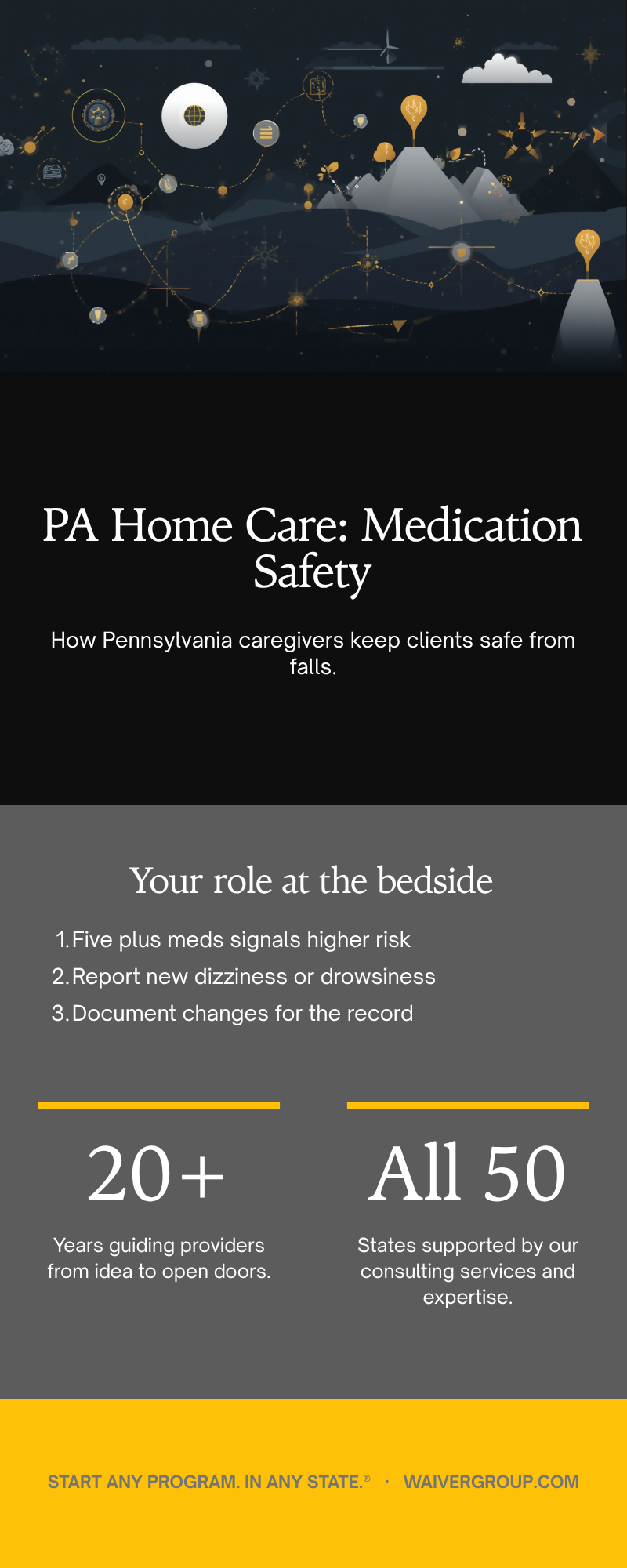
Key takeaway: Five or more medications raises fall risk. Train caregivers to observe, report, and document changes in condition. This proactive approach not only enhances client safety but also ensures that documentation is robust enough to meet the highest standards of agency care.
Start Any Program. In Any State.®
Want caregiver training and documentation that hold up? Book a video consultation at waivergroup.com/videoappointment, call 302.888.9172, or email [email protected].
Last verified: February 2024. The information provided in this article is for educational purposes only and does not constitute legal or medical advice. Always consult with your state’s Department of Health or legal counsel to ensure compliance with current local regulations and statutes.