The 4 Stages of Medicaid Provider Licensing
By Fatumata Kaba · 2026-07-01 · 5 min read
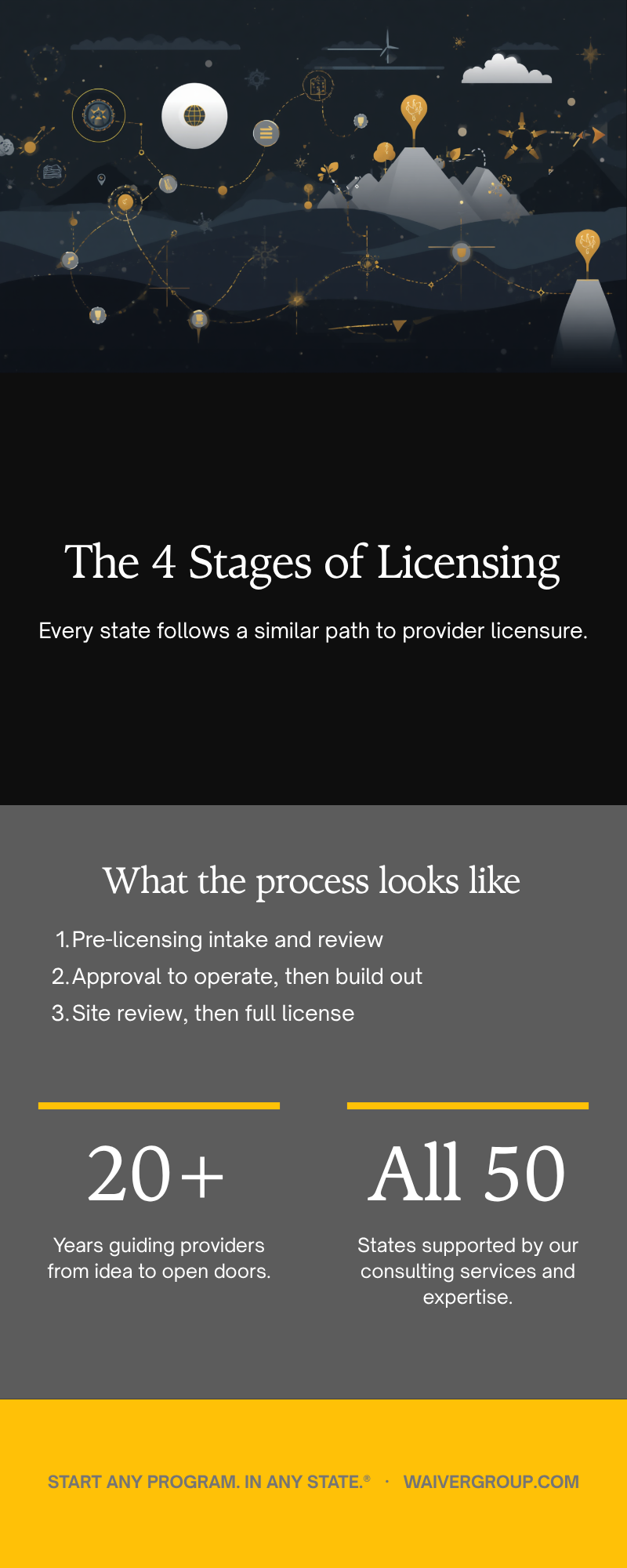
Medicaid provider licensing is a standardized, four-stage journey that moves from initial administrative validation to full operational authority. Understanding these stages allows agency founders to anticipate regulatory touchpoints, minimize avoidable processing delays, and maintain compliance throughout the lifecycle of their Home and Community-Based Services (HCBS) or waiver program.
Understanding the Strategic Foundation of Medicaid Licensing
State Medicaid agencies and their associated oversight departments maintain rigorous standards to ensure that service providers are fiscally stable, operationally sound, and compliant with federal and state regulations. While specific requirements vary significantly by state—governed by unique administrative codes and program manuals—the functional trajectory of obtaining a license is consistent across the United States.
Licensing acts as the regulatory bridge between a business entity and its ability to bill Medicaid for services. This is not merely a bureaucratic hurdle; it is a verification of the provider’s capacity to uphold the health, safety, and welfare of the populations they intend to serve. Founders must view this process as a demonstration of institutional competence rather than just a document submission exercise.
Stage 1: Pre-Licensing Intake and Document Alignment
The first stage begins with pre-licensing intake, which serves as the gatekeeper for the entire application process. During this phase, state regulators perform a comprehensive desk audit of the organization’s foundational documents. This includes verifying business registration, tax identification, insurance coverage, and the development of internal policies and procedures that align with the specific requirements of the chosen waiver program.
Accuracy during this stage is the primary determinant of how long the licensing process will take. Missing documentation or misaligned operational procedures often trigger a cycle of "Request for Information" (RFI) notices, which reset internal state review timelines. Effective preparation requires ensuring that all written policies—ranging from incident reporting protocols to personnel training manuals—are mapped directly to the state's regulatory expectations.
- Verification of legal business entity status and standing.
- Submission of service-specific policies and procedure manuals.
- Assessment of administrative structure and management experience.
- Review of fiscal viability and proof of necessary insurance coverages.
Stage 2: Receiving the Approval to Operate
Once the desk audit is completed and the initial documentation is validated, the state agency typically issues an Approval to Operate (or a similar conditional status). This stage functions as a "conditional green light." It serves as formal notice that the state has accepted the provider’s organizational design and that the agency may now proceed to finalize the critical infrastructure needed to serve vulnerable populations.
This period is intended for the practical deployment of resources. With the conditional approval in hand, providers should focus on hiring clinical or direct support staff, conducting background checks, finalizing staff orientation training, and ensuring that digital or physical record-keeping systems are fully functional. The Approval to Operate is the bridge between theoretical planning and actual service readiness.
Stage 3: The On-Site Review and Verification
The on-site review is the most rigorous stage of the licensing process. A state surveyor or designated reviewer arrives at the provider’s place of business to confirm that the operation matches the descriptions provided on paper during the intake stage. This is a practical validation of the agency’s promise to deliver quality care in accordance with state law.
During the on-site review, inspectors will scrutinize personnel files for mandatory training records, review incident logs, and examine the agency’s internal monitoring systems. If the agency passes this audit, the state moves to grant full licensure. If deficiencies are found, the provider must typically submit a formal Plan of Correction (POC) to address specific non-compliance issues before the license can be granted.
Stage 4: Full Licensure and Ongoing Compliance
Upon successfully clearing the on-site review, the state issues a full license. This document authorizes the provider to begin delivering services and billing Medicaid. Full licensure is rarely the end of the regulatory relationship; rather, it is the transition into a state of active oversight. Providers must now maintain the standards that earned them their license through annual audits, record reviews, and adherence to updated program regulations.
Full licensure often opens the door to operational expansion, allowing providers to request additions to their service array or expand their geographic service area. However, maintaining this status requires a proactive approach to compliance. Regularly auditing internal processes against the current state administrative code is the only way to ensure the license remains in good standing during future survey cycles.
Frequently Asked Questions
What is the most common reason for delay during the licensing process?
The most frequent cause of delay is incomplete or inconsistent documentation submitted during the initial intake phase. When policies are not clearly aligned with state regulations or when required supporting documents are missing, the agency must issue requests for additional information, which adds weeks or months to the timeline.
Is an Approval to Operate the same as a Full License?
No. An Approval to Operate is a conditional, temporary status that allows the provider to prepare for service delivery by finalizing staffing and systems. A Full License is issued only after the agency has demonstrated through an on-site review that it is fully capable of meeting all operational and safety requirements.
What happens if an agency fails an on-site review?
Failure does not necessarily mean the end of the licensing process. Most state agencies provide a "Statement of Deficiencies" following an unsuccessful review. The provider is then required to develop and submit a Plan of Correction (POC) that details how they will rectify identified gaps. The state will review the POC, and a follow-up visit may be scheduled to verify that the corrections were successfully implemented.
Key Takeaway
Licensing is a predictable four-stage path. Prepare complete, accurate documentation early and each stage moves without avoidable delay. Success relies on viewing every stage as a demonstration of institutional integrity and ensuring that all organizational procedures are strictly compliant with current program regulations from the outset.
Last verified by WCG Regulatory Review Board. Information provided is for educational purposes and does not constitute legal or professional advice. Always consult with state-specific regulations or a qualified advisor before undertaking Medicaid provider applications. Start Any Program. In Any State.® Book a video consultation at waivergroup.com/videoappointment, call 302.888.9172, or email [email protected].