Texas Non-Medical Home Care: How to Get Licensed and Bill Medicaid
By Fatumata Kaba · 2026-07-02 · 5 min read
To enter the non-medical home care sector in Texas and begin billing Medicaid, an entrepreneur must first obtain a Home and Community Support Services Agency (HCSSA) license in the Personal Assistance Services (PAS) category through the Texas Health and Human Services Commission (HHSC). Following licensure, the agency must enroll as a Texas Medicaid provider and secure contracts with the Managed Care Organizations (MCOs) that administer long-term services and supports (LTSS) across the state’s various service delivery areas.
Understanding the Texas HCSSA Regulatory Landscape
The foundation of any home care agency in Texas is the HCSSA license. Because non-medical services—often referred to as attendant care—do not involve the administration of medication or complex clinical procedures, the state does not require founders to be nurses or physicians. However, the regulatory burden remains significant, as the agency must demonstrate compliance with state standards regarding administrative structure, personnel policies, and service delivery protocols.
The Personal Assistance Services (PAS) category specifically covers non-medical support, such as assistance with activities of daily living (ADLs) and instrumental activities of daily living (IADLs). This includes tasks like bathing, dressing, grooming, meal preparation, and light housekeeping. Before applying, potential agency owners should review the Texas Administrative Code sections governing HCSSA operations to ensure their business model aligns with the scope of practice permitted under the PAS license.
Steps to Securing Your HCSSA License
The licensure process is managed by the Texas Health and Human Services Commission. Applicants must submit a comprehensive application packet that outlines their organizational structure, staffing plans, and service definitions. This process involves a rigorous review of the agency's policies and procedures to ensure they meet the minimum requirements for protecting the health and safety of Medicaid recipients.
Following the document review, the agency must typically undergo an on-site survey conducted by HHSC inspectors. This survey is designed to verify that the agency is prepared to operate according to state regulations. Successful completion of this survey is the final gatekeeper in the licensure process. Once the HCSSA license is issued, the agency is legally authorized to provide non-medical services to private-pay clients, allowing for operational testing before entering the Medicaid market.
Enrolling as a Texas Medicaid Provider
Once the HCSSA license is active, the agency can apply to enroll as a provider in the Texas Medicaid program. This is distinct from the licensure process and is managed through the Texas Medicaid & Healthcare Partnership (TMHP). Enrollment requires detailed disclosures about the agency’s ownership, management, and operational capacity to serve the Medicaid population.
During the enrollment phase, the agency will be evaluated on its ability to adhere to the billing and reporting requirements of the state. It is crucial to ensure that all administrative staff are trained on the specific documentation standards required for Medicaid reimbursement. Discrepancies in paperwork or failure to follow state enrollment guidelines can lead to significant delays in the activation of the provider ID, which is necessary before billing can commence.
Contracting with Managed Care Organizations
Most long-term services and supports in Texas are delivered through the STAR+PLUS program and other Medicaid managed care initiatives. Simply being an enrolled Medicaid provider does not automatically grant an agency the right to serve all Medicaid beneficiaries. An agency must contract directly with each MCO operating in its desired service delivery area.
Each MCO maintains its own credentialing process, which often involves an additional review of the agency’s quality assurance programs, staff training records, and financial stability. Developing these relationships requires a strategic approach, as MCOs look for providers that can demonstrate high standards of care and reliable reporting. Securing these contracts effectively opens the door to the primary volume of Medicaid-funded non-medical home care cases in Texas.
Managing Compliance and Quality Assurance
Licensure and enrollment are not one-time events; they are the start of an ongoing obligation to maintain compliance. Texas regulators conduct periodic surveys and audits to ensure that agencies continue to meet the standards set at the time of initial licensure. For a PAS agency, this means maintaining meticulous records of service delivery, attendant training, and consumer verification.
- Maintain current HCSSA licensure by renewing per HHSC requirements.
- Ensure all attendants complete the state-mandated training hours and competency evaluations.
- Conduct regular internal audits of service logs to ensure documentation matches billing submissions.
- Keep personnel files updated with current background checks and certifications.
- Monitor MCO bulletins for updates to service definitions or billing protocols.
Frequently Asked Questions
Do I need a clinical background to open a non-medical home care agency in Texas?
No. The Personal Assistance Services (PAS) category of the HCSSA license is designed for non-clinical, non-medical care. While your agency must maintain certain administrative and supervisory standards, you do not need to be a nurse or physician to own or operate the business.
Can I begin billing Medicaid immediately after receiving my HCSSA license?
No. The HCSSA license allows you to operate as a business, but it does not grant you the authority to bill Medicaid. You must first enroll as a Texas Medicaid provider through TMHP and then secure individual service contracts with the specific MCOs managing the Medicaid beneficiaries in your area.
What is the difference between an HCSSA license and Medicaid enrollment?
The HCSSA license is a state-level regulatory requirement that proves your agency meets the legal standards for providing care in Texas. Medicaid enrollment is a fiscal and administrative relationship with the state and MCOs that allows you to be reimbursed for services provided to eligible Medicaid beneficiaries.
Key Takeaway
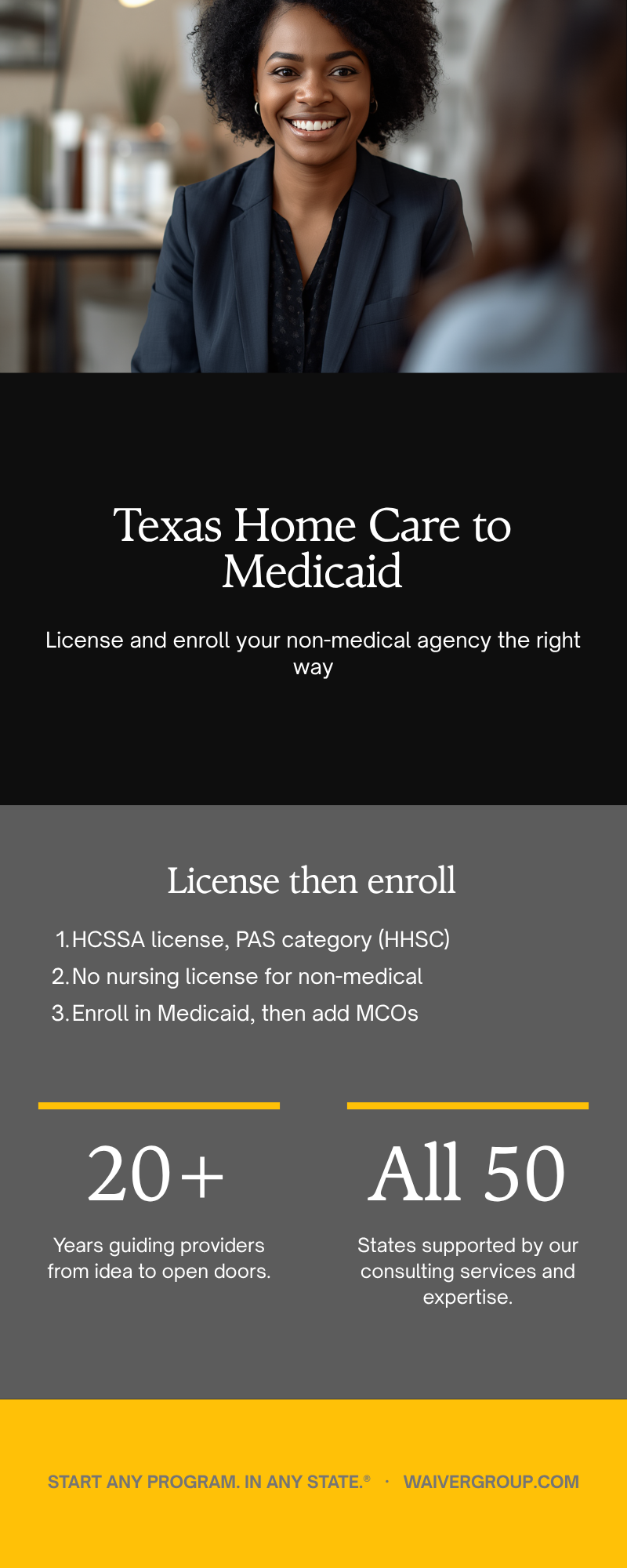
In Texas, get your HCSSA license in the PAS category from HHSC, no nursing license required, then enroll in Medicaid and add MCO contracts, in that order.
Start Any Program. In Any State.®
20+ years clearing the path in all 50 states — we've done this before, and we'll do it for you. Book a video consultation at waivergroup.com/videoappointment · 302.888.9172 · [email protected]
Last verified: 05/22/2024. This information is intended for educational purposes only and does not constitute legal or professional advice. Requirements for licensure, Medicaid enrollment, and managed care contracting are subject to change. Prospective providers should consult the official Texas Health and Human Services Commission (HHSC) and Texas Medicaid & Healthcare Partnership (TMHP) websites for the most current regulatory guidance and policy updates.