TELEMONITORING SERVICES PROVIDER IN SOUTH CAROLINA
By Fatumata Kaba · 2025-10-13 · 5 min read
Telemonitoring, often referred to as Remote Patient Monitoring (RPM), is a critical component of South Carolina’s healthcare strategy, utilizing electronic devices to capture and transmit health data from a participant’s home to clinical professionals. In South Carolina, these services are reimbursable through specific Medicaid and Home and Community-Based Services (HCBS) waiver programs, functioning as a vital intervention for individuals with chronic conditions who are at high risk of hospitalization or institutionalization.
How Do Governing Agencies Regulate Telemonitoring in South Carolina?
The South Carolina Department of Health and Human Services (SCDHHS) serves as the primary authority for authorizing and reimbursing telemonitoring services. They oversee the administration of the Community Long Term Care (CLTC) program, which is the primary vehicle for delivering these services to eligible Medicaid participants. Providers must align their operational standards with SCDHHS guidelines to ensure consistent reimbursement and program compliance.
In addition to state-level oversight, the Centers for Medicare & Medicaid Services (CMS) establishes the federal framework for Medicaid funding and the appropriate utilization of remote monitoring technologies. Furthermore, providers must remain cognizant of the South Carolina Board of Medical Examiners, which may oversee the clinical governance and physician or nurse practitioner supervision required to validate the medical necessity of monitoring activities.
What Are the Core Components of an Effective Telemonitoring Service?
Telemonitoring services are designed to improve disease management by providing real-time oversight of vital signs such as blood pressure, glucose levels, weight, and oxygen saturation. By enabling the early detection of health trends, providers can trigger clinical interventions that prevent emergency room visits and unnecessary hospital admissions. The service is not merely about data collection; it is about the integrated clinical response to that data.
Approved providers are expected to deliver a comprehensive suite of services that integrate technology with patient interaction. These services include:
- Home-Based Equipment Setup: Managing the logistics of deploying devices to the participant's residence.
- Daily Data Transmission: Ensuring secure, consistent delivery of patient readings to the monitoring center.
- Clinical Review and Alerting: Facilitating active response from clinicians who monitor for abnormal trends and notify the participant's care team.
- Education and Support: Coaching participants to ensure they are comfortable and accurate in their daily device usage.
- Documentation: Maintaining rigorous daily logs, transmission summaries, and clinical notes that meet Medicaid audit standards.
How Do Providers Meet Licensing and Enrollment Requirements?
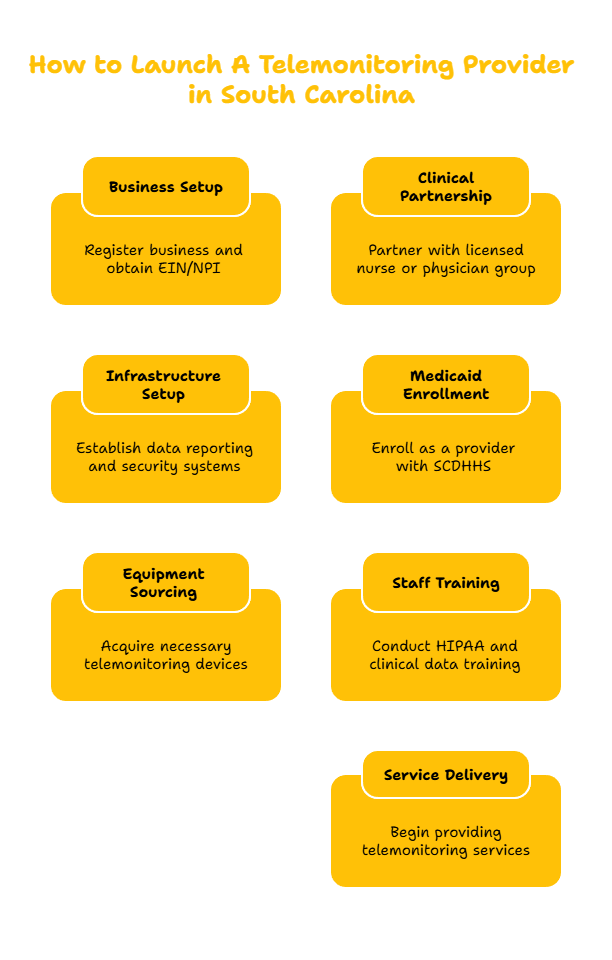
Entering the South Carolina telemonitoring market requires a structured approach to business registration and clinical infrastructure. Founders must first ensure the organization is registered with the South Carolina Secretary of State and possesses a valid EIN and Type 2 NPI. Because these services are clinically driven, the organization must secure formal partnerships with a licensed nurse or physician group to provide the necessary medical oversight.
Technical and administrative prerequisites are equally vital. Providers must procure HIPAA-compliant software and secure data storage solutions to protect sensitive health information. Following these setup steps, the entity must enroll as a Medicaid provider under the appropriate category—such as nursing, home health, or a dedicated telehealth vendor—with the SCDHHS. Finally, the development of a comprehensive Telemonitoring Services Policy & Procedure Manual is mandatory, as this document outlines the organization's approach to privacy, escalation steps, and clinical documentation.
What Is the Required Documentation and Staffing Protocol?
Audit readiness is a fundamental aspect of operating a successful telemonitoring program. A provider’s documentation must include clear evidence of clinical partnerships, HIPAA-compliant technology agreements, and a standardized Telemonitoring Services Policy & Procedure Manual. This manual serves as the operational roadmap for staff, covering intake and assessment forms, alert thresholds, transmission protocols, and the specific billing templates used for Medicaid submissions.
Staffing requirements are strictly defined by the clinical nature of the service. An effective program requires an Registered Nurse (RN) with an active South Carolina license to review transmissions and collaborate with the broader care team. A Telemonitoring Technician or Program Coordinator is also typically necessary to handle hardware troubleshooting, device setup, and ongoing client education. All personnel are required to complete specialized training in:
- HIPAA confidentiality and patient privacy.
- Clinical data interpretation and trend analysis.
- Equipment troubleshooting and maintenance.
- Emergency response protocols and participant escalation.
Which Medicaid Waiver Programs Support Telemonitoring?
Telemonitoring is authorized under several key South Carolina programs, each serving distinct populations. The Community Long Term Care (CLTC) program is the most prominent, focusing on seniors and adults with chronic illnesses who need consistent monitoring to remain in their homes. Other relevant channels include State Plan Nursing Services, which home health agencies may utilize to monitor their established caseloads.
For pediatric populations, the Medically Complex Children (MCC) program provides a pathway for health tracking under the Early and Periodic Screening, Diagnostic, and Treatment (EPSDT) mandate. Additionally, providers working with dual-eligible individuals—those covered by both Medicare and Medicaid—may find opportunities through managed care organizations (MCOs) that coordinate long-term care services for their members.
Frequently Asked Questions
What is the typical timeline for launching a telemonitoring business in South Carolina?
The timeline generally spans five to seven months. The first 1–2 months focus on business formation and clinical contracting, followed by 2–3 months for Medicaid enrollment and infrastructure development. The final 1–2 months are dedicated to equipment sourcing and rigorous staff training prior to accepting the first participant referral.
Are there specific equipment requirements for these services?
While the exact device selection depends on the participant's specific health condition (e.g., glucometers for diabetes or pulse oximeters for respiratory issues), the equipment must be capable of secure, daily data transmission. All technology must comply with HIPAA security standards for the storage and transfer of protected health information.
Who is responsible for the clinical alert escalation process?
The monitoring nurse is primarily responsible for reviewing transmitted data and identifying abnormal readings. According to the provider’s established protocols, the nurse must communicate these alerts to the participant's primary care physician or case manager, ensuring that any medical intervention is documented and implemented promptly.
Key Takeaway
Launching a telemonitoring service in South Carolina requires a deliberate alignment of administrative, technical, and clinical resources. By focusing on compliant documentation, strategic clinical partnerships, and a robust understanding of SCDHHS requirements, providers can deliver essential remote care that improves health outcomes for vulnerable populations while meeting the standards for Medicaid reimbursement.
Last verified: October 2023. This information is for educational purposes only and does not constitute legal or professional medical advice. Providers should consult directly with the South Carolina Department of Health and Human Services (SCDHHS) and the South Carolina Board of Nursing & Medical Examiners for the most current regulatory guidance and to verify specific program requirements.