SUPPORTED LIVING SERVICES PROVIDER IN NORTH CAROLINA
By Fatumata Kaba · 2025-09-15 · 5 min read
Understanding Supported Living Services in North Carolina
Supported Living Services (SLS) are a cornerstone of North Carolina’s Home and Community-Based Services (HCBS) ecosystem, designed to empower individuals with disabilities or chronic conditions to maintain autonomy within their own homes. By facilitating personalized daily living assistance, health monitoring, and social integration, these services bridge the gap between institutional care and independent living, ensuring participants receive necessary support while remaining active members of their communities.
For provider agencies, entering this space requires navigating a complex regulatory framework overseen by the North Carolina Department of Health and Human Services (NCDHHS). Successfully operating a Supported Living program involves rigorous alignment with state-mandated person-centered care standards, careful financial management through the Medicaid billing system, and a steadfast commitment to participant health, safety, and self-advocacy.
How Do Governing Agencies Regulate Supported Living Providers?
The delivery of Supported Living Services in North Carolina is governed by a multi-tiered regulatory structure that ensures quality, safety, and fiscal responsibility. At the federal level, the Centers for Medicare & Medicaid Services (CMS) sets the overarching standards for HCBS programs, ensuring that states maintain person-centered care and participant safety. These federal requirements provide the foundation upon which state-specific oversight is built.
Within North Carolina, several key divisions collaborate to manage these services. The NCDHHS serves as the primary authority, administering Medicaid waiver funding and overseeing the essential functions of provider enrollment, service authorization, and reimbursement. The NC Division of Health Benefits (NC Medicaid) manages the administrative aspects of provider participation, while the Division of Mental Health, Developmental Disabilities, and Substance Abuse Services (DMH/DD/SAS) provides specific oversight for services tailored to individuals with developmental disabilities and behavioral health needs.
- NCDHHS: Manages overall waiver funding, provider enrollment, and reimbursement protocols.
- NC Medicaid (Division of Health Benefits): Oversees Medicaid provider participation and administrative policies.
- DMH/DD/SAS: Focuses on programmatic oversight for developmental disability and behavioral health supports.
- CMS: Provides federal regulatory oversight to ensure all programs adhere to national HCBS quality and safety standards.
What Are the Core Responsibilities of a Supported Living Provider?
Supported Living providers are responsible for delivering a comprehensive array of services that evolve with the changing needs of the participant. The primary goal is to promote self-sufficiency through a person-centered approach, meaning that services are tailored to individual goals, preferences, and lifestyle requirements. Providers must be equipped to handle both routine daily activities and complex needs, such as health monitoring or behavioral crisis management.
Effective providers must maintain robust documentation practices to track service delivery, participant progress, and goal attainment. This includes everything from assisting with personal care, such as grooming and meal preparation, to facilitating community engagement and self-advocacy training. Furthermore, agencies must ensure that their staff is proficient in household management, transportation support, and the implementation of strategies that foster independence while maintaining a safe, stable, and healthy living environment.
How Does the Provider Enrollment and Readiness Process Work?
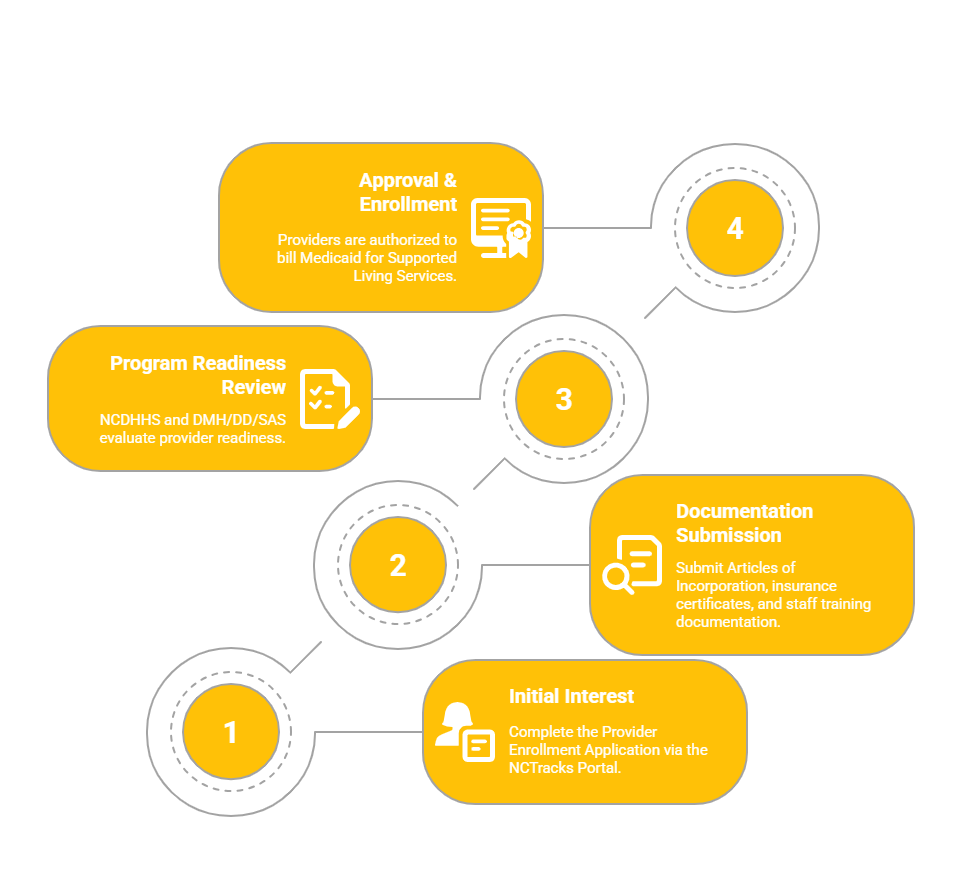
Becoming an authorized provider involves a sequenced process of establishing the business entity and demonstrating operational readiness to state agencies. Initially, providers must register their business with the North Carolina Secretary of State and obtain the necessary federal identifiers, including an EIN and a Type 2 NPI. Following these foundational steps, the provider must enroll specifically as a Medicaid Waiver Supported Living provider via the NCTracks Provider Portal.
Once the application is submitted, the agency undergoes a Program Readiness Review conducted by NCDHHS and DMH/DD/SAS. This review is critical; it evaluates the provider’s ability to implement personal care protocols, safety measures, and staff qualifications. Only after this rigorous vetting process—which ensures the agency possesses the infrastructure to deliver high-quality, compliant services—are providers granted authorization to begin billing Medicaid for their services using the approved coding structures.
- Initial Registration: Establish business entity, EIN, and Type 2 NPI.
- Portal Enrollment: Complete the NCTracks application for Supported Living Services.
- Documentation Review: Submission of articles of incorporation, insurance, and policy manuals.
- Readiness Evaluation: NCDHHS and DMH/DD/SAS review operational protocols and staffing capabilities.
- Authorization: Official approval to begin service delivery and Medicaid billing.
What Are the Essential Requirements for Staffing and Documentation?
Staffing requirements are designed to ensure that participants receive care from qualified, well-trained professionals. The Program Director plays a pivotal role, requiring a Bachelor’s or Master’s degree in a human services or healthcare field, combined with professional experience in program management and independent living support. Direct Support Professionals (DSPs) and Community Support Specialists must also meet specific standards, including a high school diploma or GED and clear background screenings.
Beyond initial qualifications, ongoing staff development is non-negotiable. All personnel must undergo training in HIPAA compliance, participant rights, crisis management, and best practices for documentation. Agencies must maintain a detailed Policy & Procedure Manual that covers these operational requirements, including how the agency handles grievances, maintains privacy, and conducts quality assurance. This documentation is essential not only for internal operations but also for demonstrating compliance during state audits.
Frequently Asked Questions
What specific Medicaid waivers cover Supported Living Services in North Carolina?
Supported Living Services are available under several key North Carolina Medicaid waivers, including the Innovations Waiver, the Community Alternatives Program for Disabled Adults (CAP/DA), the Community Alternatives Program for Children (CAP/C), the Traumatic Brain Injury (TBI) Waiver, and the general Home and Community-Based Services (HCBS) Waiver.
What is the estimated timeline for launching a Supported Living agency?
The launch process generally follows a 6 to 10-month timeline, depending on operational readiness. Business formation and initial compliance preparation typically take 1–2 months, followed by 2–3 months for staff hiring and development. The official Medicaid enrollment and readiness review phase spans 60–90 days, with a final 30–45 day period designated for billing setup and service launch.
What must be included in the Supported Living Policy & Procedure Manual?
A compliant manual must contain protocols for personal assistance and independent living support, safety and crisis management guidelines, staff credentialing and training records, documentation standards for billing, HIPAA compliance procedures, participant rights, grievance handling processes, and comprehensive quality assurance and risk management plans.
WAIVER CONSULTING GROUP’S START-UP ASSISTANCE SERVICE — NORTH CAROLINA SUPPORTED LIVING SERVICES PROVIDER
WCG supports agencies in launching Medicaid-compliant Supported Living Services in North Carolina, offering: business registration, Medicaid enrollment, and licensing assistance; policy manual development for personal care and independent living support; staff credentialing, training program templates, and compliance documentation; Medicaid billing setup and audit-prepared financial management; branding, website development, and community outreach strategies; quality assurance systems for living support and compliance monitoring; and collaboration with healthcare providers, housing agencies, and community organizations.
Key Takeaway: Establishing a successful Supported Living provider agency in North Carolina requires a methodical approach that balances regulatory compliance with the delivery of high-quality, person-centered care. By prioritizing rigorous documentation, staff competency, and strict adherence to the standards set by NCDHHS and CMS, providers can create sustainable programs that effectively facilitate community integration for participants.
Last verified: October 2023. This information is provided for educational purposes only and does not constitute legal or professional advice. Always consult with the North Carolina Department of Health and Human Services (NCDHHS) and your legal counsel to ensure compliance with the most current state and federal regulations.