SUPPORTED LIVING SERVICES PROVIDER IN NEW MEXICO
By Fatumata Kaba · 2025-09-05 · 6 min read
Supported Living Services in New Mexico serve as a critical component of the state’s Home and Community-Based Services (HCBS) ecosystem, enabling individuals with intellectual or developmental disabilities to thrive in community-integrated residential settings. By providing essential personal care, skill development, and safety monitoring, these services empower participants to maintain autonomy while receiving necessary supports authorized under various New Mexico Medicaid waiver programs.
Launching a Supported Living Services agency requires rigorous adherence to state and federal regulatory frameworks. Prospective providers must successfully navigate the complex requirements set forth by the New Mexico Human Services Department (HSD) and the Developmental Disabilities Supports Division (DDSD) to ensure clinical excellence, operational compliance, and sustained Medicaid billing eligibility.
How Are Supported Living Services Governed and Regulated in New Mexico?
The oversight of Supported Living Services is a multi-tiered process involving state and federal entities. The New Mexico Human Services Department (HSD) serves as the primary administrative authority, managing the distribution of Medicaid waiver funding, overseeing the provider enrollment process, and directing reimbursement protocols. Concurrently, the Developmental Disabilities Supports Division (DDSD) is tasked with the critical role of ensuring that service delivery meets established quality standards and that providers remain in strict compliance with state regulations.
At the federal level, the Centers for Medicare & Medicaid Services (CMS) provides the necessary oversight to ensure that all Medicaid-funded activities adhere to national standards for person-centered planning, participant protections, and the overarching principles of the HCBS settings rule. Providers must align their internal policies with the requirements set by these three bodies to maintain their certification and ensure that services support the health, safety, and integration of participants into their communities.
What Scope of Care Does a Supported Living Provider Deliver?
Supported Living Services are designed to offer individualized support that directly addresses the unique needs of each participant. These services are not one-size-fits-all; instead, they are delivered based on the Individualized Service Plan (ISP), which serves as the blueprint for care. Providers are expected to facilitate a spectrum of supports that range from basic personal hygiene to complex behavioral and health monitoring.
Approved providers generally offer the following core services to their participants:
- 24/7 Staff Support: Consistent assistance to ensure the participant's safety and support throughout the day and night.
- Personal Care Assistance: Hands-on support with activities of daily living (ADLs) such as bathing, grooming, dressing, and mobility.
- Skill Development: Structured training programs aimed at enhancing the participant's independence in household management and self-care.
- Community Integration: Facilitating active social participation, employment support, and meaningful recreational activities within the community.
- Health and Wellness Monitoring: Professional oversight of medication administration and ongoing monitoring of health conditions to promote overall well-being.
- Behavioral and Emergency Support: Implementing positive behavioral support strategies and providing crisis intervention to ensure physical and emotional safety.
What Are the Prerequisites for Licensing and Medicaid Enrollment?
Before an agency can begin billing for services, it must establish a formal business entity and satisfy all state-mandated enrollment criteria. This process begins with registering the business with the New Mexico Secretary of State and obtaining both an Employer Identification Number (EIN) from the IRS and a Type 2 National Provider Identifier (NPI). These foundational documents are essential for all subsequent stages of the enrollment process.
Beyond basic business registration, prospective providers must prepare for rigorous administrative requirements, including obtaining facility licensure from the HSD or the New Mexico Department of Health (NMDOH) if the business intends to operate a group home. Providers must also secure comprehensive liability insurance, including both general and professional coverage. Finally, creating a robust Policy and Procedure Manual is critical; this document must clearly outline how the agency will manage residential care, staff training, safety protocols, and quality assurance, as this will be a primary focus during the readiness review.
How Is the Medicaid Provider Enrollment Process Executed?
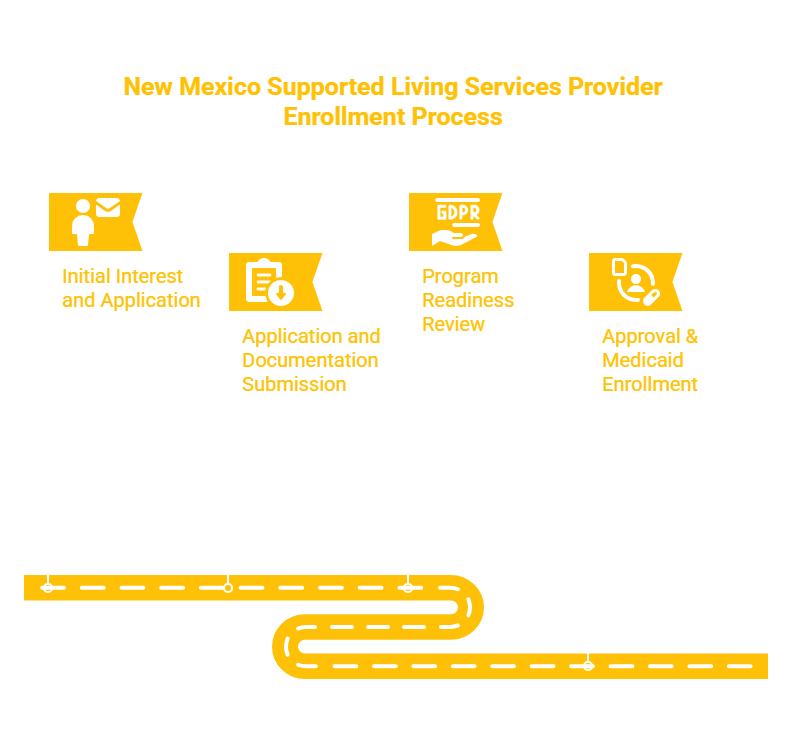
The enrollment process is a sequential journey that begins with the submission of an application through the New Mexico Medicaid Provider Enrollment Portal. Once the initial application is submitted, the agency must provide a comprehensive documentation package. This package typically includes the previously prepared Policy and Procedure Manual, articles of incorporation, proof of NPI/EIN, and any applicable facility licenses. The thoroughness of this submission is often the deciding factor in how quickly an agency can move toward the readiness review phase.
Following the document submission, HSD and DDSD conduct a Program Readiness Review. During this assessment, state officials evaluate the provider's operational readiness, focusing heavily on whether the agency’s safety protocols, staff qualification requirements, and proposed care planning models align with state waiver requirements. Once the state confirms that the provider meets all criteria, the agency is formally enrolled, enabling them to bill Medicaid using the appropriate service-specific billing codes.
What Are the Specific Staffing and Training Requirements?
The quality of Supported Living Services is directly dependent on the competence and training of the staff. Agencies must employ a qualified Program Director, typically requiring a bachelor’s degree in human services, social work, or healthcare administration, along with supervisory experience. Direct Support Professionals (DSPs) are the backbone of the service and must hold at least a high school diploma or GED, possess valid CPR/First Aid certification, and pass mandatory background clearances.
To ensure high standards of care, all staff must complete extensive training prior to interacting with participants. This includes training on residential care best practices, personal safety, HIPAA compliance, and participant rights. Furthermore, providers are responsible for documenting annual competency evaluations and ongoing professional development to ensure that staff remain current on infection control, crisis management, and wellness monitoring techniques.
Frequently Asked Questions
What types of Medicaid waivers allow for Supported Living Services in New Mexico?
Supported Living Services are available under several programs, including the Developmental Disabilities (DD) Waiver, the Mi Via Waiver, the Medically Fragile Waiver, the Supports Waiver, and the general Home and Community-Based Services (HCBS) Waiver.
How long does the launch process typically take?
The full lifecycle from business formation to the launch of billing services generally spans 7 to 10 months. This accounts for business registration (1-2 months), facility licensing (2-3 months), staff hiring (2-3 months), the Medicaid readiness review (60-90 days), and final billing setup (30-45 days).
What must be included in the Policy and Procedure Manual?
The manual must detail participant intake and care planning, health and safety monitoring, medication administration procedures, staff credentialing and background check protocols, HIPAA compliance, grievance handling, and quality assurance strategies.
Key Takeaway
Establishing a Supported Living Services agency in New Mexico is a complex undertaking that requires meticulous attention to regulatory detail, comprehensive staff training, and the development of robust internal systems. By focusing on the stringent requirements set by the HSD and DDSD early in the planning phase, providers can ensure they meet the clinical and operational standards necessary to successfully serve the community and maintain long-term Medicaid compliance.
Waiver Consulting Group (WCG) provides professional support for agencies navigating the New Mexico Medicaid landscape. This includes assistance with business registration, the development of comprehensive Policy and Procedure Manuals, staff training coordination, and the implementation of Medicaid-compliant billing and quality assurance systems. For more information, visit the WCG Client Portal to explore resources on state-specific waiver requirements and operational best practices.
Last verified: October 2023. This information is provided for educational purposes only and does not constitute legal or professional medical advice. Regulatory requirements are subject to change; always consult the latest documentation from the New Mexico Human Services Department or the Developmental Disabilities Supports Division before making business decisions.