SUPPORTED LIVING SERVICES PROVIDER IN NEVADA
By Fatumata Kaba · 2025-09-04 · 6 min read
Supported Living Services (SLS) in Nevada are essential Home and Community-Based Services (HCBS) designed to empower individuals with disabilities or chronic health conditions to live independently in their own homes. These services, authorized under Nevada Medicaid HCBS waivers, provide a structured framework of personal care, skill development, and community engagement that allows participants to thrive in inclusive settings while receiving the necessary support to maintain their health and safety.
What Are the Governing Agencies and Regulatory Frameworks?
The delivery of Supported Living Services in Nevada operates under a multi-tiered regulatory structure that ensures quality, safety, and compliance with federal guidelines. At the state level, the Nevada Department of Health and Human Services (DHHS) serves as the primary governing body responsible for administering Medicaid waiver funding, managing provider enrollment, and overseeing service authorization and reimbursement protocols.
Within the DHHS structure, the Aging and Disability Services Division (ADSD) acts as the operational arm responsible for monitoring service delivery, ensuring compliance with state regulations, and maintaining high standards of care across HCBS waiver programs. Additionally, the Centers for Medicare & Medicaid Services (CMS) provides the overarching federal regulatory framework. CMS oversight mandates that all Medicaid-funded Supported Living Services adhere to strict person-centered planning standards, protect participant rights, and meet specific HCBS quality metrics to ensure the long-term success of the waiver programs.
How Do Supported Living Services Enhance Daily Independence?
Supported Living Services are fundamentally designed to replace institutional care with community-based support, allowing individuals to maintain their autonomy. Providers deliver personalized care as outlined in the participant’s Individualized Service Plan (ISP), which ensures that the support provided aligns with the unique preferences, goals, and clinical requirements of the individual. This personalized approach is what makes HCBS programs successful in promoting long-term independence.
Approved providers deliver a comprehensive range of services, including:
- Personal Assistance: Hands-on help with Activities of Daily Living (ADLs) such as bathing, dressing, grooming, and maintaining personal hygiene.
- Household Support: Assistance with essential domestic tasks, including meal preparation, light housekeeping, and laundry services.
- Health Monitoring: Coordination with healthcare providers, medication reminders, and general health status observation.
- Skill Development: Training focused on building capacity for daily tasks, such as money management, budgeting, self-care routines, and navigating public community resources.
- Community Integration: Facilitating active participation in social, vocational, and recreational activities to prevent isolation.
- Safety Monitoring: Providing supervision and support to ensure the living environment remains safe and conducive to the participant's well-being.
What Are the Prerequisites for Provider Licensing and Approval?
Launching a Supported Living Services agency requires a rigorous commitment to legal and administrative compliance. Before an agency can begin serving participants, it must formally establish its business entity with the Nevada Secretary of State. Following business formation, the agency must secure a federal Employer Identification Number (EIN) and a National Provider Identifier (NPI Type 2) to facilitate Medicaid billing and program identification.
Operational requirements extend beyond basic business registration. Providers must obtain a Residential Support Service License through the DHHS if the model involves group living settings. Furthermore, agencies are required to maintain comprehensive general and professional liability insurance policies. Success in this sector depends on having robust internal policies that govern participant safety, medication management, and staff conduct. Ensuring that all personnel meet state-mandated background check requirements, health screenings, and professional training standards is not merely a formality but a core compliance requirement for ongoing participation in Nevada’s Medicaid waiver system.
Navigating the Nevada Provider Enrollment and Readiness Process
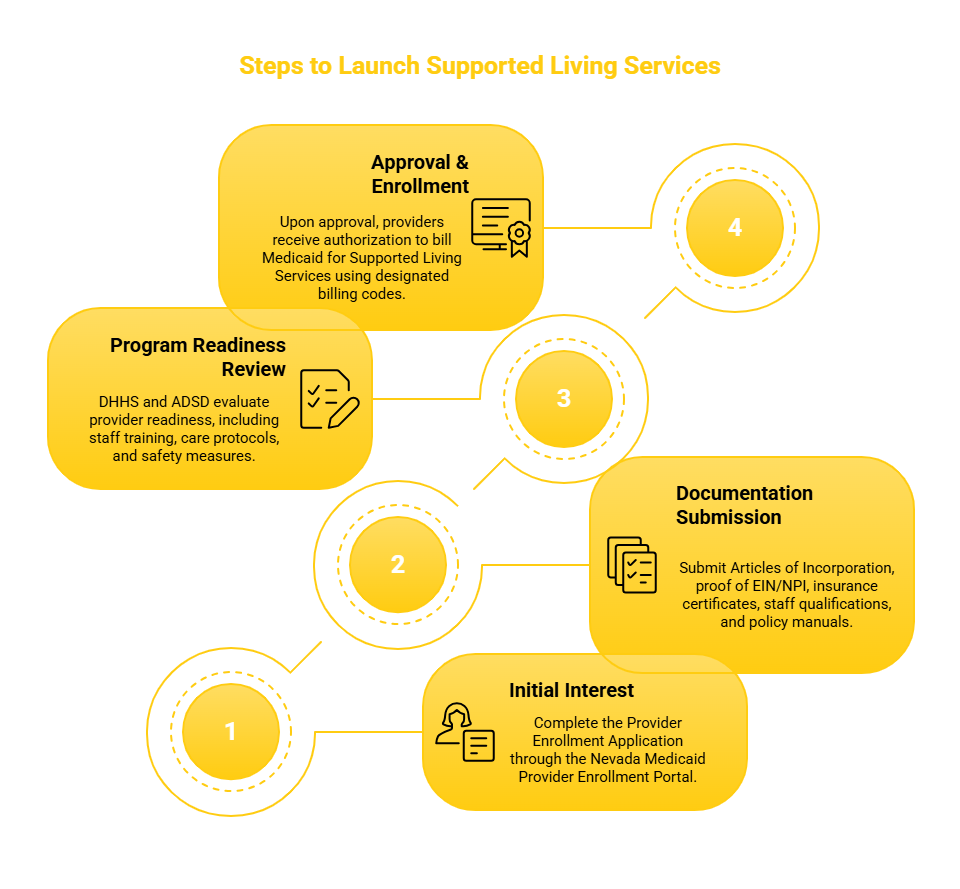
The journey to becoming a certified provider follows a sequential, state-directed timeline. The initial step involves submitting a formal application through the Nevada Medicaid Provider Enrollment Portal. This application must be accompanied by all foundational documentation, including Articles of Incorporation, proof of business insurance, and evidence of professional credentials for key staff members. Transparency and accuracy during this phase are critical to avoiding delays.
Once the application is submitted, the DHHS and ADSD conduct a Program Readiness Review. This phase is designed to assess whether the provider is prepared to deliver services in accordance with state law. Evaluators look for well-defined care protocols, documented staff training programs, and effective safety measures. Upon successful completion of this review, the agency is formally approved and granted authorization to bill Medicaid for services rendered. Providers must ensure their internal systems are fully integrated with the state’s billing codes to ensure timely reimbursement for Supported Living Services.
How to Maintain Compliance with Staffing and Training Requirements
The quality of Supported Living Services is defined by the caliber of the staff delivering the care. The Supported Living Program Director serves as the administrative lead, requiring a bachelor’s degree in a social services or healthcare-related field and proven experience in supervising community-based support programs. This role is responsible for the oversight of all service delivery and ensures that the agency remains in compliance with state standards.
Direct Support Professionals (DSPs) and Community Integration Specialists form the backbone of the program. Requirements for these roles include a high school diploma or GED, valid CPR and First Aid certifications, and successful completion of a criminal background check. Every staff member must participate in mandatory training that covers HIPAA compliance, participant rights, safety protocols, and emergency response. Furthermore, agencies must implement a system for annual competency evaluations and ongoing continuing education to keep staff updated on best practices in person-centered care and independent living skill-building.
Frequently Asked Questions
Which Nevada Medicaid Waivers include Supported Living Services?
Supported Living Services are available under several key waivers, including the Home and Community-Based Waiver for Persons with Intellectual and Developmental Disabilities (HCBS-IDD), the Frail Elderly (FE) Waiver, the Physical Disabilities Waiver, the Traumatic Brain Injury (TBI) Waiver, and the Aged and Disabled (AD) Waiver.
How long does the provider enrollment process take?
The entire timeline from initial business formation to launching services generally spans several months. The Nevada Medicaid Provider Enrollment and Readiness Review phase specifically requires approximately 60–90 days for completion, depending on the completeness of the documentation submitted.
What must be included in the Policy & Procedure Manual?
The manual must detail participant intake and assessment procedures, care planning, personal care protocols, medication management, HIPAA compliance, grievance handling, and procedures for billing and auditing. It must also document how the agency handles staff credentialing and ongoing training requirements.
Key Takeaway for New Provider Agencies
Launching a Supported Living Services agency in Nevada requires meticulous attention to both administrative regulations and the clinical standards set by the ADSD and CMS. By focusing on compliant business formation, rigorous staff training, and the development of comprehensive service protocols, new providers can ensure they are well-positioned to offer vital support to vulnerable populations while maintaining long-term financial and operational sustainability within the Medicaid waiver system.
WAIVER CONSULTING GROUP’S START-UP ASSISTANCE SERVICE — NEVADA SUPPORTED LIVING SERVICES PROVIDER
WCG supports agencies in launching Medicaid-compliant Supported Living Services in Nevada, offering: Business registration, Medicaid enrollment, and licensing support; Policy manual development tailored to supported living and community integration; Staff credentialing, training program templates, and care coordination guidance; Medicaid billing setup and audit-prepared financial management; Branding, website development, and community outreach strategies; Quality assurance systems for safety monitoring and service compliance; Networking with community organizations for referrals and collaborative support.
Last verified: May 2024. The information provided in this article is for educational purposes only and does not constitute legal or professional medical advice. Regulatory requirements for Medicaid waiver programs are subject to change; please consult official Nevada DHHS and ADSD documentation or a qualified consultant to ensure full compliance with current state and federal regulations.