SUPPORTED LIVING SERVICES PROVIDER IN MINNESOTA
By Fatumata Kaba · 2025-07-26 · 5 min read
PROMOTING INDEPENDENCE BY PROVIDING PERSONALIZED SUPPORT IN COMMUNITY SETTINGS
Supported Living Services in Minnesota empower individuals with disabilities to reside independently within their own communities through personalized care, supervision, and targeted skill-building support. These services, administered under Minnesota’s Home and Community-Based Services (HCBS) Waivers, are essential for fostering social integration and enhancing the daily living capabilities of program participants.
Navigating the Governing Landscape for Minnesota Providers
Operating as a Supported Living Services provider requires a comprehensive understanding of the regulatory hierarchy within Minnesota. Oversight is divided between state and federal entities to ensure that care delivery meets both localized health standards and national Medicaid compliance mandates. Providers must navigate these relationships early in the development phase to ensure long-term operational success.
The Minnesota Department of Human Services (DHS) serves as the primary administrator for Medicaid programs and the overarching HCBS Waivers. Concurrently, the Minnesota Department of Health (MDH) holds the authority to license and regulate facilities and care providers to ensure quality of care. Finally, the Centers for Medicare & Medicaid Services (CMS) provides federal oversight, setting the baseline requirements for waiver compliance and service delivery integrity.
- Minnesota Department of Human Services (DHS): Administers Medicaid programs, including supported living under HCBS Waivers.
- Minnesota Department of Health (MDH): Licenses and regulates supported living facilities and care providers.
- Centers for Medicare & Medicaid Services (CMS): Provides federal oversight and ensures waiver compliance.
Understanding the Scope of Supported Living Services
Supported Living Services are fundamentally rooted in a person-centered philosophy. Each service offering is strictly tailored to the individual’s unique needs as outlined in their Individual Service Plan (ISP) or Person-Centered Plan (PCP). The goal is to maximize an individual's autonomy while maintaining a safe, stable environment that promotes health and community engagement.
Services are diverse and highly adaptive, ranging from high-level supervision to specific daily skill training. Providers are expected to maintain meticulous records of these services, ensuring that every intervention aligns with the participant's stated goals for independence. This professional support structure ensures that participants can transition from institutional settings into meaningful community living.
- Personal care and assistance with activities of daily living (ADLs).
- Health monitoring and medication management.
- Skills training for independent living, such as cooking and budgeting.
- Community integration and social support.
- Transportation to appointments and community events.
- Safety supervision and crisis intervention.
The Roadmap to Licensure and Medicaid Enrollment
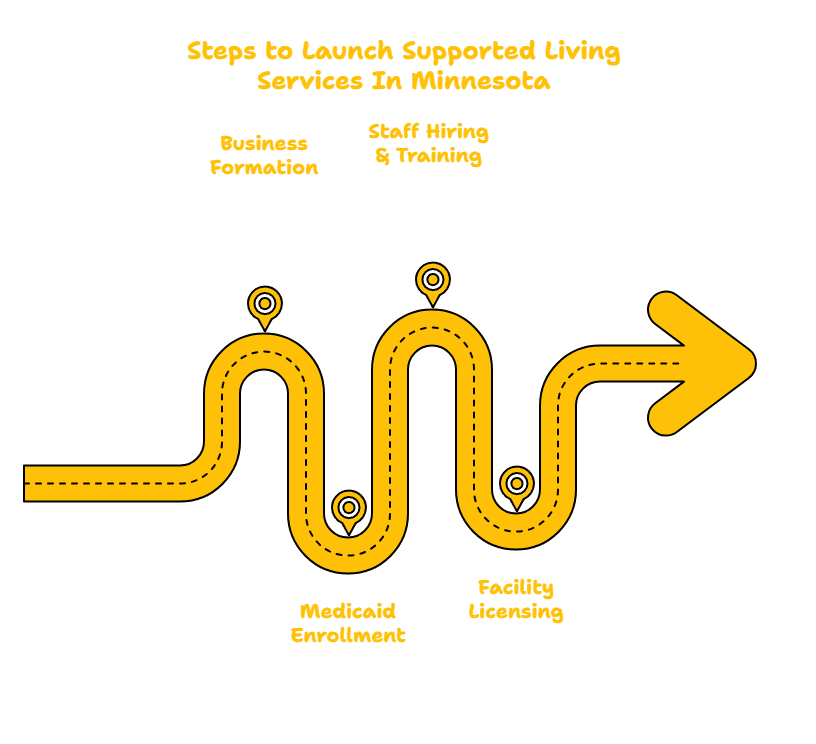
Becoming an approved provider is a multi-step process that demands rigorous attention to administrative detail. Before a provider can begin billing for services, they must establish a legal business entity and satisfy all state-level licensing requirements. This involves securing necessary identifiers from both the IRS and the state, followed by an formal enrollment process with the DHS.
The enrollment journey begins with a pre-application contact with the DHS to clarify specific program requirements. Once the business is registered with the Minnesota Secretary of State and an NPI (Type 2) is obtained, the provider must obtain a Comprehensive Home Care License through the MDH. Maintaining current liability insurance and exhaustive documentation of staff training are non-negotiable prerequisites for approval.
- Register your business with the Minnesota Secretary of State.
- Obtain an EIN from the IRS and NPI (Type 2).
- Enroll as a Medicaid provider with the Minnesota Department of Human Services.
- Obtain a Comprehensive Home Care License from the Minnesota Department of Health.
- Maintain liability insurance and staff training documentation.
Developing Essential Documentation and Operational Policies
Success as a Supported Living provider relies on the development of a robust Policy & Procedure manual. This document serves as the backbone of the organization, providing clear instructions for staff on how to manage client intake, health monitoring, and emergency response. Regulators will audit these policies to ensure they meet state standards for client safety and procedural transparency.
Founders must compile comprehensive files, including business registration documents, NPI confirmation, and evidence of professional liability coverage. Furthermore, internal documentation—such as incident reports, daily activity logs, and staff training records—must be maintained systematically. These records are the primary evidence used during state surveys and Medicaid audits to demonstrate compliance with the participant's person-centered plan.
Staffing, Training, and Program Management
The quality of Supported Living Services is directly tied to the competency of the direct support staff. Hiring a qualified Program Manager with a background in social services or residential care is a critical first step. This leadership role is responsible for overseeing the day-to-day operations and ensuring that Direct Support Professionals (DSPs) are properly onboarded and supervised.
Training protocols must be comprehensive and ongoing. All staff must be well-versed in person-centered planning, individual rights, and specific crisis management techniques. By fostering a culture of continuous learning, providers ensure that their workforce is capable of responding to the complex health, safety, and emotional needs of the individuals they support within the Minnesota HCBS framework.
- Supported Living Program Manager: Experience in social services, residential care, or community living support.
- Direct Support Professional (DSP): High school diploma or equivalent, CPR/First Aid certification, and completed background check/TB clearance.
- Core Training Areas: Person-centered planning, medication administration, community integration, and safety management.
Frequently Asked Questions
What waivers are covered under Minnesota Supported Living Services?
These services are primarily provided through the 1915(c) HCBS Waiver for Individuals with Disabilities, the Community Access for Disability Inclusion (CADI) Waiver, and the Brain Injury (BI) Waiver.
How long does the provider enrollment process typically take?
While timelines can vary based on organizational readiness, the Medicaid provider enrollment process generally takes between 60 and 90 days after the initial submission of documentation.
What is the role of a Program Manager?
The Program Manager oversees the day-to-day operations, ensures compliance with MDH and DHS regulations, manages staff training and supervision, and maintains the integrity of individualized support plans.
WAIVER CONSULTING GROUP'S START-UP ASSISTANCE SERVICE — MINNESOTA SUPPORTED LIVING SERVICES PROVIDER. We support agencies and entrepreneurs in launching compliant Supported Living Services across Minnesota under the HCBS Waiver models. Scope of Work includes business registration and licensing assistance, Medicaid provider enrollment, policy & procedure manual development, staff credentialing, and risk management protocols.
Key takeaway: Launching a Supported Living Services provider in Minnesota requires a dual focus on rigorous regulatory adherence—specifically obtaining a Comprehensive Home Care License—and a deep commitment to person-centered service delivery to ensure compliance and quality of life for program participants.
Last verified: September 2023. Disclaimer: This article is for informational purposes only and does not constitute legal or professional advice. Always consult with the Minnesota Department of Human Services and the Minnesota Department of Health regarding current state-specific regulations and requirements.