SUPPORTED LIVING SERVICES PROVIDER IN ARKANSAS
By Fatumata Kaba · 2025-07-04 · 5 min read
Becoming a Supported Living Services provider in Arkansas allows your agency to play a critical role in fostering independence for individuals with developmental disabilities under the Community and Employment Supports (CES) Waiver. By delivering tailored, home-based support, providers help participants successfully navigate daily living within their own communities while meeting stringent state and federal regulatory standards.
Supported Living Services are defined as individualized, flexible supports authorized under the Arkansas CES Waiver. These services are specifically designed to empower individuals with developmental disabilities to reside in their own homes or apartments, rather than in institutional settings. Whether a participant requires minimal assistance with community integration or comprehensive 24/7 care, your agency’s role is to ensure these services are delivered with dignity, promoting both personal autonomy and safety.
Navigating the Regulatory Landscape and Governing Agencies
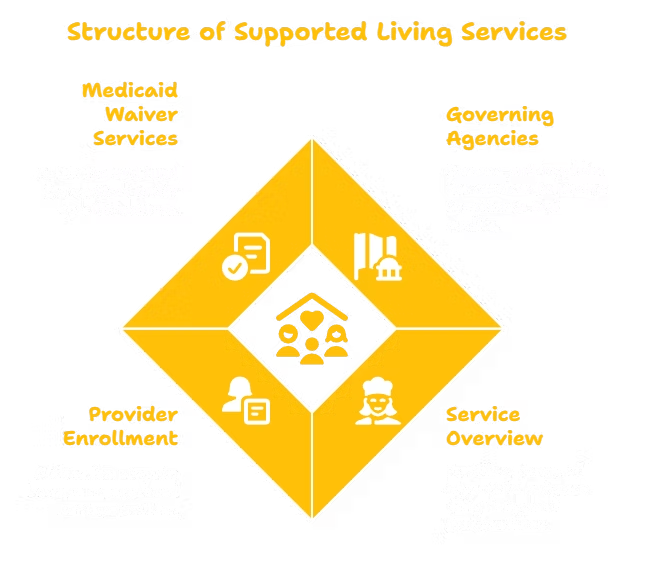
The provision of Supported Living Services is governed by a tripartite structure involving state and federal oversight. Understanding the specific roles of each agency is essential for maintaining compliance and securing reimbursement. The Arkansas Department of Human Services (DHS), specifically the Division of Developmental Disabilities Services (DDS), serves as the primary authority responsible for the approval and ongoing monitoring of providers. Their role ensures that your agency adheres to the specific service standards required for CES Waiver participants.
Beyond state-level operations, the Arkansas Medicaid program, under the Division of Medical Services (DMS), manages the fiscal aspects of your business, including provider enrollment and the processing of claims for reimbursement. Finally, the Centers for Medicare & Medicaid Services (CMS) provides federal oversight. CMS mandates that all home- and community-based services (HCBS) meet strict compliance requirements regarding the quality of care, person-centered planning, and integration into the community.
Establishing Your Agency: Core Service Delivery Requirements
At the heart of the Supported Living model is the Individualized Service Plan (ISP). Services are not "one size fits all"; they must be calibrated to the unique goals and support needs of each participant. Your agency must be prepared to provide a broad spectrum of care that shifts dynamically based on the participant’s progress and changing life circumstances.
Approved providers are expected to deliver a variety of essential services, which include but are not limited to the following:
- Assistance with activities of daily living (ADLs) such as hygiene, meal preparation, cleaning, and personal care.
- Support with financial management, including budgeting and assistance with shopping.
- Non-clinical health monitoring, including medication reminders and observational reporting.
- Supervision and behavioral redirection to ensure the health and safety of the individual.
- Facilitation of community engagement, social skill-building, and reliable transportation support.
- Rigorous documentation of service delivery and ongoing tracking of progress toward ISP goals.
Formalizing Your Operations: Licensing and Provider Approval
The process of becoming an authorized provider involves a series of sequential business and clinical milestones. You must first establish a legal business entity by registering with the Arkansas Secretary of State, followed by obtaining a federal Employer Identification Number (EIN) and a Type 2 National Provider Identifier (NPI). These foundational steps are necessary to interact with both state and federal healthcare databases.
Following business formation, you must demonstrate your agency’s capacity to deliver quality care. This requires the submission of a comprehensive provider application to the DDS, which must be accompanied by detailed policy and procedure manuals. Once the DDS reviews and approves your service framework, you must complete the Medicaid enrollment process via the Arkansas Medicaid Portal to be eligible for payment. Throughout this process, you must maintain active liability insurance and demonstrate that your documentation systems are ready to record sensitive health information securely.
Managing Staffing, Credentialing, and Training Protocols
A high-quality Supported Living program relies heavily on the competency of its staff. The Program Supervisor must possess verified experience in home- and community-based disability services and demonstrate the ability to oversee direct support staff effectively. This leadership role is vital for ensuring that the agency’s care plans are implemented with consistency and clinical oversight.
Direct Support Professionals (DSPs) are the primary point of contact for service recipients and must meet specific baseline requirements. This includes, at minimum, a high school diploma or GED, valid CPR/First Aid certification, and full clearance through the Adult/Child Maltreatment Registry and state background checks. Your agency must maintain robust training records for all staff, covering:
- Person-centered planning and the legal requirements for implementing ISPs.
- Best practices in documentation, ethical behavior, and maintaining client confidentiality.
- Safety and emergency response procedures to handle household and medical incidents.
- Annual refresher courses on client rights, waiver compliance, and updated state policies.
Frequently Asked Questions
What is the typical timeline for launching a Supported Living agency in Arkansas?
The timeline typically spans several months. Business formation usually takes 1–2 weeks, followed by a 45–90 day period for Medicaid and CES Waiver enrollment. After initial approval, staff hiring and onboarding take approximately 30–45 days, with referral coordination and service activation typically occurring within 2–4 weeks thereafter.
What documentation is essential for state audits?
Providers must maintain comprehensive records, including articles of incorporation, EIN, NPI, and formal proof of Medicaid provider approval. Furthermore, your internal files should contain staff training logs, client intake packets, ISP goal-tracking forms, medication observation logs, incident reports, and evidence of emergency preparedness protocols.
How are referrals for Supported Living Services generated?
Referrals are generated through the Division of Developmental Disabilities Services (DDS). Once your agency is fully enrolled and approved as a provider, you will receive notifications based on the Individualized Service Plans (ISPs) of participants who are authorized for Supported Living Services under the CES Waiver.
Key Takeaway for New Providers
Success as a Supported Living provider in Arkansas depends on a deep commitment to regulatory compliance and person-centered service delivery. By meticulously adhering to DDS requirements, maintaining organized staff training and service documentation, and fostering strong relationships with state agencies, your agency can ensure long-term stability and success in supporting the independence of Arkansans with developmental disabilities.
Last verified: 2024. The information provided in this article is for educational purposes and is intended to summarize current regulatory requirements. Prospective providers should consult directly with the Arkansas Department of Human Services (DHS) and the Division of Developmental Disabilities Services (DDS) to ensure they are working with the most current policies, rules, and application forms, as program requirements are subject to change.