SUPPORTED EMPLOYMENT SERVICES PROVIDER IN WYOMING
By Fatumata Kaba · 2026-04-14 · 5 min read
Understanding Supported Employment Services in Wyoming
Supported Employment Services in Wyoming are essential initiatives designed to empower individuals with intellectual, developmental, or physical disabilities by facilitating their entry into and retention within competitive, integrated employment environments. These services focus on providing customized, individualized supports that allow participants to achieve self-sufficiency, independence, and meaningful community inclusion through real-world work opportunities.
As a provider, operating within this space requires navigating the intersection of the Wyoming Department of Health (WDH) Developmental Disabilities Division (DDD) waiver programs and the vocational support framework. By delivering tailored job coaching, development, and advocacy, providers serve as a vital bridge between individuals with disabilities and the competitive labor market, ensuring that each participant’s unique vocational goals are documented and supported within their Individualized Plan of Care (IPC).
The Regulatory Landscape and Governing Agencies
Establishing a successful Supported Employment agency in Wyoming requires a thorough understanding of the inter-agency structure that oversees service delivery. The Developmental Disabilities Division (DDD) serves as the primary authority for the Comprehensive and Supports Waivers, holding the responsibility for certifying providers, establishing service standards, and ensuring strict compliance with Medicaid regulations.
Coordination with other state entities is a mandatory component of program administration. For instance, the Wyoming Department of Workforce Services’ Division of Vocational Rehabilitation (VR) must be utilized as the first payer for employment services. Providers must ensure that participants have exhausted or been found ineligible for VR-funded supports before initiating waiver-funded billing. Additionally, Case Management Agencies play a critical role in the participant’s journey, assessing needs and integrating employment objectives into the IPC, while the Division of Healthcare Financing manages the complex Medicaid provider enrollment and reimbursement processes.
Establishing Your Agency: Licensing and Certification Requirements
To operate as a Supported Employment provider in Wyoming, an agency must demonstrate both administrative competence and a commitment to DDD service standards. While there is no specialized "Supported Employment license" beyond general business registration, providers must be certified by the DDD to bill for waiver-funded services. This certification process serves as a formal validation of the agency’s capability to provide high-quality support consistent with state and federal expectations.
The organizational foundation requires several non-negotiable elements. Providers must obtain a Federal Employer Identification Number (EIN) and a Type 2 National Provider Identifier (NPI). Beyond these structural requirements, the agency must develop a comprehensive Policy & Procedure Manual that outlines the service delivery model, including specific protocols for job matching, workplace advocacy, and compliance tracking. Maintaining general liability insurance and ensuring that all staff undergo mandatory, rigorous background checks are baseline requirements to protect both the agency and the participants served.
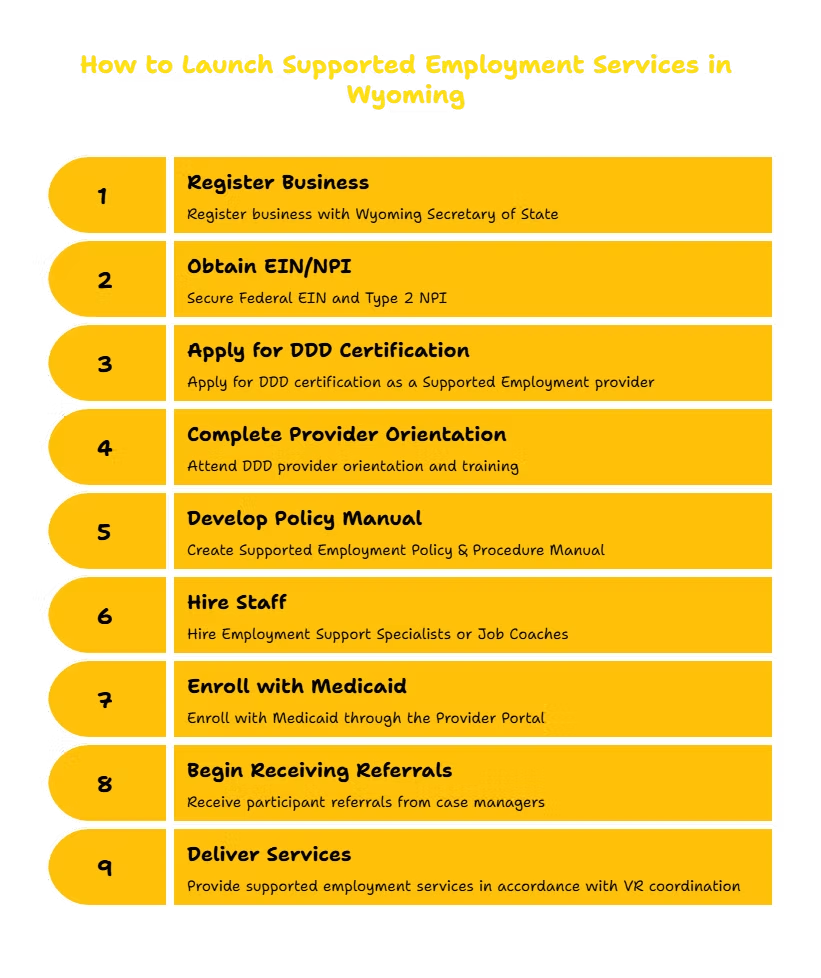
- Register the business entity with the Wyoming Secretary of State.
- Secure a Federal EIN and Type 2 NPI.
- Submit a formal application for DDD certification as a Supported Employment provider.
- Complete the mandatory DDD-led provider orientation and training sessions.
- Draft and implement a robust Policy & Procedure Manual governing all support activities.
- Hire and train qualified Employment Support Specialists or Job Coaches.
The Step-by-Step Provider Enrollment and Launch Process
The path to becoming an active Medicaid provider is structured as a deliberate progression. The process begins with the registration of the business and the acquisition of the necessary federal identifiers. Once the organizational groundwork is laid, the prospective provider must engage directly with the DDD to pursue certification. This phase involves submitting detailed documentation, including internal manuals, training plans, and staff qualifications, all of which undergo a thorough review by state representatives.
Upon achieving certification, the provider must navigate the Medicaid Provider Portal to complete enrollment with the Division of Healthcare Financing. This finalizes the ability to bill for services. Once the agency is officially enrolled, services can commence, provided the participant’s IPC explicitly lists the employment services and evidence of VR coordination or eligibility determination has been established. Providers must maintain strict alignment with these timelines to ensure uninterrupted service delivery and clean billing practices.
Managing Staffing, Documentation, and Operational Compliance
The quality of Supported Employment services is highly dependent on the competence of the Employment Support Specialists or Job Coaches. Staff must possess, at a minimum, a high school diploma or GED, though a background in human services is highly encouraged. Beyond formal education, staff must complete all DDD-mandated training modules, which cover crucial topics such as disability sensitivity, workplace inclusion, effective vocational documentation, and ethical service delivery. Ensuring that staff are well-versed in HIPAA compliance and participant rights is non-negotiable for any community-based work environment.
Documentation is the backbone of service auditability. Providers are required to maintain meticulous records of all coaching sessions, employer communications, and monthly progress reports linked directly to the participant's IPC goals. These reports must accurately reflect the hours worked, progress made, and any obstacles to employment. Failure to maintain these records can result in billing denials or recoupments, making consistent documentation training for all staff an ongoing operational priority.
Frequently Asked Questions
What is the relationship between Vocational Rehabilitation (VR) and Medicaid waiver funding?
VR is considered the first payer for employment-related services. Supported Employment providers must ensure that a participant has either exhausted their eligibility for VR services or been declined before shifting them to waiver-funded supports. All coordination must be clearly documented to prevent duplication of services.
What specific components must be included in the Policy & Procedure Manual?
The manual must detail the agency's internal models for job coaching, coordination with external partners, staff supervision plans, and HIPAA compliance. It must also include specific protocols for safety, emergency response, transportation, and service delivery logs that comply with DDD reporting requirements.
How long does the typical enrollment and launch process take?
The timeline varies by agency readiness but generally spans several months. Business registration and manual development typically take 2–3 weeks, followed by staff recruitment and training (30–45 days). The formal DDD certification and Medicaid enrollment process is the most intensive phase, often requiring 2–3 months to complete.
WAIVER CONSULTING GROUP’S START-UP ASSISTANCE SERVICE — WYOMING SUPPORTED EMPLOYMENT PROVIDER
WCG helps agencies and job coaches launch high-impact supported employment programs in Wyoming that connect individuals with disabilities to meaningful, competitive work opportunities. Scope of work includes DDD certification and Medicaid enrollment, Supported Employment P&P Manual creation, job development and coaching templates, coordination workflows for VR/waiver integration, and staff training plans for IPC compliance.
Key Takeaway: To successfully provide Supported Employment in Wyoming, agencies must maintain strict adherence to the sequential requirements of the Developmental Disabilities Division, prioritize robust staff training, and ensure that every service delivered is documented within the participant’s Individualized Plan of Care while respecting the first-payer status of Vocational Rehabilitation.
Last verified: October 2023. This information is intended for educational purposes and should not be considered legal or professional business advice. Providers should consult directly with the Wyoming Department of Health and relevant state agencies for the most current regulatory updates.