SUPPORTED EMPLOYMENT SERVICES PROVIDER IN WISCONSIN
By Fatumata Kaba · 2026-04-14 · 6 min read
EMPOWERING INDIVIDUALS WITH DISABILITIES TO OBTAIN AND MAINTAIN COMPETITIVE, INTEGRATED EMPLOYMENT IN THEIR COMMUNITIES
Supported Employment Services in Wisconsin provide a structured pathway for individuals with disabilities to secure and retain meaningful, competitive work in inclusive community settings. By focusing on person-centered outcomes, these services foster independence and financial self-sufficiency through a continuum of care that spans from initial career discovery to long-term workplace coaching.
These services are reimbursed under Wisconsin’s Medicaid Home and Community-Based Services (HCBS) Waivers, specifically the IRIS (Include, Respect, I Self-Direct) program, Family Care, Family Care Partnership, and the Children’s Long-Term Support (CLTS) Waiver. Oversight is governed by the Wisconsin Department of Health Services (DHS), with service authorization and provider network management facilitated by IRIS Consultant Agencies (ICAs) and Managed Care Organizations (MCOs).
How Do Governing Agencies Regulate Supported Employment in Wisconsin?
The regulatory framework for Supported Employment in Wisconsin is tiered to ensure quality, safety, and fiscal accountability. The Wisconsin Department of Health Services (DHS) serves as the primary authority, establishing the clinical guidelines, service definitions, and quality standards that all providers must follow. By setting these statewide expectations, DHS ensures that services remain person-centered and aligned with the goal of integrated employment.
Operational execution occurs at the regional and local level through ICAs and MCOs. These entities act as the gatekeepers for service authorization, responsible for vetting new providers, managing provider enrollment, and monitoring participant outcomes. When a provider enters the marketplace, they must align their operational protocols with the specific requirements of the Managed Care Organizations or IRIS Consultant Agencies in their service region. Additionally, ForwardHealth remains the central hub for Medicaid provider enrollment and the processing of payments for State Plan-covered supports, necessitating that providers maintain updated profiles within this system.
What Are the Essential Components of Supported Employment Services?
Supported Employment is not a one-size-fits-all model; it is a personalized suite of services designed to meet the unique vocational goals of each participant. Services must be documented within the participant’s Individual Service Plan (ISP) or the IRIS Support and Service Plan (SSP) to ensure they are outcome-oriented and meet the specific needs identified during the intake process.
A high-quality provider agency typically offers a comprehensive array of supports, including:
- Career Planning & Discovery: Assisting participants in identifying their specific interests, existing skills, and long-term job goals.
- Job Development & Placement: Providing hands-on support for resume building, filling out applications, and navigating the interview process.
- Job Coaching: Delivering on-site support to help individuals learn new tasks and adapt to the social and physical work environment.
- Job Retention: Facilitating ongoing check-ins, managing employer communication, and providing continued skill-building to ensure long-term stability.
- Self-Employment Support: Providing guidance for participants interested in starting microbusinesses or pursuing freelance opportunities.
- Workplace Soft Skills Training: Developing essential habits like effective communication, time management, and professional teamwork.
How Do Providers Qualify and Enroll in Wisconsin Medicaid Programs?
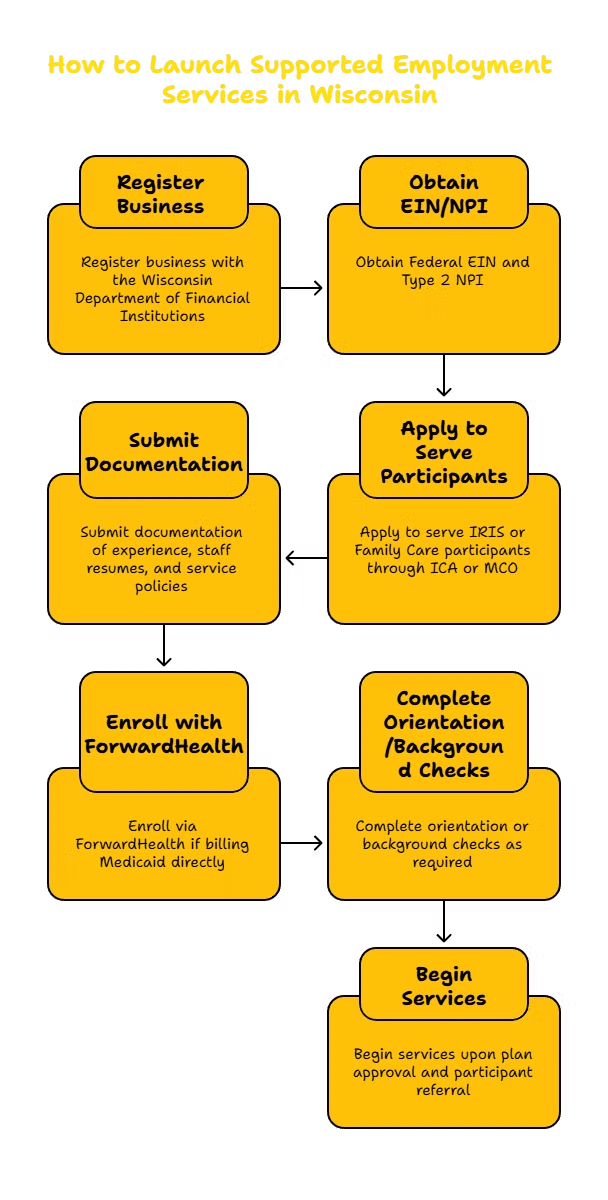
Becoming an approved Supported Employment provider in Wisconsin requires a systematic approach to business and clinical readiness. Before providing services to waiver participants, an agency must establish a formal business identity and meet the regulatory prerequisites set by the state. This includes formal registration with the Wisconsin Department of Financial Institutions (DFI) and securing a Federal Employer Identification Number (EIN), along with a Type 2 NPI where applicable.
The enrollment trajectory follows a logical sequence. First, the provider must obtain their business credentials. Second, they must apply to serve participants through the relevant ICA or MCO network. This process often involves the submission of a robust Supported Employment Services Policy & Procedure Manual, which must detail the agency's commitment to HIPAA compliance, participant rights, and health and safety protocols. Once credentials are verified and the agency is enrolled with relevant MCOs or the IRIS fiscal employer agents (FEAs), the agency can begin accepting referrals and billing for services.
What Documentation and Staffing Standards Are Required?
Compliance hinges on the agency's ability to demonstrate that services are being delivered as authorized. Agencies must maintain detailed documentation that spans from the initial discovery assessment to ongoing progress notes. These records serve as the evidence required for Medicaid billing and are subject to audit by DHS or the managing MCOs. Providers must ensure they have templates for employer communication, accommodation logs, and service verification that clearly track the hours and impact of coaching activities.
Staffing requirements are equally rigorous, as job coaches and employment specialists are the frontline representatives of the agency. Staff must possess, at a minimum, a high school diploma, though a bachelor's degree is often preferred for vocational-focused roles. Beyond education, agencies must verify that all employees have undergone background checks compliant with Wisconsin’s Caregiver Law. Training is a critical pillar of this role, requiring staff to be proficient in person-centered care, HIPAA standards, and the specific nuances of workplace safety and de-escalation.
What Is the Realistic Timeline to Launch an Agency?
Launching a vocational support agency is a multifaceted project that typically unfolds over several months. During the first phase (2–3 weeks), the focus remains on foundational business registration, DFI filing, and drafting the core Policy & Procedure Manual. This document is the backbone of the agency, as it outlines everything from internal intake assessments to billing verification logs.
The subsequent 1–2 months involve the more administrative heavy-lifting of ICA and MCO enrollment. During this time, the agency must also onboard staff and ensure all required training, such as abuse/neglect prevention and workplace safety, is finalized. The final 30–45 days are often dedicated to fine-tuning documentation workflows and ensuring readiness for participant referrals. Service launch only occurs once the provider has cleared the credentialing hurdles and a participant’s ISP or SSP has been officially approved for services.
Frequently Asked Questions
What is the difference between IRIS and Family Care regarding employment support?
IRIS is a self-directed program where participants have more control over their budget and can hire their own providers, whereas Family Care is managed by MCOs that coordinate a broader array of services through their established provider networks.
Do volunteers count as job coaches for Medicaid billing purposes?
No, Supported Employment services must be provided by qualified, agency-employed staff who meet specific training and background check requirements. Participation in volunteer activities does not constitute a reimbursable Supported Employment service.
Can we bill for pre-vocational services under the same code as Supported Employment?
No, these are distinct service categories. Providers must ensure that documentation strictly reflects the service type authorized in the participant’s plan, and pre-vocational services do not replace the requirement for active employment support.
WAIVER CONSULTING GROUP’S START-UP ASSISTANCE SERVICE — WISCONSIN SUPPORTED EMPLOYMENT PROVIDER
WCG supports agencies in launching vocational support programs that empower individuals with disabilities to succeed in the workforce. Our assistance includes IRIS, MCO, and ForwardHealth enrollment support, the development of comprehensive Supported Employment Services P&P Manuals, and the creation of standardized documentation templates for job readiness, coaching, and outcome tracking. We provide the expertise necessary to navigate staff training requirements and establish robust billing protocols for ongoing and time-limited supports.
Key takeaway: Success as a Supported Employment provider in Wisconsin requires a disciplined approach to regulatory compliance, rigorous adherence to ISP/SSP documentation standards, and a focus on outcome-oriented job coaching that translates into long-term community integration for participants.
Last verified: May 2024. The information provided is for educational purposes only and does not constitute legal or professional advice. Always refer to the Wisconsin Department of Health Services (DHS) official publications and the ForwardHealth Online Handbook for the most current regulatory updates and requirements.