SUPPORTED EMPLOYMENT SERVICES PROVIDER IN WASHINGTON
By Fatumata Kaba · 2026-04-06 · 5 min read
Supported Employment Services in Washington provide a critical pathway for individuals with intellectual and developmental disabilities (ID/DD) to achieve economic self-sufficiency and social inclusion through competitive, integrated employment. By partnering with the Developmental Disabilities Administration (DDA) and various state agencies, provider agencies facilitate the entire vocational journey, from initial career discovery and job development to long-term on-the-job coaching and employer engagement.
What is the Role of Supported Employment in Washington’s HCBS Waivers?
Supported Employment in Washington is designed to transition individuals from traditional day programs into meaningful community-based careers. These services are not merely about placement; they are comprehensive, person-centered programs that ensure individuals have the necessary training, transportation coordination, and follow-along support to maintain jobs at or above minimum wage. By focusing on individualized job development, providers help participants bridge the gap between their unique skill sets and the needs of local employers.
These services are funded through the DDA under specific Medicaid waiver programs, including Basic Plus, Individual and Family Services (IFS), and the Core Waiver. Because these services are part of a Medicaid-funded system, they must be explicitly tied to the individual’s Person-Centered Service Plan (PCSP). Providers play a vital role in documenting these outcomes, ensuring that every hour of service delivery aligns with the regulatory requirements set forth by both the DDA and the Washington State Health Care Authority (HCA).
Which Agencies Govern Supported Employment Provider Compliance?
Navigating the regulatory landscape of Washington’s disability services requires coordination among several state and local entities. The Developmental Disabilities Administration (DDA) acts as the primary authority, establishing the service definitions, provider qualifications, and quality standards for all waiver-based employment services. Simultaneously, the Washington State Health Care Authority (HCA) oversees the Medicaid funding streams that make these programs financially viable, ensuring that all billing and service delivery remains compliant with state and federal regulations.
Beyond state-level administration, the Division of Vocational Rehabilitation (DVR) and County Developmental Disabilities Programs provide essential support at different stages of the employment process. The DVR often handles short-term vocational needs, such as initial job readiness and placement, while individual counties often contract directly with providers to administer regional programs. Understanding the hierarchical relationship between these agencies is essential for any provider seeking to maintain good standing and consistent funding.
- DDA: Sets service definitions and oversees ID/DD waiver programs.
- HCA: Manages Medicaid funding and state-wide compliance.
- DVR: Provides funding for short-term job placement and readiness.
- County Programs: Contract directly with providers for local service delivery.
How Do Agencies Become Qualified Supported Employment Providers?
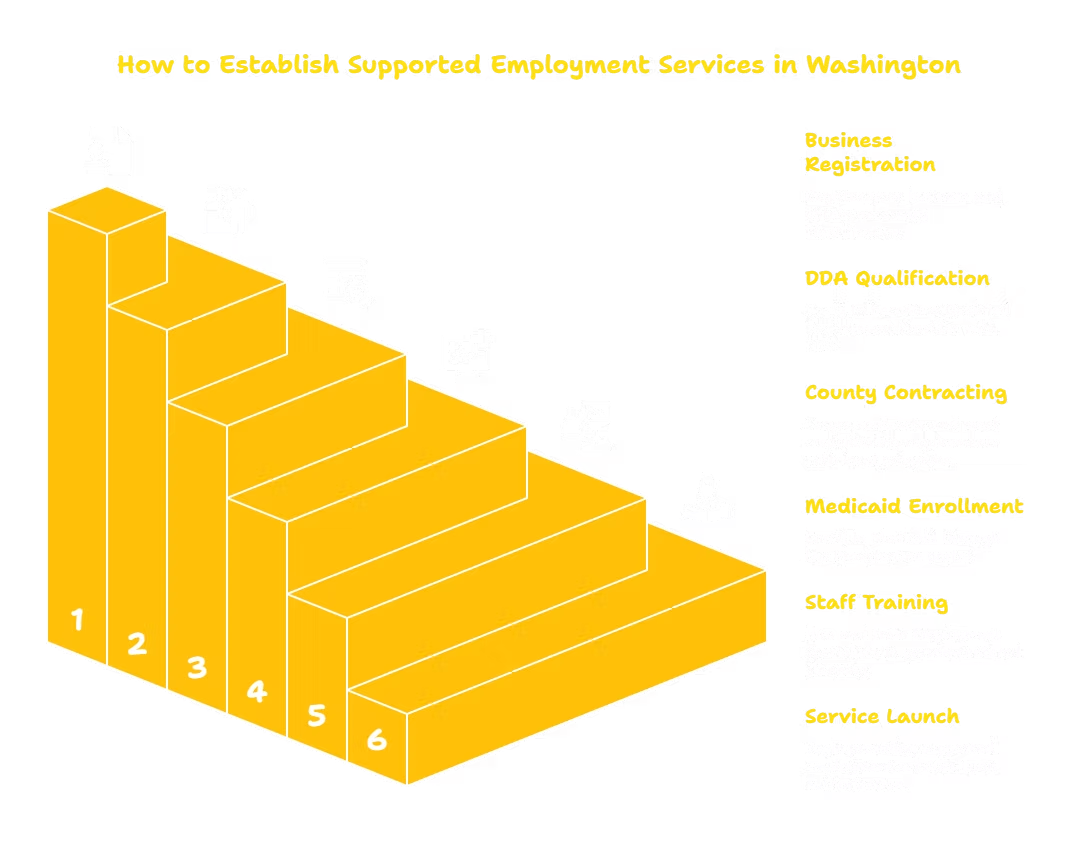
The journey to becoming a DDA-approved provider is a multi-phased process that demands meticulous preparation. Before any services can be offered, a business must establish its legal foundation by registering with the Washington Secretary of State, obtaining an Employer Identification Number (EIN), and securing a Type 2 National Provider Identifier (NPI). These are the prerequisites for entering into the state’s healthcare procurement system.
Once the legal framework is established, the agency must apply for status as a Qualified Employment Provider through the DDA. This involves meeting specific staffing standards, including rigorous background checks and OIG screenings. Following approval, the agency must coordinate with the relevant county programs, complete the Medicaid enrollment process via the ProviderOne portal, and finalize an internal Supported Employment Services Policy & Procedure Manual. This manual serves as the operational blueprint for all staff, ensuring that documentation of community integration and employer outreach meets mandatory audit standards.
What are the Staffing and Training Requirements for Employment Specialists?
The success of a Supported Employment program hinges on the competence and compassion of the Employment Specialists and Job Coaches. At a minimum, these professionals should possess a high school diploma or equivalent, though a Bachelor’s degree is often preferred given the complexity of person-centered vocational planning. Regardless of formal education, all staff members must complete DDA-approved training in employment planning, disability awareness, and community inclusion strategies.
In addition to foundational knowledge, staff must be proficient in the technical aspects of the role, including job development, coaching techniques, and precise clinical documentation. Agencies are strongly encouraged to appoint an Employment Program Supervisor to oversee service delivery, ensure staff performance remains consistent with individual needs, and maintain healthy relationships with local employers. Regular supervision and training protocols must be documented in the provider's records to satisfy ongoing compliance reviews.
Frequently Asked Questions
How long does the provider enrollment process typically take?
The timeline varies by agency, but generally spans several months. Business registration and initial staffing typically take 3–4 weeks, followed by 2–3 months for DDA qualification and county contracting. Medicaid enrollment via ProviderOne adds another 4–6 weeks, meaning the entire startup phase often requires 5 to 8 months of dedicated administrative effort before services can launch.
What documentation is required for Medicaid billing?
Providers must maintain comprehensive records for every participant, including current PCSP authorizations, discovery and job development tracking, individual employment support logs, transportation support documentation, and periodic progress reports. All documentation must strictly adhere to HIPAA standards and demonstrate that services delivered align with the specific authorizations provided by DDA.
Can providers offer both DDA waiver services and DVR services?
Yes, providers can coordinate services across both systems. While DDA waivers such as Basic Plus and Core Waiver focus on long-term, ongoing job support, the DVR often provides funding for the initial placement phase. Successful agencies often work in tandem with both to create a seamless transition for the participant from pre-employment training to long-term career stability.
Strategic Implementation and Key Takeaways
Launching a Supported Employment agency in Washington requires a strategic approach to balancing regulatory compliance with high-quality, person-centered service delivery. Success is defined not only by securing contracts but by maintaining meticulous records, investing in ongoing staff professional development, and building strong collaborative relationships with DDA and county partners. By adhering to these rigorous standards, providers ensure that they remain viable contributors to the state’s disability employment ecosystem.
Last verified: 2024. This article is intended for informational purposes for prospective and current providers and does not constitute legal or professional advice. Please consult with the Washington DDA or a qualified consultant for specific regulatory guidance regarding your agency’s operations.