SUPPORTED EMPLOYMENT SERVICES PROVIDER IN VIRGINIA
By Fatumata Kaba · 2026-04-08 · 5 min read
Becoming a Supported Employment services provider in Virginia allows organizations to empower individuals with intellectual or developmental disabilities (ID/DD) to achieve meaningful, competitive, and integrated employment. By navigating the regulatory frameworks established by the Department of Medical Assistance Services (DMAS) and the Department of Behavioral Health and Developmental Services (DBHDS), new providers can offer essential vocational guidance and long-term retention supports to a population eager for community inclusion.
Supported Employment services are vital components of Virginia’s Medicaid waiver programs, specifically the Community Living (CL) and Family and Individual Supports (FIS) Waivers. These services provide the structured, personalized assistance necessary for participants to successfully prepare for, obtain, and maintain employment within competitive work environments, moving beyond traditional day support models toward fully integrated professional success.
How Do Governing Agencies Regulate Supported Employment in Virginia?
The regulatory landscape for employment services in Virginia is a collaborative effort between several key entities. The Department of Medical Assistance Services (DMAS) acts as the primary authority for Medicaid waiver administration. DMAS is responsible for setting provider payment policies, managing the Medicaid Enterprise System (MES) portal, and ensuring that reimbursement for employment services aligns with state and federal regulations.
The Department of Behavioral Health and Developmental Services (DBHDS) serves as the primary licensing body. Any organization intending to provide Supported Employment must secure proper licensure through DBHDS, which defines the specific service models allowed and enforces rigorous regulatory compliance. Furthermore, Community Services Boards (CSBs) act as the frontline for service coordination. CSBs are responsible for identifying the needs of the population, providing referrals to authorized providers, and ensuring that these services are correctly incorporated into the participant's Individual Support Plan (ISP).
- DMAS: Oversees Medicaid waiver programs and establishes reimbursement rates.
- DBHDS: Licenses providers and ensures compliance with service-specific regulations.
- CSBs: Coordinate referrals and authorize services within the Individual Support Plan.
What Are the Core Service Models for Supported Employment?
Service delivery in Virginia is categorized into several models designed to meet participants at different stages of their vocational journey. Individual Supported Employment is the gold standard for autonomy, providing one-on-one job coaching and customized supports. This model focuses on securing competitive work where the individual is paid at least minimum wage and works alongside peers without disabilities.
Alternative models include Group Supported Employment, which provides supervised work in settings such as mobile crews or enclaves. Beyond direct coaching, providers are expected to facilitate Job Development—actively scouting for employment opportunities, assisting with résumé creation, and conducting interview coaching. Once employment is secured, providers must transition into Workplace Supports and Job Retention Services, which ensure that the participant receives the ongoing follow-up needed to sustain their position over time.
How Do New Providers Navigate the Enrollment Process?
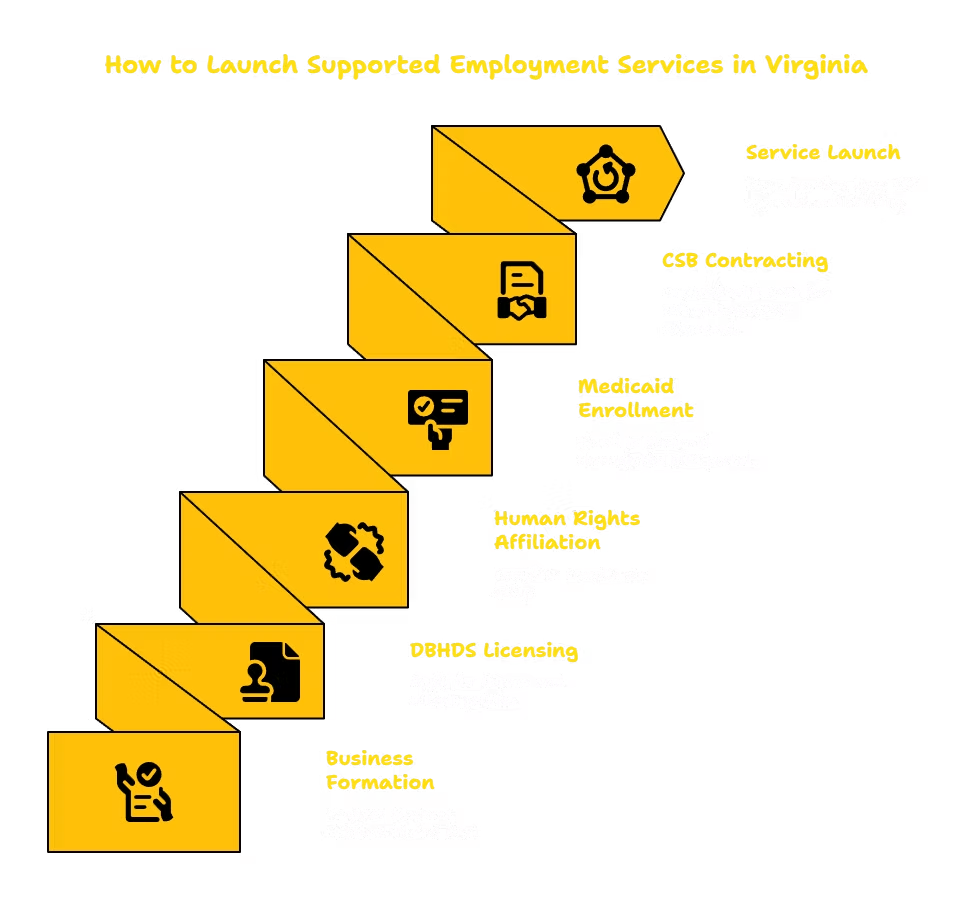
The process to become a Medicaid provider is a sequential, multi-step journey that requires careful attention to detail. Providers must first establish their business entity with the Virginia State Corporation Commission (SCC) and obtain an Employer Identification Number (EIN) and a Type 2 National Provider Identifier (NPI). These credentials serve as the foundation for all subsequent applications.
Once the business is legally formed, the provider must apply for a DBHDS license under the Supported Employment category. This phase requires the submission of a robust Policy & Procedure Manual. Simultaneously, the provider must complete the Human Rights Office affiliation, as all Virginia Medicaid providers are strictly mandated to uphold the rights of the individuals they serve. Following license approval, the provider enrolls in the Medicaid program via the MES portal and initiates contracting with local CSBs to begin receiving referrals.
- Step 1: Business registration with the SCC, EIN, and NPI procurement.
- Step 2: DBHDS licensure application and policy manual submission.
- Step 3: Human Rights Office affiliation and compliance setup.
- Step 4: Medicaid enrollment through the MES Provider Portal.
- Step 5: CSB contracting for service referrals and ISP coordination.
What Documentation Is Required for Ongoing Compliance?
Documentation serves as the audit trail for both quality assurance and reimbursement. At a minimum, every provider must maintain proof of their SCC registration, current DBHDS license, and Medicaid enrollment. Furthermore, the agency must have a comprehensive Supported Employment Services Policy & Procedure Manual that clearly outlines staff supervision plans, transportation safety protocols, and incident reporting procedures.
Specific tracking tools are essential for demonstrating that services are being provided in alignment with the participant’s Person-Centered Plan (PCP). This includes job development tracking logs, employer contact records, and ongoing progress notes that detail the participant’s movement toward independence. Because these services are tied to Medicaid funding, documentation must be precise, outcome-focused, and readily available for review by both DMAS and DBHDS inspectors.
What Are the Staffing and Training Mandates?
The success of Supported Employment rests on the caliber of the Employment Specialist or Job Coach. While a high school diploma or GED is the minimum education requirement, a bachelor’s degree is preferred. All staff members must hold a valid driver’s license if they are expected to transport participants, and they must undergo thorough background checks alongside First Aid and CPR certification.
Beyond baseline qualifications, staff must be adequately trained in person-centered practices and community integration strategies. Agencies should employ a Program Supervisor to maintain quality assurance and provide oversight for the employment staff. Mandatory training for all staff includes HIPAA compliance, confidentiality protocols, and specific techniques for job analysis and behavior support. Regular performance evaluations are necessary to ensure that the staff is effectively assisting participants in meeting their vocational goals.
Frequently Asked Questions
What is the difference between individual and group supported employment?
Individual Supported Employment involves one-on-one assistance for a person working in a competitive, integrated setting. Group Supported Employment involves a smaller, supervised group working together in settings such as mobile crews or enclaves, often with more direct, continuous supervision.
How long does the provider enrollment process typically take?
While timelines vary based on application volume and regulatory review, the initial business formation and licensing application typically take 4–6 weeks. Medicaid enrollment and CSB contracting follow, usually requiring an additional 1–2 months, followed by 30–45 days for staff recruitment and training.
Can I provide services to individuals in the FIS and CL Waivers?
Yes, Supported Employment is a covered service under both the Community Living (CL) and Family and Individual Supports (FIS) Waivers. Providers must ensure that the specific service is included in the individual's Person-Centered Plan and Individual Support Plan before initiating services.
Key Takeaway
Successfully launching a Supported Employment agency in Virginia requires strict adherence to the regulatory requirements set by DMAS and DBHDS, a commitment to person-centered service delivery, and the development of robust administrative documentation. By following the established pathway for licensing, enrollment, and staff training, providers can build a sustainable, mission-driven program that significantly improves employment outcomes for individuals with disabilities.
Last verified: October 2023. Disclaimer: This article is for informational purposes only and does not constitute legal or professional regulatory advice. Always consult the official Virginia DMAS and DBHDS provider manuals for the most current regulations and policy changes.